
Enacted on July 4, 2025, the One Big Beautiful Bill Act (OBBBA) is described as a “sprawling and transformative piece of legislation” intended to enact Trump 2.0’s wide-ranging domestic and economic agenda. It passed with the narrowest of margins via the budget reconciliation process.
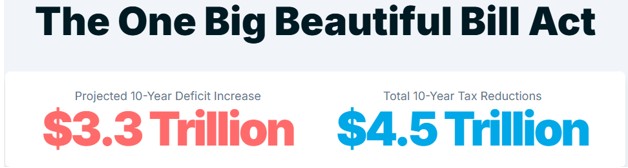
The OBBBA codifies the Trump 2.0 domestic agenda, emphasizing lower taxes, deregulation, and protective tariffs to stimulate domestic investment, reduce social safety nets, and strengthen national security and immigration enforcement. It extends the 2017 Tax Cuts and Jobs Act, eliminates taxes on tips and overtime, and funds border security and deportation. The OBBBA seeks to reduce federal government size, dismantle the “administrative state,” and use executive/legislative authority to implement tax cuts, restructure entitlement programs (like Medicaid), and reverse prior climate/energy policies. It also targets the Affordable Care Act and Inflation Reduction Act. This “all-or-nothing” legislative bundling minimized dissent but is, in my opinion, no way to produce legislation.
There are plenty of things to like in OBBBA as well as some that aren’t so good. For instance, the bill relies on tariffs and considerable deficit spending at a time when we are already on the brink. Here is an overview of the major points of OBBBA.
Tax Reforms
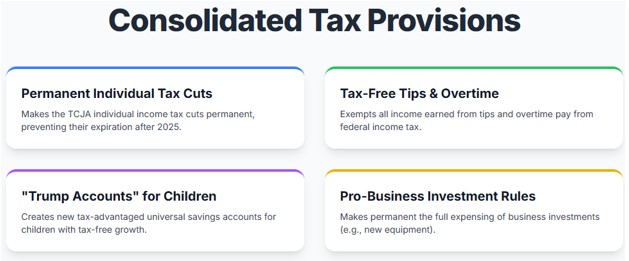
- Cuts Made Permanent: The OBBBA makes permanent the TCJA individual income tax cuts, originally expiring after 2025. This means lower marginal tax rates, providing tax certainty and stimulating the economy.
- Tax-Free Tips and Overtime: A populist provision, this exempts up to $25,000 of income from tips and overtime pay from federal income tax, directly increasing take-home pay for service workers and those working extra hours. The rule will expire in 2028.
- “Trump Accounts” for Children: These new tax-advantaged universal savings accounts allow tax-free growth for children's future expenses (education, business, home), encouraging long-term savings and wealth-building from a young age.
- Business Tax Provisions: The OBBBA makes permanent the full expensing of business investments, letting companies deduct the full cost of new equipment in the year of purchase. This incentivizes capital investment and boosts productivity. Adjustments to international tax rules are also included to encourage domestic business activity.
- Estate and Gift Taxes: Permanent Increase and Inflation Adjustment: The OBBBA permanently increases the federal estate and gift tax exclusion amount (lifetime exemption) to $15 million per person, effective for estates and gifts made after December 31, 2025. This exemption is indexed for inflation in future years, using 2025 as the base year.
New Spending Priorities and Changes
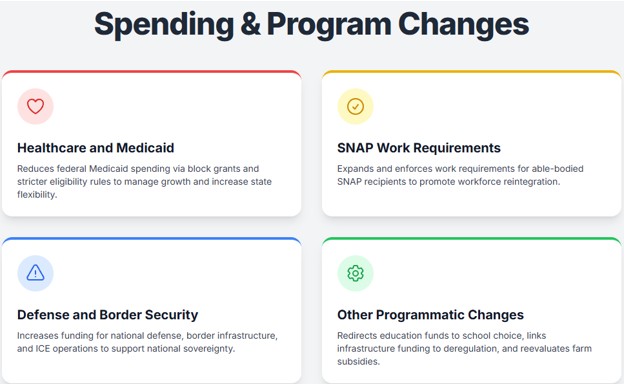
The OBBBA seeks to significantly alter federal spending, prioritizing national security and workforce participation.
Key areas of change include:
- Healthcare and Medicaid: The bill reduces federal Medicaid spending through block grants to states or stricter eligibility rules. This manages healthcare entitlement growth and offers states greater flexibility.
- Supplemental Nutrition Assistance Program (SNAP): To encourage employment, the OBBBA broadens and enforces work requirements for able-bodied adults receiving SNAP benefits, aligning with a policy of temporary assistance and workforce reintegration.
- Defense and Border Security: The legislation will increase funding for national defense, as well as for border security infrastructure and ICE operations, reflecting a “law and order” and national sovereignty stance.
- Other Programmatic Changes: Reductions or reforms will occur in other domestic areas. Education spending will be redirected towards school choice, infrastructure funding will be linked to deregulation to expedite projects, and agricultural subsidies will be reevaluated.
Energy, Environment, and Industry
The OBBBA represents a significant pivot in U.S. energy and industrial strategy, prioritizing domestic fossil fuel production and strategic manufacturing over renewable energy initiatives.
Energy Policy: The bill accelerates the rollback or phase-out of numerous clean energy tax credits expanded by the Inflation Reduction Act of 2022, including those for electric vehicles, solar and wind power generation, and green hydrogen. Conversely, the bill introduces new incentives or deregulatory measures aimed at stimulating the exploration and development of oil, natural gas, and coal resources, with the objective of achieving energy dominance.
Strategic Industries: While green energy incentives would be curtailed, the bill will preserve or adjust support for vital strategic industries. For instance, incentives for domestic semiconductor manufacturing, established by the CHIPS Act, will be maintained to safeguard a reliable supply chain for critical technologies.
The Fiscal Impact of OBBBA
Without an official score from the Congressional Budget Office (CBO), any analysis is speculative. However, the combination of permanent, large-scale tax cuts and increased defense spending would, in the absence of deep and immediate spending cuts elsewhere, be projected to substantially increase the federal deficit and national debt. The headline infographic at the top shows this.
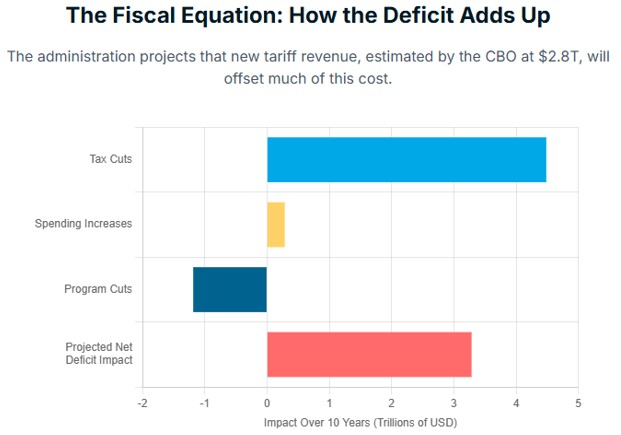
The tax cuts will generate new revenue, but will they be enough to offset these new costs over the long term? Unknown. Consider this infographic.
Can Tariffs Truly Offset OBBBA Spending?
Theoretical Offset
According to the Congressional Budget Office (CBO), projected tariff revenue ($2.8 trillion) almost equals the anticipated primary deficit increase from the OBBBA ($3.3 trillion). This has led some policymakers to argue that the OBBBA is “paid for” by tariffs. Oh boy…
Major Caveats and Uncertainties
However, several significant factors introduce uncertainty regarding the actual offset:
- Economic Impact: Tariffs can hinder economic growth and fuel inflation, potentially diminishing other tax revenues and negating some of the tariff gains.
- Behavioral Effects: Increased tariffs might lead to a greater-than-anticipated reduction in imports, consequently lowering actual tariff revenue below projections.
- Legal and Political Risks: The long-term stability of tariff revenue is uncertain due to ongoing legal challenges and the possibility of future administrations altering or repealing these tariffs.
- Dynamic Scoring: Estimates that incorporate the negative macroeconomic effects of tariffs (“dynamic scoring”) often suggest lower net revenue than initial figures indicate.
- Not a Direct “Pay For”: The CBO does not assert a direct causal link, even if the figures seem to align. The OBBBA will still contribute to the deficit unless the tariffs are consistently implemented and maintained at their current levels.
The Bottom Line
The One Big Beautiful Bill Act (OBBBA) of 2025 is a legislative landmark that fundamentally alters the trajectory of U.S. domestic policy. This transformative legislation embodies a broad agenda, featuring deep and permanent tax cuts, a historic expansion of immigration enforcement and defense spending, and a sharp reversal of federal clean energy policy.
On the downside, the OBBBA will result in a multi-trillion-dollar increase in the national debt, which might be offset by an aggressive and uncertain tariff regime. But I doubt it.
Ultimately, the OBBBA is engineered to entrench its foundational tax cuts and security funding, establishing a new fiscal and policy baseline that will be difficult to modify in the future.
Big Beautiful AI
I laughed out loud at the output. You can’t make this up.


Spencer Wright is the Executive Vice President of Halbert Wealth Management, Inc. and the author of Forecasts & Trends. He has been with HWM for over 25 years.