
Artificial Intelligence is a transformative technology with major implications for national security, economic prosperity, and global power. The U.S., a leader in innovation, faces vulnerabilities in maintaining AI dominance. This analysis outlines key themes, concepts, problems, and solutions for a national strategy to secure U.S. AI leadership.
The AI Imperative: A New Foundation of National Power
AI is a fundamental pillar of 21st-century national power, driving economic growth and revolutionizing military and intelligence capabilities. Global leadership in AI is equivalent to geopolitical influence, requiring strategic prioritization and coordinated action. The dual-use nature and increasing accessibility of AI necessitate a comprehensive, globally informed strategy that incorporates national security within the wider AI landscape. The emergence of agentic AI escalates great power competition in this field.
The U.S. AI Ecosystem: Strengths and Strategic Vulnerabilities
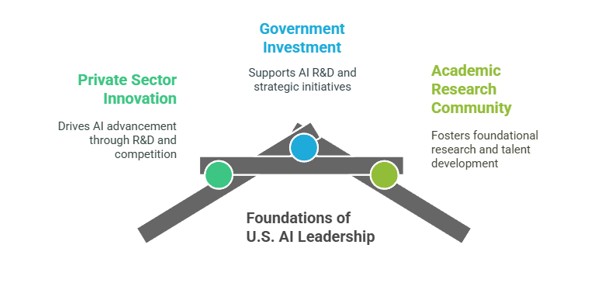
The United States currently holds a leading position in the global AI landscape, built upon a dynamic interplay of private sector innovation, substantial government investment, and a world-class academic research community.
Foundations of U.S. AI Leadership:
- Private Sector Innovation and R&D: The engine of American AI advancement is largely fueled by its vibrant private sector. U.S. companies are at the global forefront of AI research, investing heavily in pioneering new algorithms, models (like Large Language Models – LLMs), and applications. This commercial dynamism fosters a competitive environment that encourages risk-taking and rapid iteration.
- Government Investment and Strategic Initiatives: Recognizing AI's strategic importance, the U.S. government has significantly increased investment in AI R&D and launched numerous initiatives to bolster national capabilities. This includes establishing National AI Research Institutes and issuing Executive Orders to promote responsible innovation and ensure continued leadership. Federal agencies are also being directed to adopt a pro-innovation approach to AI.
- Robust Academic Research Community: U.S. universities and academic institutions are critical hubs for foundational research, educating the next generation of AI talent, and fostering an environment of open inquiry that drives discovery.
Critical Deficiencies and Chokepoints:
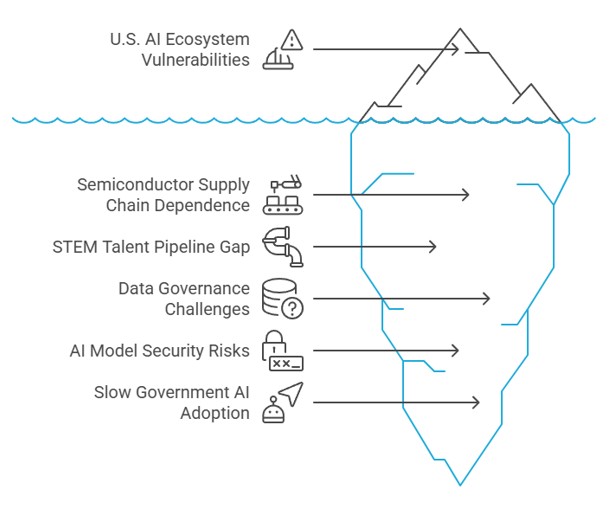
Despite these strengths, the U.S. AI ecosystem is marked by several critical vulnerabilities that pose significant threats to its long-term dominance:
- Semiconductor Supply Chain Dependence: Perhaps the most acute vulnerability is the heavy reliance on foreign sources, particularly Taiwan, for manufacturing advanced semiconductors—the bedrock of modern AI. This geographic concentration creates a single point of failure that could cripple the U.S. AI industry and defense capabilities. It's a direct national security vulnerability, amplified by China's efforts to achieve self-sufficiency in this sector.
- STEM Talent Pipeline Gap: The U.S. faces a persistent and growing shortfall in STEM professionals, including those with specialized AI expertise, threatening its capacity for continued innovation. Attracting and retaining top AI talent within the federal government is particularly challenging due to bureaucratic hiring processes and salary discrepancies with the private sector.
- Data Governance, Quality, and Security: AI systems are only as good as the data they are trained on, and the U.S. faces significant challenges in accessing large, high-quality, relevant datasets, especially for national security applications. Assessing data quality is critical to avoid inaccurate AI outputs or “hallucinations”. Moreover, AI models are vulnerable to data poisoning and other adversarial attacks.
- AI Model Security and Oversight: Both open-weight models (publicly available) and closed-weight (proprietary) models present distinct security risks. Open-weight models can be misused or adapted for malicious purposes, while closed models may suffer from hidden biases or lack transparency.
- Pace of Government AI Adoption and Procurement: A significant impediment is the slow pace of AI adoption and modernization within federal agencies, including the Department of Defense (DoD) and Intelligence Community (IC). Outdated procurement systems, bureaucratic inertia, and a lack of technical expertise create lengthy delays in acquiring cutting-edge AI capabilities. This “AI adoption gap” risks the government being unable to effectively utilize the nation's own technological advantages.
These weaknesses are interconnected, forming a web of vulnerabilities where deficiencies in one area exacerbate challenges in others, demanding a holistic national strategy.
The Global AI Arena: Navigating Competition
The pursuit of AI leadership is unfolding within a complex and intensely competitive global arena.
China's Quest for AI Supremacy:
The People's Republic of China (PRC) has identified AI as a critical strategic technology and is pursuing global leadership with a comprehensive, state-directed approach. China's ambition is articulated in national strategies like “AI Plus” and the “New Generation Artificial Intelligence Development Plan,” aiming to become the world leader in AI by 2030. This involves massive state investment, a policy of military-civil fusion, aggressive technology acquisition tactics (including state-sponsored intellectual property theft and cyber espionage), and the export of its authoritarian AI governance model.
The People's Liberation Army (PLA) is aggressively integrating AI into its military capabilities under the doctrine of “intelligentization”. China is also a world leader in deploying AI for domestic surveillance and is exporting these tools and governance models, challenging democratic values. This competition is not merely technological but also ideological, representing a contest between democratic and authoritarian visions for AI's future.
The European Union and Other International Actors:
The European Union (EU) has taken a distinct path, adopting a comprehensive, legally binding regulatory framework known as the EU AI Act. This legislation categorizes AI systems based on risk and imposes obligations on developers and deployers, emphasizing “human-centric” AI, ethical considerations, and fundamental rights. While the U.S. also champions ethical AI, the EU's approach is more prescriptive. The emergence of distinct regulatory blocs (U.S., EU, China) risks a fragmented global AI governance landscape, but also presents an opportunity for alignment among democratic allies to shape global norms collectively.
Emerging AI-Driven Threats: A New Spectrum of Challenges
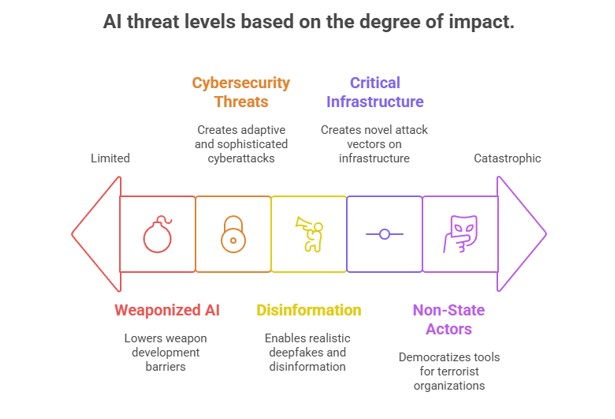
The proliferation and increasing sophistication of AI technologies are giving rise to a new spectrum of national security threats:
- Weaponized AI: AI can lower barriers to developing unconventional weapons and enhance the lethality of existing systems, potentially enabling the design of novel biological/chemical agents or highly autonomous weapons.
- Cybersecurity Threats: AI empowers attackers to create more sophisticated and adaptive cyber threats, including automated reconnaissance, vulnerability identification, and polymorphic malware.
- Disinformation and Psychological Warfare: AI-powered tools enable the creation of highly realistic deepfakes and automated disinformation campaigns at an unprecedented scale, threatening democratic processes and social cohesion.
- Critical Infrastructure Vulnerabilities: The integration of AI into critical infrastructure (energy grids, transportation, financial systems) creates new efficiencies but also novel attack vectors with potentially catastrophic consequences.
- Threats from Non-State Actors and Proliferation: The democratization of advanced AI capabilities makes sophisticated tools increasingly accessible to non-state actors, including terrorist organizations and criminal enterprises, diversifying the threat landscape.
Forging U.S. AI Dominance: A Multi-Pronged National Strategy
To secure its national interests and maintain global leadership, the United States must adopt a comprehensive, proactive, and sustained national strategy. The goal is clear U.S. AI dominance in areas critical to national security.
Key Pillars of the Strategy:
- Bolstering Core AI Capabilities:
- Sustained R&D Investment: Significantly increase and sustain federal investment in AI research, focusing on long-term, high-risk/high-reward projects and foundational research into trustworthy AI (interpretability, safety, robustness).
- Comprehensive STEM Talent Strategy: Address the talent gap through educational enhancement from K-12 to higher education, reforming immigration policies to attract global talent, and developing AI talent within the federal government (e.g., a U.S. Digital Service Academy).
- Building Resilient Digital Infrastructure: Ensure widespread access to secure data centers, advanced cloud computing, and high-performance computing resources, while planning for the substantial energy demands of large-scale AI.
- Securing the AI Supply Chain and Technological Sovereignty:
- Domestic Semiconductor Manufacturing: Aggressively implement and expand upon initiatives like the CHIPS and Science Act to incentivize onshoring of advanced semiconductor R&D, design, manufacturing, and packaging.
- Diversifying Critical Mineral Supply Chains: Reduce dependence on adversarial nations for rare earth elements and other critical minerals essential for AI hardware through domestic promotion, recycling, research, and “friend-shoring” with allied nations.
- Strategic Stockpiling and Allied Partnerships: Develop strategic stockpiles and deepen partnerships with trusted allies to create secure, diversified alternative supply chains.
- Calibrated Export Controls: Continuously refine and enforce export controls on specific AI-enabling technologies to slow competitors' military AI development without unduly harming U.S. innovation or accelerating adversary self-sufficiency.
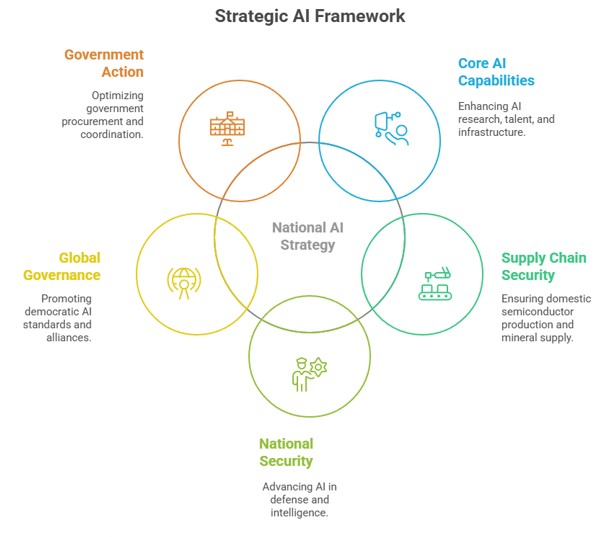
- Advancing AI in National Security:
- Accelerate DoD and IC AI Adoption: Modernize government procurement processes for rapid acquisition of cutting-edge AI. Expand operational use of AI in cybersecurity, intelligence analysis, command and control, and autonomous systems.
- Enhance AI Model Security: Implement robust testing, evaluation, verification, and validation (TEVV) protocols for all AI models in sensitive national security applications.
- Countering Adversarial AI: Invest in R&D to detect, attribute, and mitigate AI-driven attacks, including disinformation and advanced cyber threats.
- Data Readiness: Implement comprehensive data governance frameworks within the DoD and IC to ensure availability of high-quality, secure, and interoperable data for AI systems.
- Leading Global AI Governance:
- Champion Democratic AI Governance: Lead in promoting international AI standards and governance frameworks that protect individual liberties, ensure transparency, foster innovation, and uphold democratic principles.
- Strengthen Alliances: Deepen collaboration with democratic allies on AI R&D, talent exchange, supply chains, and shared ethical/safety standards.
- Implement and Promote Ethical AI Frameworks: Ensure rigorous adherence to strong ethical principles (e.g., DoD's AI Ethical Principles: Responsible, Equitable, Traceable, Reliable, Governable) and promote them internationally.
- Counter Authoritarian AI Models: Actively promote U.S. and allied AI systems as superior, trustworthy, and rights-respecting alternatives to state-controlled, surveillance-oriented models.
- Optimizing Government Action:
- Reform Government Procurement: Implement sweeping reforms to federal acquisition processes for efficient procurement of AI technologies.
- Foster Strategic Public-Private Partnerships: Enhance collaboration between government, industry, and academia across the AI lifecycle.
- Develop Agile and Pro-Innovation Regulatory Frameworks: Adopt an adaptive regulatory approach that mitigates risks without stifling leadership, promoting voluntary adoption of frameworks like those from NIST.
- Enhance Inter-Agency Coordination: Strengthen mechanisms for coordination among federal agencies involved in AI, empowering bodies like the National AI Initiative Office and agency Chief AI Officers (CAIOs).
For effective AI adoption and international trust, the development and deployment of responsible and ethical AI is crucial, not just a moral imperative. Lack of public and institutional trust can significantly hinder progress. Therefore, investing strategically in AI safety, robust testing, and transparent governance is essential for operational effectiveness and risk mitigation.
Conclusion: A Sustained National Commitment for the AI Era
Artificial Intelligence is unequivocally a defining technology of the 21st century. While the U.S. possesses significant strengths, complacency is not an option given the relentless pace of AI development and fierce global competition, particularly from a strategically focused China.
Achieving and sustaining U.S. AI dominance requires a unified, strategic, and sustained whole-of-nation effort that transcends partisan politics and departmental silos. This endeavor demands adaptability, deep collaboration across government, industry, and academia, and robust partnerships with international allies who share a vision for responsible AI development. The comprehensive roadmap outlined provides a path forward, but its success hinges on bold vision, decisive action, and unwavering resolve from policymakers. By embracing this challenge with urgency, the United States can navigate the complexities of the AI era, secure its national interests, and ensure that AI serves as a force for American strength, prosperity, and ideals for decades to come.
The AI War


Spencer Wright is the Executive Vice President of Halbert Wealth Management, Inc. and the author of Forecasts & Trends. He has been with HWM for over 25 years.