

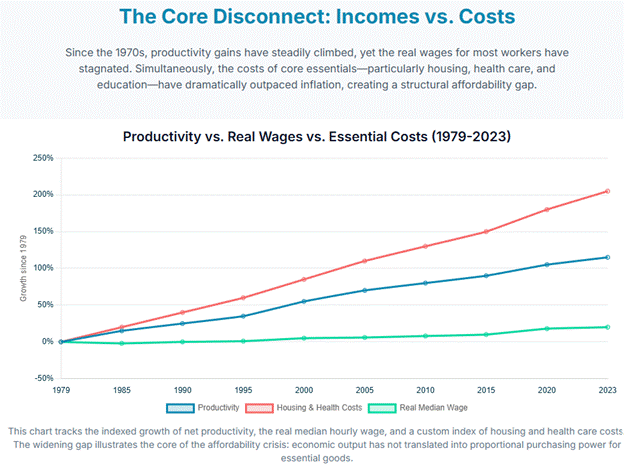
The current affordability crisis is fundamentally distinct from prior economic downturns, such as the Great Inflation of the 1970s and the 2008 housing collapse. These differences are rooted in key historical shifts.
1. The Great Divergence (1979-Present): A Structural Gap in Wealth Creation
The most crucial long-term change is the unlinking of worker pay and productivity. Between 1979 and 2021, while net productivity surged by 64.6%, the typical worker’s hourly compensation grew by only 17.3%. This structural divergence means the wealth created by increased efficiency no longer reliably translates into higher pay for the majority of workers.
2. Divergent Inflation Dynamics (1970s vs. 2020s)
The nature of inflation has changed.
- 1970s: Fueled by a wage-price spiral and a loss of central bank credibility, leading to unanchored inflation expectations.
- 2020s: Primarily driven by major supply chain disruptions, excessive government capital injections, and an expansion of corporate profit margins, with long-term inflation expectations remaining relatively stable due to strong central bank credibility.
3. Housing Market Crisis (2008 vs. 2024)
The factors driving the housing crisis have reversed.
- 2008: Characterized by overly loose credit standards and an excess of housing supply (a supply glut).
- 2024: Defined by extremely tight credit standards combined with a severe shortage of housing supply (a supply famine). This current crisis is amplified by a massive demographic wave of millennial buyers competing for a historically low number of available homes.
Housing: The Core of the Affordability Crisis
Housing costs are the single most significant factor driving the affordability crisis, directly eroding the financial stability of both homeowners and renters.
The Ownership Barrier
- Decoupling of Price and Income: The traditional benchmark where a median home cost was about 3.5 times the median income has been broken. By 2023, the national average for this ratio climbed to 5.3, and in major coastal metropolitan areas, it exceeded 10. Between 1985 and 2023, median home prices skyrocketed by 408%, while median household income saw a much smaller increase of 241%.
- The Monthly Payment Burden: Although current mortgage rates (6–7%) are lower than their 1980s peaks, the substantially larger principal amounts mean that the effective monthly mortgage payment for new buyers, when measured against disposable income, is near historical highs.
The Rental Squeeze
- Widespread Cost Burden: The situation is severe for the 35% of households who rent. In 2023, nearly half (49.5%) of all renter households were classified as “cost-burdened,” meaning they spent more than 30% of their income on rent.
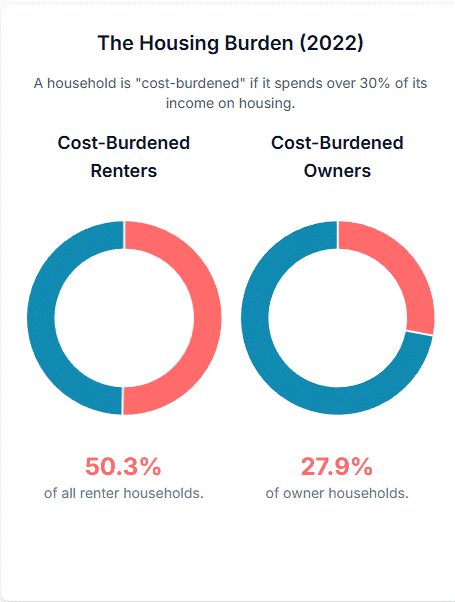
- Crisis for Vulnerable Populations: The crisis is most acute for low-income populations. A staggering 66.5% of households earning less than $30,000 face a “severe cost burden,” dedicating over 50% of their income to rent. Additionally, over 58% of older renters (aged 65 and up) are also cost-burdened.
Structural Cause
- Supply Deficiency: The primary cause of this intense price pressure is a fundamental shortage in housing supply. Estimates for the national housing deficit range from 3.7 million to 7.3 million units, largely the result of a “lost decade” of insufficient construction following the 2008 financial crisis.
The Unstable Costs of Daily Life: Food, Energy, and Transportation
Essential household costs—food, energy, and transportation—are not just a burden; they are sources of severe financial volatility for American households.
These non-negotiable expenditures have become major sources of financial strain, disproportionately affecting the poor.
- Permanently Higher Food Prices: The inflation period of 2021-2023 established a new, elevated plateau for food costs. This is maintained by “asymmetric pass-through” in highly concentrated markets (e.g., four firms controlling 85% of meatpacking). This allows corporations to quickly transfer cost increases to consumers but delay or avoid passing through cost decreases.
- Regressive Energy Burden: Home energy and fuel costs consume nearly 20% of the income of low-income households, compared to single-digit percentages for higher earners. In the lowest-income quartile, the energy burden can surpass 26%.
- Future Energy Price Risk: U.S. electricity demand is projected to surge by 25% by 2030, driven by electrification and AI data centers. Without a rapid expansion of generation and transmission capacity, this demand increase could push retail electricity prices up by as much as 40% in supply-constrained markets.
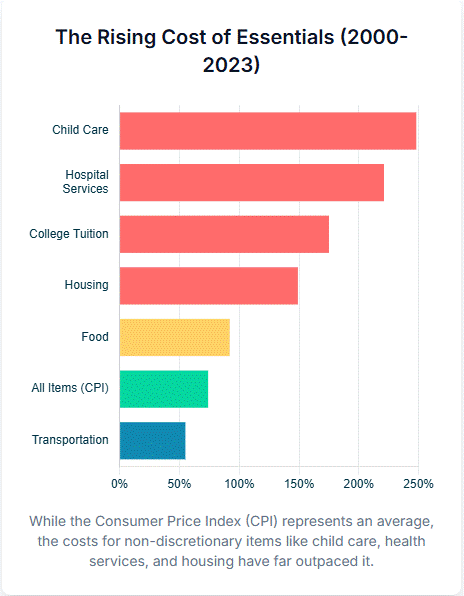
Transportation: The Hidden Tariff on Work
As the second largest household expenditure, transportation costs act as a disproportionate fixed cost for those seeking to participate in the labor market.
- Disproportionate Cost Structure: Transportation is significantly more burdensome for the poor. In 2023, the lowest-income quintile allocated 30.4% of their after-tax income to transportation, a stark contrast to the 12% spent by the highest quintile. Reliance on private vehicles is a high, non-negotiable cost.
- Dysfunctional Vehicle Market: The average new car transaction price reached $44,271 in late 2024. More critically, production shortages during the pandemic severely depleted the used car market, keeping prices high. This forces lower-income buyers into older, less reliable vehicles, leading to higher long-term maintenance costs.
The Service Sector Squeeze: Healthcare and Childcare Driving Unaffordability
Labor-intensive services like healthcare and childcare are persistent drivers of the US affordability crisis.
- Healthcare: The primary cause of the US spending twice the per capita amount on healthcare compared to peer nations is higher prices, not greater use. A significant factor is administrative overhead, with the US spending over $1,000 per person on administration. Furthermore, hospital consolidation has reduced market competition, contributing to price inflation.
- Childcare: Childcare is a clear market failure. High labor and regulatory costs make the service expensive, yet many parents cannot afford it. Tuition for two children can consume 20-30% of a median family’s income, often exceeding housing costs. Despite this, the childcare workforce remains one of the lowest paid. The recent end of pandemic stabilization funds threatens to further shrink supply.
Key Economic Metrics Across Periods
| Metric | 1970s Era (Approx.) | 2000s Housing Boom | 2020s Era (Current) | Trend / Insight |
| Median Home Price / Income | ~3.5x | ~4.5x – 5.0x | ~5.3x – 5.5x | Housing has fundamentally decoupled from wages. |
| Mortgage Rates | 8% – 18% (High Volatility) | ~6% | ~6% – 7% | Rates are currently moderate, but principal balances are at record highs. |
| Rent Burden (>30% income) | ~25% of renters | ~40% of renters | ~50% of renters | Renting is no longer a cheap alternative; it is a driver of poverty. |
| Inflation Driver | Wage-Price Spiral | Asset Inflation | Supply Shock / Profit Expansion | Current inflation is supply-side and profit-driven, not wage-driven. |
The Bottom Line
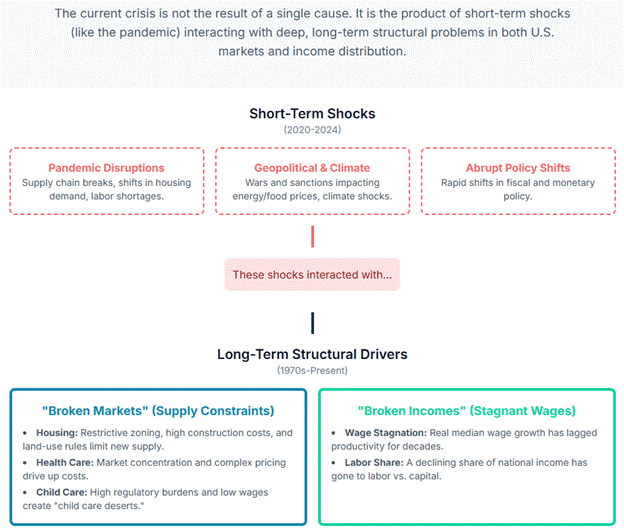
This infographic summarizes our current predicament.
Old Meets New
AI Affordability Solutions


Spencer Wright is the Executive Vice President of Halbert Wealth Management, Inc. and the author of Forecasts & Trends. He has been with HWM for over 25 years.