This week’s highlights…
- Artificial intelligence is no longer just a futuristic concept.
- It has rapidly transitioned from a niche analytical tool into a core component of modern investment management.
- Whether you are a casual investor or a seasoned portfolio manager, AI is fundamentally reshaping how the financial industry analyzes markets, optimizes portfolios, and discovers new opportunities.
The Data Revolution in Finance
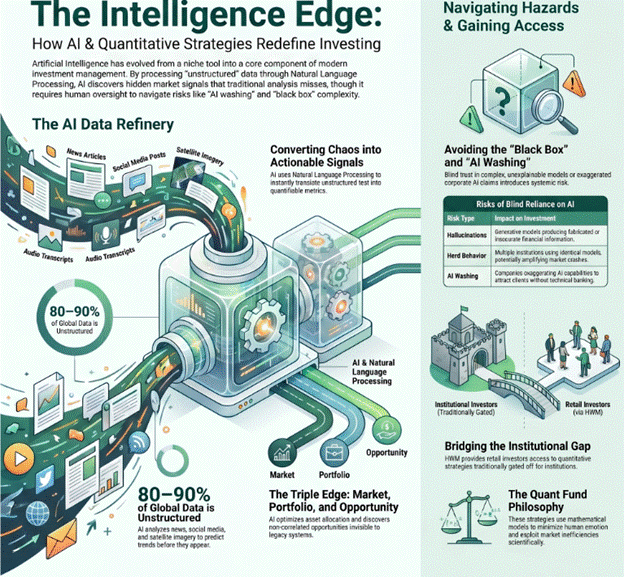
One of the most powerful applications of AI in general investing is its ability to process vast amounts of unstructured data. Since an estimated 80% to 90% of the world’s data is unstructured, such as news articles, social media posts, and earnings call transcripts, AI tools use Natural Language Processing (NLP) to read and understand this information almost instantly. This allows investment firms to gauge market sentiment and predict trends before they ever show up in traditional financial statements.

Beyond market analysis, firms are utilizing AI in their internal operations to enhance efficiency by automating routine tasks that were previously handled manually. This includes everything from transcribing client meetings and managing customer relationships to automating complex regulatory reporting. By speeding up reporting cycles and running dynamic financial forecasts, AI frees up human analysts to focus on higher-level strategic planning.

Furthermore, this data revolution extends far beyond text, allowing AI systems to digest unconventional “alternative data” to anticipate economic shifts in real time. Instead of relying solely on traditional financial metrics, AI can analyze unique inputs like satellite imagery of retail parking lots or anonymous credit card transaction flows. By treating the global market as a massive dataset, AI helps identify and scientifically exploit hidden market inefficiencies long before they become obvious to the broader public
Navigating the Hype and the Hazards
While the promise of AI is undeniable, bringing greater efficiency and precision to the industry, it is not without its risks. The sudden surge in AI enthusiasm has led to “AI washing,” a practice where companies exaggerate their use of artificial intelligence to attract clients and boost revenues.
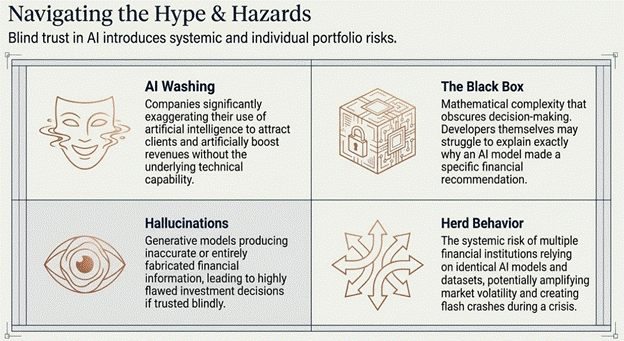
Furthermore, many complex AI systems operate as “black boxes”. This means the decision-making process is so mathematically complex that even the developers might struggle to explain exactly why the AI made a specific recommendation. There is also the risk of AI “hallucinations,” where generative models might produce inaccurate or entirely fabricated information, which could lead to flawed investment decisions if blindly trusted.
Finally, if multiple financial institutions rely on similar AI models and datasets, it could lead to herd-like behavior, potentially amplifying market volatility during a crisis. Because of these risks, the consensus among financial experts is that AI should be treated as a powerful aid to human judgment, not a complete substitute for it.
What You’re Missing
As AI continues to evolve, it is supercharging a specific, highly sophisticated corner of the financial world: quantitative investing. But what exactly is a “quant” fund, and how is AI transforming it?
The Mechanics of Quant Funds
Quantitative funds are investment vehicles that rely heavily on mathematical models, statistical analysis, and computer algorithms to identify and execute trades. The primary goal of a quant strategy is to minimize human subjectivity and emotion, treating the global market as a massive dataset where hidden inefficiencies can be scientifically identified and exploited.
The AI Upgrade
Historically, traditional quant models relied on fixed, human-crafted rules. Today, AI and machine learning are fundamentally reshaping these funds by allowing them to adapt to complex, non-linear market realities. AI-driven quant systems can autonomously discover hundreds of trading signals by rapidly searching through massive parameters. They also digest unconventional “alternative data”, such as satellite imagery of retail parking lots or anonymous credit card transaction flows, to anticipate economic shifts in real time.
Finding Your Edge

While these advanced, data-driven approaches offer exciting opportunities for diversification and risk management, gaining access to top-tier quantitative strategies can be challenging for the everyday investor. This is where Halbert Wealth Management’s focus on alternative investments and non-traditional strategies provides a distinct advantage. HWM offers quantitative strategies for retail investors. We have operated our own quantitative strategy for nearly 12 years.

We specialize in bespoke, institutional-style solutions that look beyond standard stocks and bonds. Whether it is exploring quantitative funds, specialized private offerings, or bespoke options strategies our goal is to help investors access non-correlated investments that may help smooth volatility and expand return opportunities. We focus on connecting you with strategies that prioritize risk-aware, absolute-return philosophies.
Ready to learn more about HWM’s quant strategies?
Infographic Summary

Spencer Wright is the Executive Vice President of Halbert Wealth Management, Inc. and the author of Forecasts & Trends. He has been with HWM for over 25 years.