
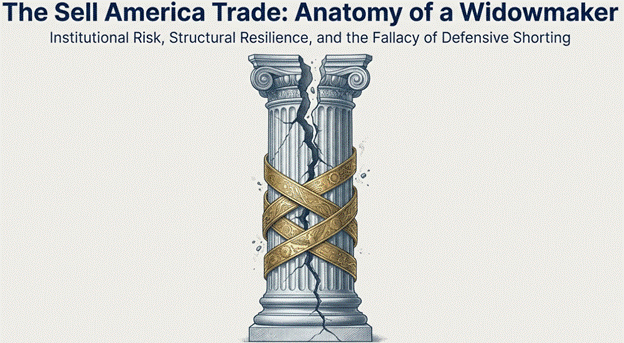
The “Sell America” Trade: Separating Fear from Fact
The “Sell America” trade is currently a dominant financial narrative, fueled by recent market movements that challenge the perception of the United States as the ultimate global economic safe haven.
While this climate of scrutiny and fear is prompting many investors to question the U.S. economy’s resilience, it’s crucial to look beyond the immediate panic. A deeper analysis suggests the structural foundations of the American economy are far more robust than the surface-level anxiety implies.
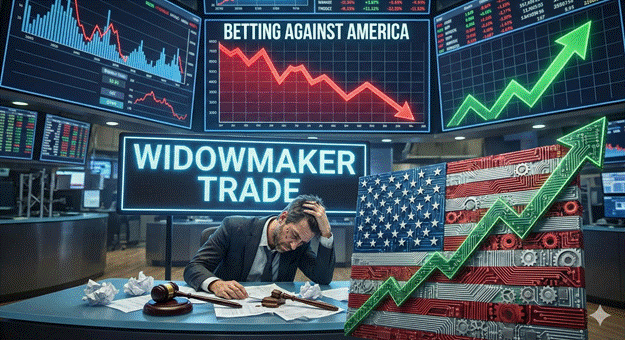
This piece will dissect the current market dynamics, explain the feeling of unprecedented uncertainty, and ultimately argue that wagering against the U.S. remains the most dangerous, or “Widowmaker”, bet an investor can make.
What Exactly is the “Sell America” Trade?
To understand the current volatility, we have to look at how markets usually behave versus what they are doing now.
In a normal market, there is a comfortable see-saw effect. When stock markets get rocky and equities fall, investors typically flock to safe-haven assets, specifically the U.S. dollar and U.S. Treasury bonds. This flight to quality usually pushes the value of the dollar up when risk assets go down.
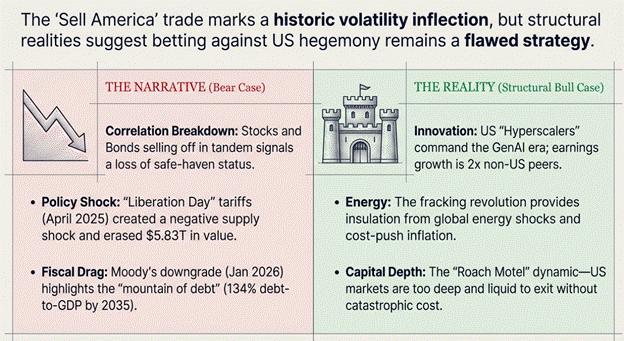
The “Sell America” trade flips this logic on its head. It is defined by a simultaneous sell-off of U.S. stocks, bonds, and the dollar. Instead of the dollar acting as a shield during volatility, it falls right alongside the S&P 500. This positive correlation, where everything moves down together; is historically rare and signals that investors are viewing U.S. assets not as a diversified safe haven, but as a singular, concentrated risk.
Some analysts view this through the lens of generational cycles, suggesting we are in a “Fourth Turning”; a crisis era characterized by institutional distrust and social unraveling. But what actually triggered this shift?
The Catalysts: Tariffs, Geopolitics, and Debt
This wasn’t a spontaneous event. The shift in sentiment was driven by three specific shockwaves that hit the market between 2025 and 2026.
1. The “Liberation Day” Shock
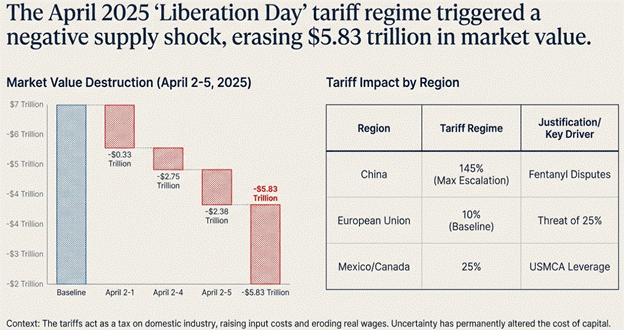
On April 2, 2025, the administration announced the “Liberation Day” tariffs; a 10% baseline tax on nearly all imports designed to protect domestic manufacturing. The market reaction was, to put it mildly, violent. The S&P 500 lost approximately $5.83 trillion in value over just four days, marking the steepest losses since the 1950s. Investors quickly realized that while these tariffs might help specific industries, they acted as a negative supply shock that would raise costs for companies and prices for consumers.
2. The Greenland Crisis
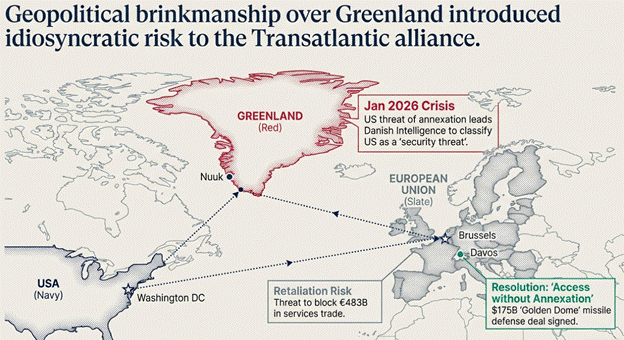
Just as markets were adjusting to trade friction, January 2026 brought a geopolitical stress test. Tensions flared over a diplomatic confrontation regarding the potential American annexation of Greenland. When the U.S. refused to rule out military force, it rattled the Transatlantic alliance to its core. The EU threatened retaliation, and for the first time, Danish intelligence classified the U.S. as a potential security threat. This introduced “idiosyncratic risk” into U.S. markets; essentially, the fear that American foreign policy had become too erratic to trust.
3. The Fiscal Cliff
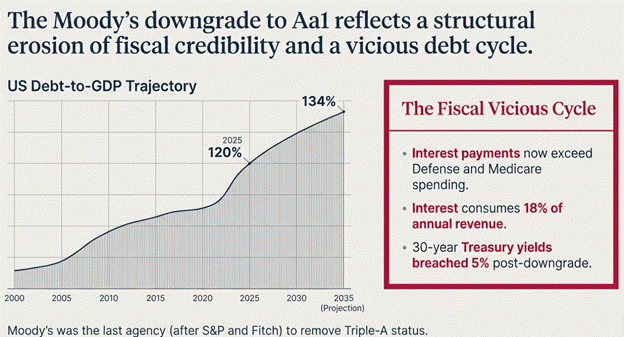
Underlying these events is the boring but dangerous reality of the federal balance sheet. In January 2026, Moody’s downgraded the U.S. credit rating to Aa1, citing a projected debt-to-GDP ratio of 134% by 2035. With interest payments consuming 18% of revenue, the bond market began to fear a “non-linear repricing”, fancy talk for interest rates spiraling upward because there is simply too much debt to sell.
The “Widowmaker” Trap: Why Betting Against the U.S. is Dangerous
Given those three factors, selling U.S. assets seems like the rational play, right? Not necessarily.
In trading, a “widowmaker” is a bet that looks perfect on paper but crushes anyone who tries to execute it because the market remains irrational longer than the trader can stay solvent. For decades, shorting Japanese government bonds was the ultimate widowmaker. Today, shorting the U.S. economy is taking that title.
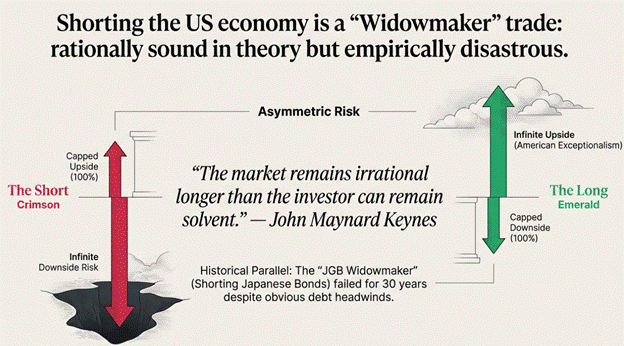
Despite the noise, the U.S. retains deep structural advantages often called “American Exceptionalism” that make betting against it a fundamentally flawed strategy.
The Innovation Moat
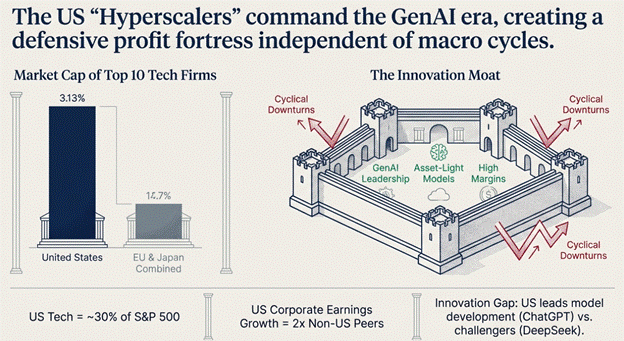
The U.S. is not just another economy; it is the engine of global innovation. The GenAI era is dominated by American hyperscalers, companies like, Nvidia, Microsoft, Alphabet, Apple and Tesla that hold massive cash reserves and dominate global profit pools. While Europe and Japan struggle to foster deep venture capital ecosystems, the U.S. consistently leads in R&D and tech capability. Even if the macro picture looks bleak, these companies have defensive properties because they are so profitable and essential to the global economy.
Energy Independence
Unlike Europe, which remains vulnerable to energy shocks, the U.S. is an energy powerhouse thanks to the fracking revolution. This energy independence insulates the U.S. manufacturing base from the kind of cost spikes that cripple international competitors.
The “There Is No Alternative” (TINA) Problem
Here is the hard truth for the “Sell America” crowd: Where else will you put your money? The U.S. has the deepest, most liquid capital markets in the world. If European nations tried to retaliate against the U.S. by selling their Treasury holdings, they would crash the value of their own reserves and trigger a global financial crisis that would hurt them just as much as the U.S. The interdependence of the global economy means that a total divorce from U.S. assets is practically impossible without causing a global depression.
The Buffett Rule
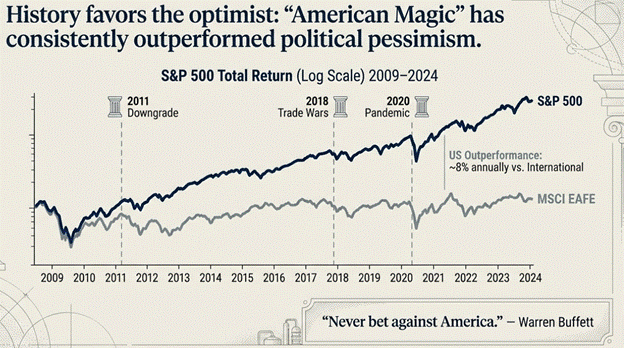
It is always helpful to check in with the Oracle of Omaha. Warren Buffett has famously maintained that “American magic has always prevailed” and that for 240 years, betting against the U.S. has been a “terrible mistake.” His view is that the country’s “golden goose of commerce and innovation” will continue to produce wealth regardless of who is in the White House or what the short-term policy headwinds are.
The Bottom Line
The U.S. economy has a history of defying the odds. Its combination of energy independence, technological dominance, and deep capital markets provides a moat that is incredibly difficult to cross. While it might be time to diversify and look for value globally, the idea of abandoning the U.S. market entirely is a strategy that has historically led to catastrophic losses.
As we navigate the rest of the year, the best approach isn’t to bet against the house, it’s to ensure you have a seat at the table.
The AI Widowmaker Trade

Spencer Wright is the Executive Vice President of Halbert Wealth Management, Inc. and the author of Forecasts & Trends. He has been with HWM for over 25 years.