
This Week’s Highlights
- Fundamentals and Macroeconomics: Corporate earnings and broad economic indicators (like GDP and employment) are the primary long-term drivers of stock prices, while inflation can introduce volatility.
- Central Bank Policy: Interest rate decisions by the central bank directly control the cost of capital, acting as a major lever to stimulate or slow down the market.
- Geopolitical Risk: Sudden, unexpected geopolitical events introduce short-term uncertainty and sharp market drops, but history suggests markets tend to recover.
- Investor Psychology: Emotional factors like fear and greed fuel loss aversion and herd mentality, leading to phenomena like panic selling and speculative bubbles (e.g., meme stocks).
- Institutional Trading: The majority of market volume is driven by High-Frequency Trading (HFT) algorithms utilized by institutional investors, which can amplify both market stability and volatility.
Corporate Earnings and True Value
Over the long term, the most important factor driving a company’s stock price is its earnings. Corporate earnings represent a business’s net income, or its true bottom line, after all expenses are paid. Public companies report their financial results four times a year during what is known as earnings season. If a company reports profits that surprise Wall Street in a positive way, investor confidence grows, and the stock price usually jumps.
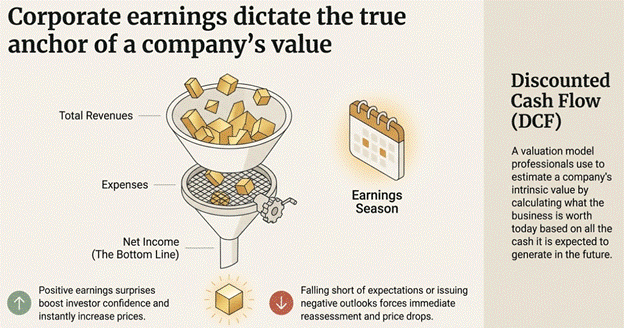
However, if a company’s earnings fall short of expectations, or if management issues a negative outlook for the future, the stock price will likely fall as investors reassess the business’s value. Ultimately, professionals use models like Discounted Cash Flow (DCF) to estimate a company’s intrinsic value, calculating what the business is worth today based on all the cash it is expected to generate in the future.
The Macroeconomic Engine
Beyond individual company performance, broader economic conditions act as a tide that lifts or lowers the entire market. A strong Gross Domestic Product (GDP) usually indicates a robust, expanding economy, which supports higher corporate earnings and pushes stock prices higher.
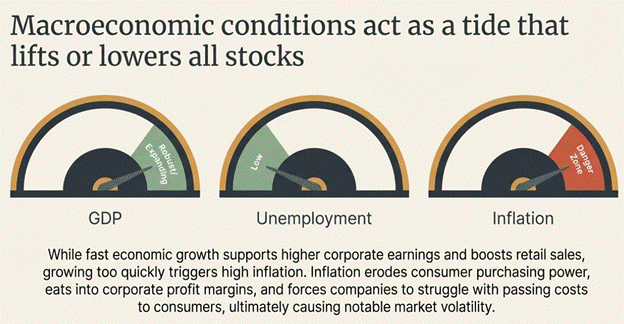
Additionally, low unemployment rates mean that consumers have more disposable income to spend, which directly boosts retail sales and business revenues. On the other hand, if the economy grows too quickly, it can trigger high inflation, eroding consumer purchasing power and eating into corporate profit margins. When inflation surges above normal trends, the stock market often faces increased volatility and downward pressure as companies struggle to pass costs onto consumers.
The Power of Interest Rates
To combat inflation and keep the economy stable, central banks, like the Federal Reserve, use monetary policy to set interest rates. Interest rates act as a macroeconomic throttle by controlling the cost of borrowing money. When central banks raise rates, loans become more expensive for both consumers and businesses. This tighter financial environment typically slows down business expansion, reduces profit margins, and causes stock valuations to decline.
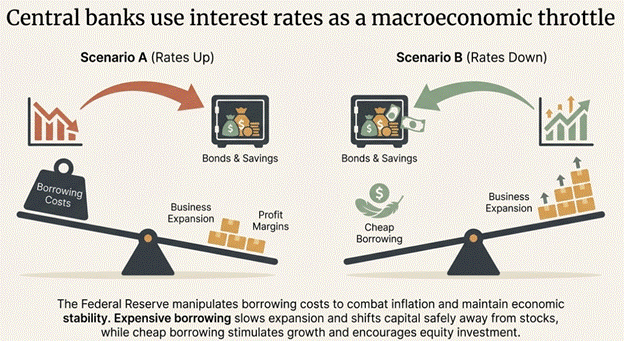
Higher interest rates also make bonds and savings accounts more attractive, pulling investment capital safely away from the stock market. Conversely, when central banks lower interest rates, borrowing becomes cheap, which stimulates economic activity and generally encourages investors to pour money back into stocks. Central banks also influence the market through Quantitative Easing (QE), which injects liquidity into the system to support prices, and Quantitative Tightening (QT), which removes liquidity by shrinking the central bank’s balance sheet.
Geopolitical Tremors
The global stock market is deeply interconnected with international politics and world events. Occurrences like elections, wars, and international trade disputes introduce a level of sudden uncertainty into the global economy. Markets despise unpredictability, and the initial reaction to geopolitical shocks is often a sharp decline in stock prices as investors flock to safe-haven assets like gold.
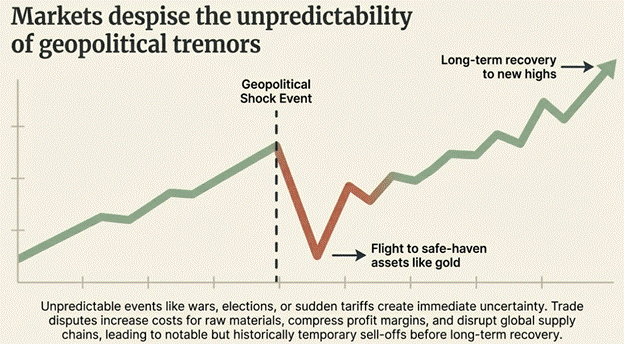
Trade policies also play a massive role; for instance, when a government imposes tariffs on imported goods, companies often face higher costs for raw materials and components. These increased costs can compress profit margins and disrupt global supply chains, leading to notable market sell-offs. However, history shows that while geopolitical events cause sharp, short-term drops, the market typically recovers and often reaches new highs in the long run.
Investor Psychology and The Herd
While we might hope the market is entirely logical, it is frequently driven by the powerful human emotions of fear and greed. Behavioral finance explains that investors suffer from loss aversion, meaning the psychological pain of losing money is felt twice as intensely as the joy of an equivalent gain.
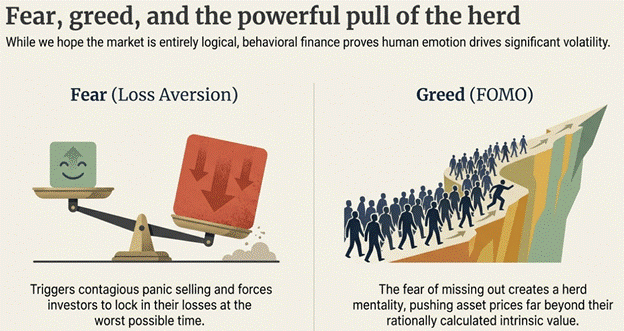
During market downturns, this fear can trigger contagious panic selling, causing investors to exit the market and lock in their losses. Conversely, during a bull market, the fear of missing out (FOMO) can lead to herd mentality, where investors blindly follow the crowd and push asset prices far beyond their actual intrinsic value.
Meme Stocks and Market Squeezes
In recent years, social media platforms have amplified these behavioral biases, leading to unprecedented market events. The rise of meme stocks, like GameStop and AMC in 2021, showcased how retail investors coordinating online could drive massive, irrational price surges. This collective buying triggered massive short squeezes.
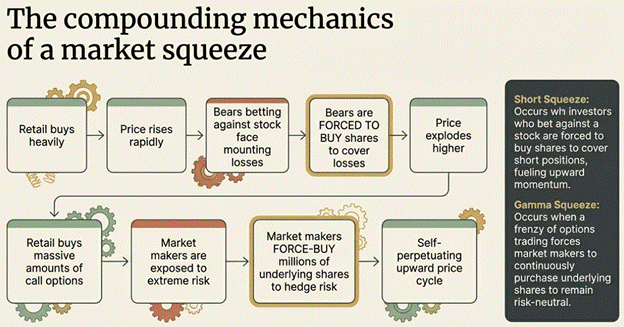
A short squeeze occurs when investors who have bet against a stock are forced to buy shares at rapidly rising prices to cover their mounting losses, fueling an explosive upward price loop. Similarly, a gamma squeeze can occur when a frenzy of retail traders buying call options forces market makers to purchase millions of underlying shares to hedge their own risk, driving the stock price even higher in a self-perpetuating cycle.
Institutional Giants vs. Retail Traders
Finally, to understand why the market moves, you must look at who is doing the trading. The financial landscape is broadly divided into retail investors, everyday individuals investing their personal funds, and institutional investors, such as pension funds, mutual funds, and investment banks. Because institutional investors control trillions of dollars, they account for the vast majority of daily trading volume and have the power to significantly alter real-time prices.
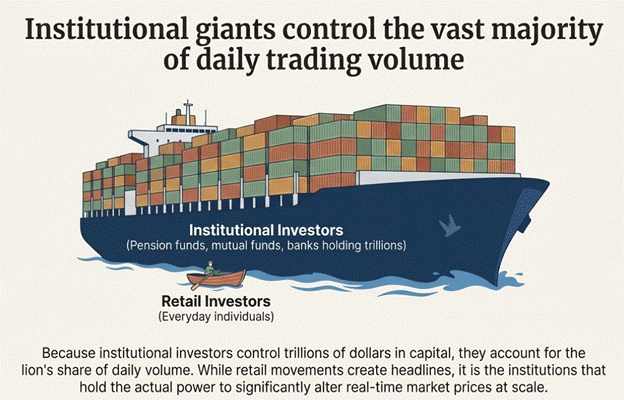
Today, institutions frequently utilize High-Frequency Trading (HFT) algorithms, which use powerful supercomputers to execute thousands of trades in mere microseconds. While HFT provides valuable liquidity to the market under normal conditions, these algorithms can rapidly withdraw liquidity and cancel orders during periods of stress, thereby amplifying intraday volatility and contributing to sudden market crashes.
The Bottom Line
Understanding the intricate dance of supply, macroeconomic indicators, and human psychology is the key to navigating the stock market. By keeping a long-term perspective and ignoring short-term emotional noise, you can build a resilient strategy that weathers any market storm. Until next week, stay informed.
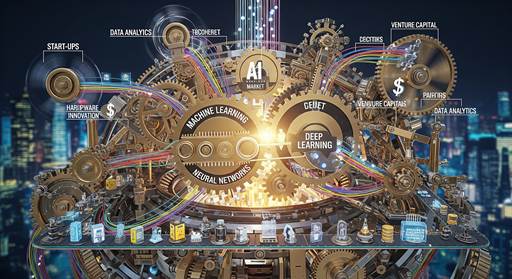
The AI Market Machinery

Spencer Wright is the Executive Vice President of Halbert Wealth Management, Inc. and the author of Forecasts & Trends. He has been with HWM for over 25 years.