
An examination of U.S. equity markets over the last century reveals two persistent characteristics.
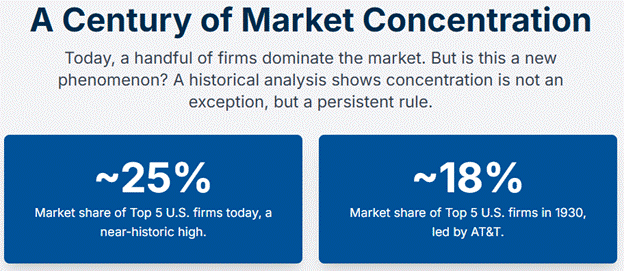
First, high market concentration is typical rather than unusual. The current preeminence of a few “superstar” firms, often technology platforms, marks the fourth major concentration zenith in the past 100 years. Historical data confirms that the proportion of market capitalization held by the top ten companies is cyclical; the present 30-35%+ peak is comparable to the infrastructure-led peak of the early 1930s.
Second, despite the strong advantages held by dominant companies in any particular period, market leadership is inherently short-lived. The dynamics of creative destruction and shifts between sectors have consistently restructured the upper echelon of the market.
U.S. Market Concentration: A Powerful and Recurring Trend
Historical market data shows that the concentration of leadership in the U.S. equity market is a profoundly cyclical phenomenon. Over the last century, the share of total market capitalization held by the ten largest companies has experienced significant swings, repeatedly reaching distinct peaks and troughs. The current high level of concentration, largely driven by the “Magnificent Seven,” structurally mirrors the peak observed following the Gilded Age and far exceeds the levels seen during the peaks of the 1970s and 2000s.
| Approximate Era | Peak / Trough | Top 10 as % of Total U.S. Market Cap (Approx.) | Dominant Sectors / Narrative |
| c. 1932 | Peak | 30% – 35% | Post-Gilded Age Infrastructure (Telecom, Oil, Steel) |
| c. 1960 | Trough | 15% – 20% | Postwar Diversification |
| c. 1972 | Peak | 23% – 27% | “Nifty Fifty” (Consumer Brands, Computers) |
| c. 1990 | Trough | 14% – 18% | Post-Inflation Reset (Energy, Conglomerates) |
| c. 2000 | Peak | 22% – 25% | Dot-Com Bubble (Tech/Media/Telecom Infrastructure) |
| c. 2012 | Trough | 15% – 20% | Post-Financial Crisis Recovery |
| c. 2024 | Peak | 30% – 35%+ | “Magnificent Seven” (Platforms & AI) |
The Evolution of Market Concentration
Market leadership has historically converged in distinct eras, with each “concentration peak” driven by a new fundamental economic structure.
1. The Industrial & Infrastructure Age (c. 1930s)
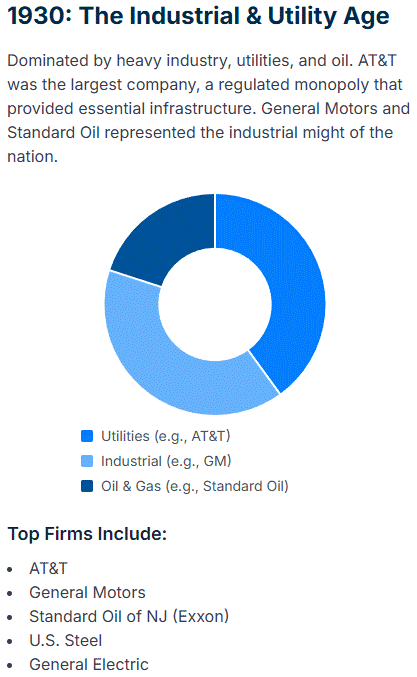
- Dominant Theme: Control of physical infrastructure.
- Sector Leaders: Industrials, Energy, and monopolistic Telecommunications.
- Nature of Dominance: Power was derived from immense, capital-intensive physical assets (e.g., factories, railroads, telephone lines), which created substantial barriers to entry.
- Lesson on Transience: None of the companies that led the 1932 peak remain in the Top 10 today in their original form.
2. Postwar Consumerism & the “Nifty Fifty” (c. 1960s)
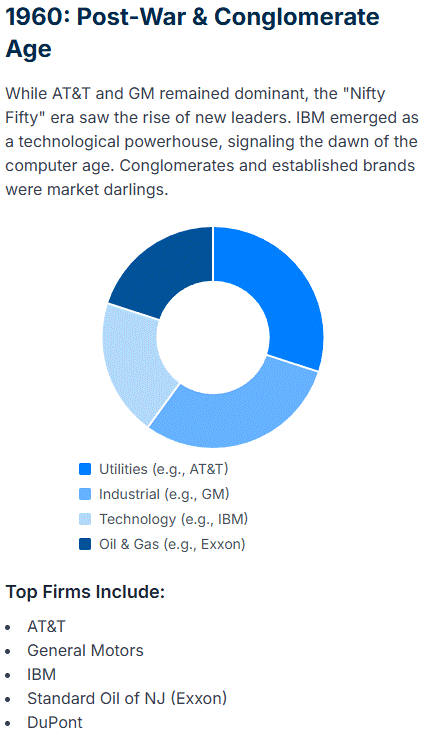
- Dominant Theme: Shift from a production-centric to a consumer-centric economy.
- Sector Leaders: The rise of Technology (IBM) and major consumer-facing companies (Kodak, Sears, Coca-Cola), alongside established “old-economy” titans.
- Nature of Dominance: Market value shifted to intangible assets for the first time, defined by global brands (Coca-Cola) and patent portfolios (Kodak).
- Bubble Dynamic: This era was marked by a “growth-at-any-price” market psychology, resulting in the “Nifty Fifty” bubble. The subsequent decline and failures of companies like Kodak and Sears underscore the inherent instability of concentrated leadership.
3. The Transitional Era and Computer Revolution (c. 1980s–1990s)
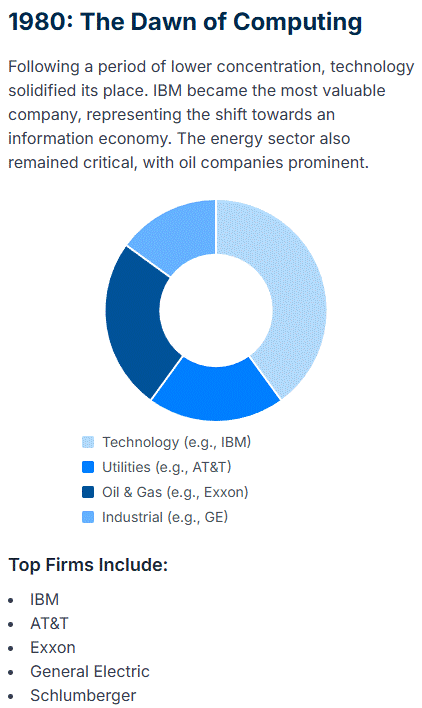
- Dominant Theme: A “valley” or market “reset” phase following the “Nifty Fifty” crash, characterized by transitional leadership.
- Leadership Shift: High-valuation consumer stocks were replaced by firms benefiting from high inflation, particularly Energy companies. Conglomerates (GE) and “Big Pharma” (Merck) also gained prominence.
- Creative Destruction: This period showcased the process of creative destruction. The old leaders fell, while the next wave of future dominators, such as Microsoft and Intel, were building their core platforms outside of the Top 10.
4. The Dot-Com Bubble (c. 2000)
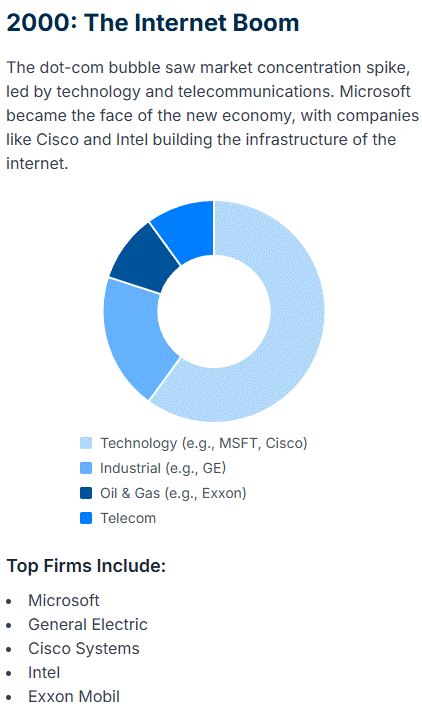
- Dominant Theme: The market peak was fueled almost entirely by the promise of the new digital economy.
- Sector Leaders: Technology, Media, and Telecom (TMT) firms that were building the digital infrastructure (Cisco, Lucent, Nortel) dominated, echoing the 1930s physical infrastructure builders.
- Nature of Dominance: Leadership focused on network protocols and ecosystems, notably the “Wintel” (Windows-Intel) partnership. Valuations were highly speculative, based on future expectations of owning the internet’s “plumbing.”
- Extreme Risk: This concentration peak highlighted extreme risk; several top firms (Lucent, Nortel) would soon become virtually worthless. The focus on infrastructure and enterprise technology set the stage for the next rotation toward consumer-facing internet platforms.
5. The Modern Era of Platforms & AI (c. 2024)
- Dominant Theme: The most extreme concentration peak in modern history, driven by platform companies that have successfully integrated previous models of market power.
- Sector Leaders: The leaders of 2000 (infrastructure builders) have been replaced by firms that own the customer relationship (Apple, Google, Amazon) or build the foundational layer for Artificial Intelligence (Nvidia, Microsoft).
- The Synthesis Model of Moats: Today’s leaders combine all historical forms of dominance:
- Physical Assets (like 1930s): Massive cloud data centers (Google, Microsoft) and logistics networks (Amazon).
- Brand & R&D (like 1960s & 70s): Global brands (Apple) and research powerhouses (Eli Lilly).
- Ecosystems (like 2000s): Global digital control via mobile operating system duopolies (Apple’s iOS, Google’s Android).
- Horizontal Market Power: This synthesis creates deeper and broader market control, enabling companies like Microsoft and Amazon to exert influence across a diverse and seemingly unrelated range of economic sectors.
The Bottom Line
A clear lesson from a century of U.S. market history is that although high concentration is a recurring theme, the specific leaders are always changing. The seemingly unbreachable competitive advantages of one time period are invariably swept away by the technological and economic transformations of the next.
AI Market Concentration


Spencer Wright is the Executive Vice President of Halbert Wealth Management, Inc. and the author of Forecasts & Trends. He has been with HWM for over 25 years.