
Issue No. 06 | July 21, 2026
This week’s highlights…
- The financial landscape is undergoing significant change.
- Between a highly polarized transition at the Federal Reserve and stubborn economic crosscurrents, investors are facing a new era of central banking.
- As your trusted partner, we at Halbert Wealth Management are committed to helping you cut through the noise and understand how these historic changes affect your hard-earned wealth.
Simplicity and Stewardship: The “Warsh Fed” Takes Shape
In May 2026, Kevin Warsh was sworn in as the 17th Chairman of the Federal Reserve Board of Governors, succeeding Jerome Powell after one of the most polarized confirmation processes in U.S. history. In his June debut meeting, Chairman Warsh made it clear that a “regime change” in monetary policy communication has officially arrived.
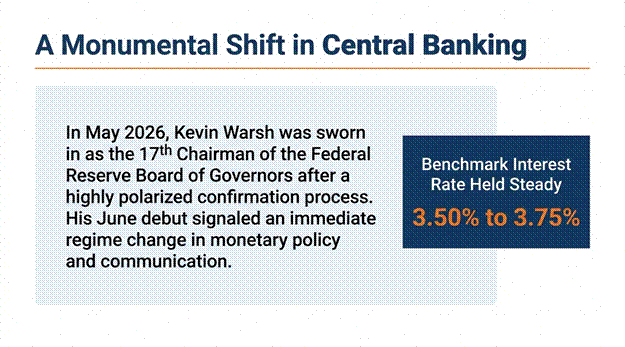
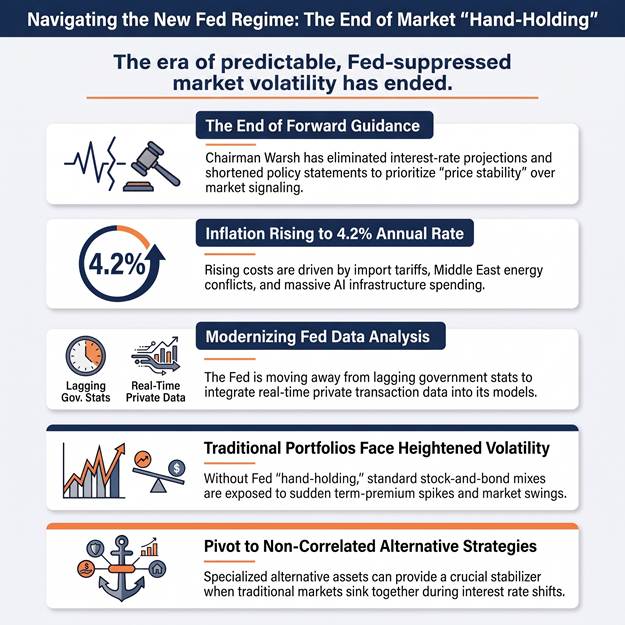
While the Federal Open Market Committee (FOMC) unanimously held the benchmark interest rate steady at a range of 3.50% to 3.75%, one notable development was how the decision was communicated. In an effort to stop “hand-holding” the markets, Chairman Warsh dramatically shortened the Fed’s policy statement from a standard 344 words down to just 130 words, with a blunt closing sentence: “The committee will deliver price stability”.
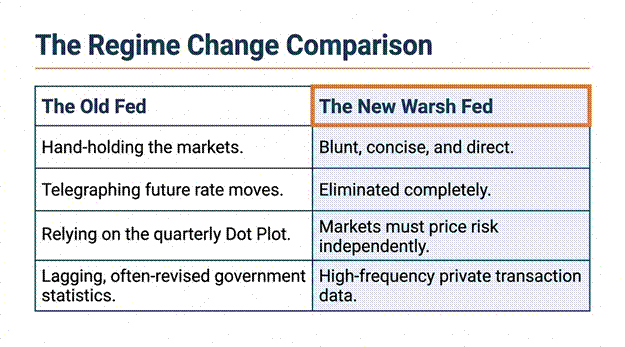
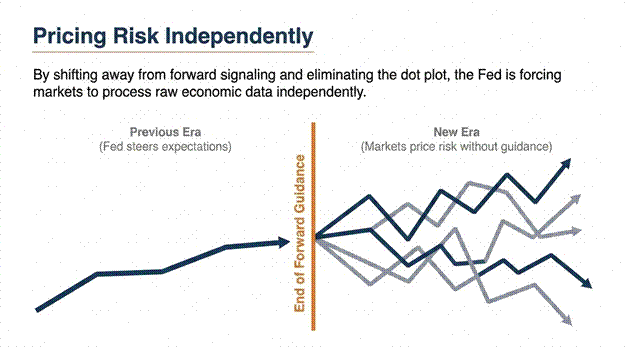
Furthermore, Warsh completely eliminated “forward guidance”, the practice of central banks telegraphing future rate moves, and refused to submit his own interest-rate projection to the quarterly “dot plot”. By shifting away from forward signaling, Warsh wants markets to price risk independently based on real economic data, rather than treating Fed transcripts like a promise.
Economic Crosscurrents: Inflation is More Than Just Lagging Data
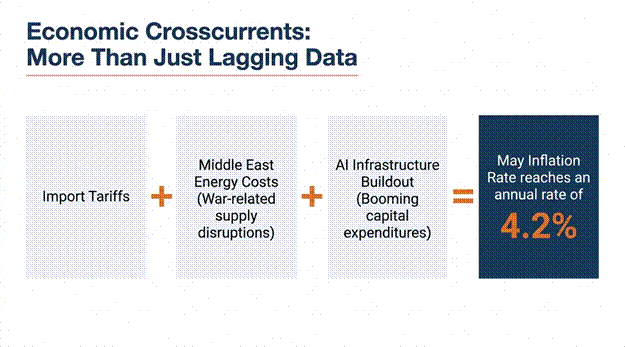
This communication pivot arrives at a difficult juncture. May inflation rose to an annual rate of 4.2%, driven by a combination of import tariffs, a war-related rise in energy costs from the Middle East, and the booming infrastructure buildout for artificial intelligence.
Faced with these pressures, the Fed is looking to modernize its analytical tools. Warsh has established five independent, externally led task forces to overhaul the central bank’s operations. For example, the Data Task Force, co-led by former Walmart CEO Doug McMillon, is designing a framework to integrate high-frequency private transaction data directly into Fed models.
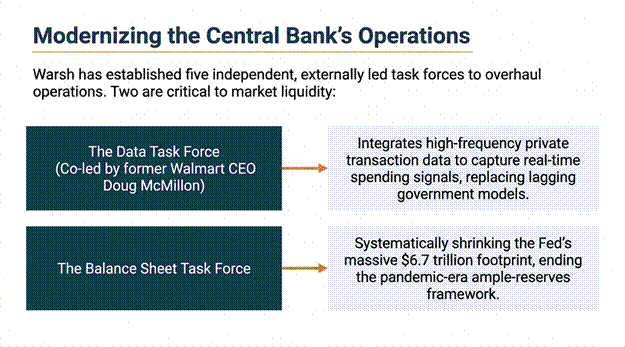
Rather than relying solely on lagging, often-revised government statistics, the Fed aims to capture real-time spending signals. Simultaneously, a Balance Sheet Task Force is analyzing how to systematically shrink the Fed’s massive $6.7 trillion footprint, transitioning away from the pandemic-era “ample-reserves” framework.
What You’re Missing
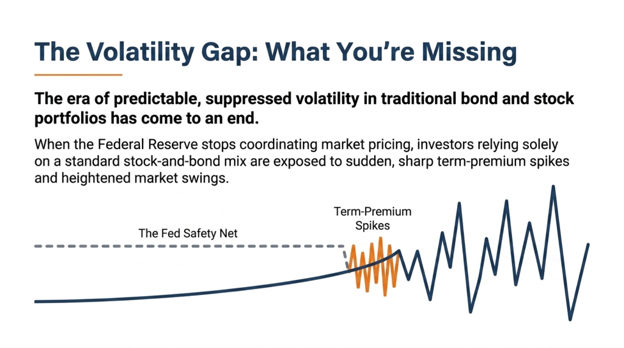
With the Federal Reserve taking its hands off the steering wheel of market expectations, it appears that the era of predictable, suppressed volatility in traditional bond and stock portfolios has come to an end. When the Fed stops coordinating market pricing, investors who rely solely on a standard stock-and-bond mix are exposed to sudden, sharp term-premium spikes and heightened market swings.
This is where Halbert Wealth Management’s focus on alternative investments and non-traditional strategies can help you bridge the gap. Our absolute-return, risk-aware philosophy is built for precisely this kind of environment.
We offer access to specialized alternative assets that are specifically designed to endure regardless of what the Federal Reserve decides to do with interest rates. While traditional assets often sink together when interest rates rise or stay elevated, non-correlated alternative strategies seek opportunities across diverse, independent markets. They are engineered to help manage risk, smooth out volatility, and potentially capture positive returns even when equity and fixed-income markets face headwinds.
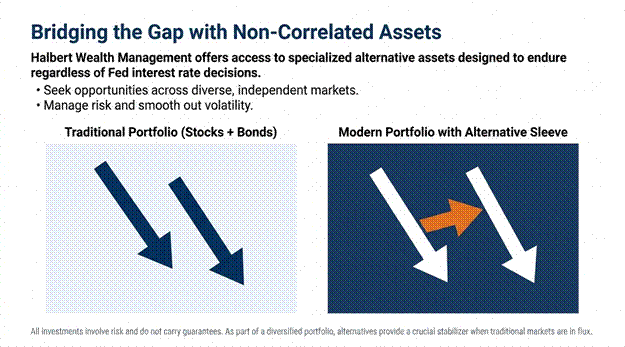
Of course, all investments involve risk, and alternative assets are no exception; they do not carry guarantees. However, as part of a diversified portfolio, they can provide a crucial stabilizer when traditional markets are in flux.
| Your Next Step: To help you understand how historical interest rate cycles have shaped financial assets over the long term, we have prepared an educational resource: “30-Year Correlation Report: Federal Reserve Interest Rates vs. Market Response (1994-2024).” This guide provides a historical look at how traditional equities, fixed income, and non-correlated alternative assets have historically behaved during previous periods of Fed tightening and communication shifts. |
Infographic Summary

Spencer Wright is the Executive Vice President of Halbert Wealth Management, Inc. and the author of Forecasts & Trends. He has been with HWM for over 25 years.