
In today's globalized world, Foreign Direct Investment (FDI) is a really important way capital moves internationally over the long term. It plays a big role in boosting economic growth, encouraging new ideas, and driving overall development for both the countries that invest and the ones that receive the investment. We'll take a look at what FDI actually is and how it's evolved over time, what's good and bad about it, how it affects the countries that do the investing, and particularly, what FDI means for the United States, along with the hurdles it faces here.
Understanding Foreign Direct Investment: More Than Just Capital
Foreign Direct Investment (FDI) involves an investor from one country making a long-term investment in a business in another country, aiming to establish a lasting interest and influence its management. This combination of enduring involvement and managerial impact sets FDI apart from other forms of international investment.
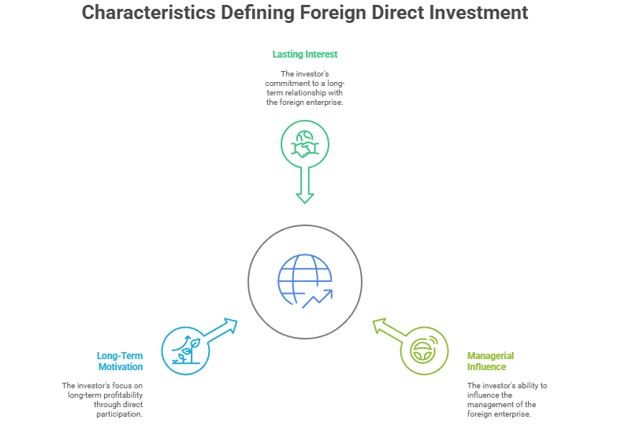
Key characteristics that define FDI include:
- Lasting Interest: International bodies like the IMF (International Monetary Fund), OECD ((Organization for Economic Co-operation and Development), and UNCTAD (United Nations Conference on Trade and Development) often use a benchmark of acquiring 10% or more of the voting securities in a foreign enterprise to define this.
- Distinction from FPI: This threshold helps differentiate FDI from Foreign Portfolio Investment (FPI), which involves passive holdings of securities (like stocks and bonds) without the intent to control operations.
- Long-Term Motivation: Unlike FPI or foreign bank lending, which are often driven by short-term profit motives and can be volatile, FDI is typically motivated by long-term profitability through direct participation in productive activities. This makes FDI a more stable form of international investment.
A Journey Through Time: The Evolution of FDI
The concept and practice of FDI are not new; they have a long and storied history, evolving from early mercantile ventures and foundational cross-border trade activities.
Key periods in the evolution of FDI include:
- 19th Century: Driven by the Industrial Revolution, this era saw a significant increase in international capital flows, particularly towards infrastructure like railroads.
- World War I to the 1970s: This period was marked by disruptions but also saw the rise of the U.S. as a major source and recipient of FDI, especially for post-war reconstruction.
- The Modern Era (1980s onwards): This period has witnessed an unprecedented acceleration and transformation of FDI due to:
- Widespread policy liberalization.
- Rapid technological advancements.
- The broader forces of globalization.
- A key development was the rise of developing countries as significant recipients and sources of FDI, and a shift towards more complex global production networks.
- Recent Trends: Geopolitical tensions have recently led to a slowdown and fragmentation of FDI flows, with an increased focus on strategic industries.
The Upside for Host Nations: Unpacking the Benefits of FDI
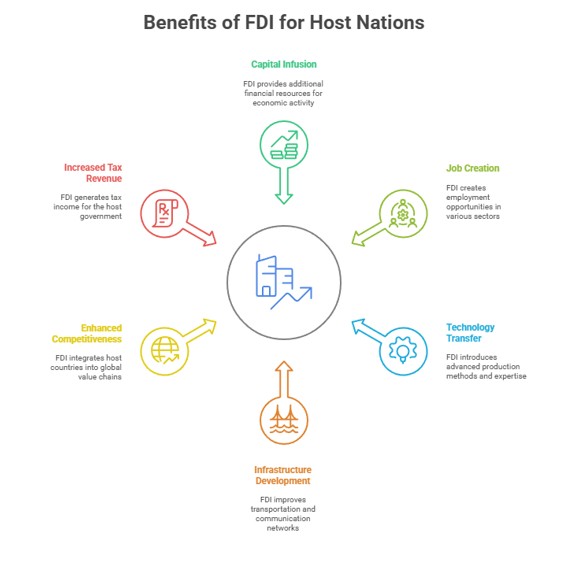
Host countries stand to gain a multitude of significant benefits from attracting FDI. These advantages include:
- Capital Infusion: FDI complements domestic investment, stimulating economic activity by providing additional financial resources.
- Job Creation: It is a significant source of employment, both directly within foreign affiliates and indirectly in supporting industries.
- Technology and Skills Transfer: FDI serves as a crucial channel for introducing:
- Advanced production methods.
- Managerial expertise.
- Innovative practices.
- This can lead to productivity improvements in domestic firms, although the host country's capacity to absorb these technologies is vital.
- Infrastructure Development: Foreign firms may invest in improving transportation, communication, and energy supplies.
- Enhanced Competitiveness: FDI can integrate host countries into global value chains, fostering a more competitive domestic market.
- Increased Tax Revenue: The operations of foreign affiliates generate tax income for the host government.
- Contribution to Sustainable Development Goals: Quality FDI can support goals related to economic well-being and climate action.
A Word of Caution: Potential Downsides and Criticisms of FDI for Host Countries
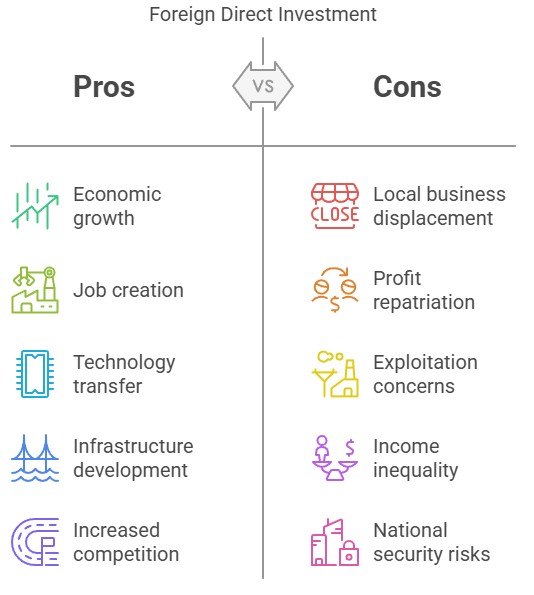
Despite the array of potential benefits, FDI is not without its critics, and host countries can indeed face several negative consequences. Key concerns include:
- Displacement of Local Businesses: Domestic firms, especially smaller ones, may struggle to compete with larger, more efficient MNEs (Multinational Enterprise).
- Profit Repatriation: Foreign firms may send profits back to their home country instead of reinvesting them locally.
- Exploitation Concerns:
- Poor labor standards and working conditions.
- Firms potentially relocating polluting activities to countries with weaker environmental regulations.
- Increased Income Inequality: Benefits of FDI might concentrate among a skilled segment of the workforce, widening the wage gap, particularly in developing countries.
- National Security Vulnerabilities: Foreign investment in critical infrastructure or sensitive technologies can pose risks.
- Deterrents to FDI: Political and economic instability in the host country can discourage foreign investment.
- Fears of Economic Colonialism: Particularly in countries with a colonial past, FDI can raise concerns about reduced national sovereignty.
The Other Side of the Coin: FDI's Impact on Home Countries
The effects of FDI are not confined to host nations; countries from which the investment originates also experience a range of impacts.
Potential negative impacts for home countries:
- Job Displacement: Often termed “hollowing out” or the “export of jobs,” this can occur when firms move production to countries with lower labor costs.
- Capital Outflow and Reduced Domestic Investment: Companies might prioritize overseas opportunities over domestic ones.
- Loss of Technological Edge: There's a risk if sensitive technologies are transferred abroad.
However, the impact is nuanced, and home countries can also benefit:
- Nuanced Employment Effects: While efficiency-seeking FDI may lead to job losses, market-seeking and resource-seeking FDI can create or support jobs in the home country through increased exports and expanded administrative functions.
- Benefits for Firms:
- Market expansion.
- Access to resources.
- Enhanced competitiveness through economies of scale and international experience.
- Potential stimulation of domestic innovation.
The United States and FDI: A Historical Powerhouse and Ongoing Contributor
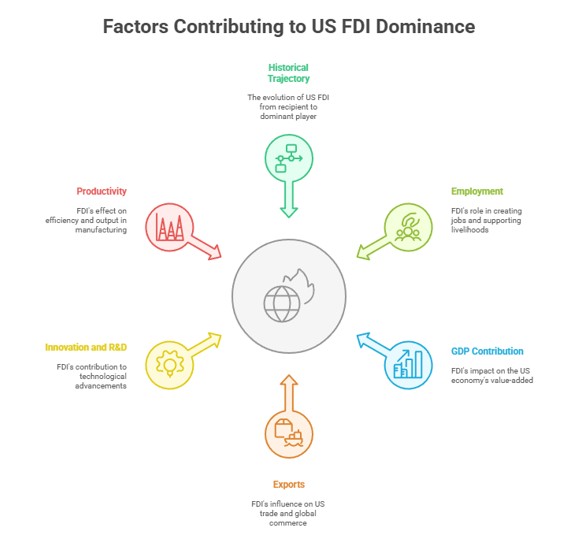
The United States has a fascinating and dynamic history with global FDI, having transitioned from a major recipient of foreign capital to a dominant global player in both inward and outward investment flows.
Historical trajectory:
- 19th Century: A major recipient of foreign capital, primarily portfolio investments financing infrastructure like railroads and government debt. Outward U.S. investment was largely direct, focused on controlling foreign operations.
- Post-World War I: The U.S. shifted to a creditor nation.
- Post-WWII Era: Saw a steady increase in inward FDI, particularly in manufacturing, with the UK and Canada as major investors.
- Modern Era (1980s onwards): Solidified the U.S.'s position as the world's largest recipient and a major source of FDI, attracting investments in high-value sectors.
Current contributions of FDI to the U.S. economy:
- Employment: Foreign-owned firms directly employed nearly 8 million workers in 2019 (6% of private-industry employment), with total supported jobs estimated at around 16 million.
- GDP Contribution: Added over a trillion dollars in value in 2019 (7% of total U.S. business sector value-added).
- Exports: Businesses supported by FDI account for nearly a quarter of all U.S. exports.
- Innovation and R&D: FDI is a vital channel, with foreign-owned firms significantly contributing to corporate R&D spending and bringing advanced practices.
- Productivity: The presence of FDI is linked to higher productivity levels, particularly in manufacturing.
- Infrastructure Development: While less prominent than historically, FDI can still contribute to this area.
Navigating the Complexities: Challenges for the U.S. in Managing FDI
Despite the considerable benefits, managing FDI presents several ongoing challenges for the United States. These include:
- National Security Implications:
- Concerns regarding foreign control over critical industries, technology transfer, and data security.
- The Committee on Foreign Investment in the United States (CFIUS) reviews transactions for these risks, with its scope having expanded, requiring a balance between safeguarding national interests and maintaining an open investment climate.
- Domestic Market Competition: The entry of large MNEs can sometimes displace smaller local businesses.
- Job Displacement Concerns (Outward FDI): While research is nuanced, outward FDI can raise concerns about job losses in specific domestic sectors.
- Uneven Regional Distribution: FDI inflows are not evenly spread across the U.S., potentially exacerbating regional economic disparities.
- Environmental Considerations: While foreign-owned plants often have comparable or better environmental performance, this remains a factor.
- Maintaining Attractiveness: Broader challenges include addressing concerns about the fiscal deficit, trade policy uncertainty, and political unpredictability, which can impact the U.S.'s appeal for FDI.
Conclusion: FDI as a Double-Edged Sword
Foreign Direct Investment (FDI) significantly impacts the global economy, offering substantial economic benefits for host nations such as capital investment, job creation, technological advancements, and increased competitiveness. For home countries, FDI can unlock new markets, secure access to resources, and stimulate innovation. The United States' extensive experience with FDI illustrates both its advantages and the challenges it presents.
However, FDI is not without risks. Host countries might face the displacement of domestic industries, the outflow of profits, potential exploitation, and threats to national security. Conversely, home countries need to consider the implications of outward investment on their own economies. Consequently, both host and home countries must develop strategic policies and regulations to maximize the numerous advantages of FDI while minimizing its potential disadvantages. Adopting a strategic, balanced, and watchful approach is crucial to ensure that FDI promotes sustainable and inclusive growth in the dynamic global environment.
AI FDI!

Spencer Wright is the Executive Vice President of Halbert Wealth Management, Inc. and the author of Forecasts & Trends. He has been with HWM for over 25 years.