
This Week’s Highlights
- We are taking a look into the fascinating, highly profitable, and intensely scrutinized world of congressional stock trading.
- How lawmakers’ portfolios stack up against the broader market.
- How the intersection of public policy and private capital impacts public trust.
- Break down the latest market data, explore the legislative loopholes, and review the bipartisan push to ban stock trading on Capitol Hill.
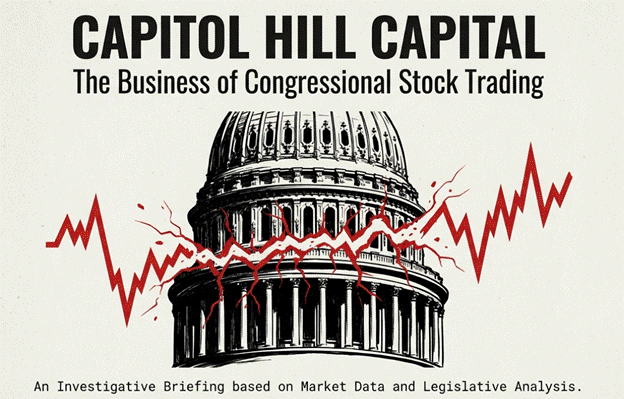
Capitol Hill Capital: The Business of Congressional Stock Trading
There is a running joke on Wall Street that the best-performing hedge fund in America is not located in Manhattan but is run by elected officials in Washington. Recent data suggests there is more than a little truth to this.
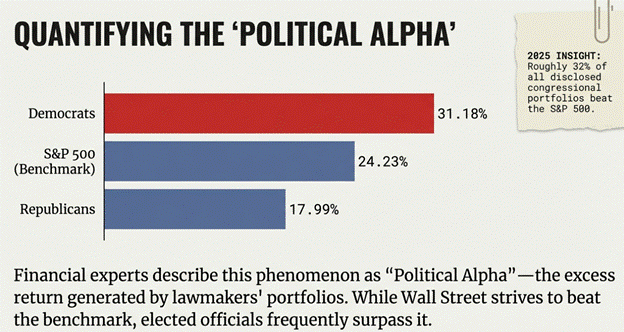
Lawmakers frequently outperform the broader market, tapping into what financial experts have dubbed the “political alpha”. In 2023, for example, Democratic members of Congress averaged a 31.18% return on their investments, while Republicans averaged 17.99%, compared to the S&P 500’s 24.23% return. In 2025, roughly 32% of all disclosed congressional portfolios managed to beat the S&P 500.
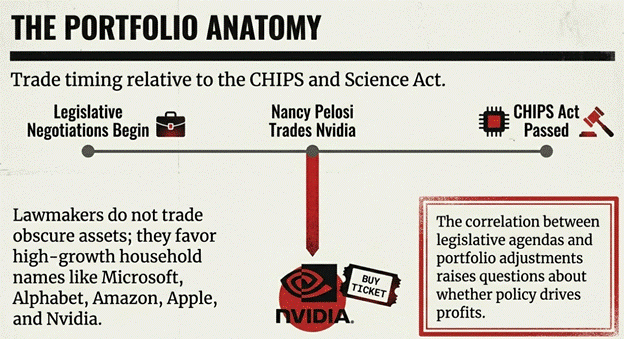
What exactly are they buying? Lawmakers heavily favor household names and high-growth technology stocks, frequently trading shares of Microsoft, Alphabet, Amazon, Apple, and Nvidia. Strikingly, many of these trades perfectly align with legislative action. During the negotiations for the CHIPS and Science Act, several members of Congress, including former House Speaker Nancy Pelosi, actively traded Nvidia, a major semiconductor company.
Are all lawmakers financial prodigies? The academic research is somewhat divided. While an early prominent study found that U.S. Senators beat the market by an astonishing 12% a year, other researchers argue that the average member of Congress actually underperforms passive index funds.
However, a recent National Bureau of Economic Research paper uncovered a massive caveat: congressional leaders, those with the most influence over the legislative agenda, see massive gains, outperforming their peers by up to 47 percentage points per year.
Furthermore, an opaque, multi-million-dollar political intelligence industry has emerged alongside them, where consultants gather non-public information from government sources to sell to hedge funds and institutional investors, proving that Washington’s inside knowledge is highly lucrative.
The Trust Deficit and the Limits of the STOCK Act
Lawmakers sit at the absolute center of information flows, gaining early access to non-public briefings on public health crises, upcoming tariff schedules, and major federal procurement contracts. To address ethical concerns, Congress passed the Stop Trading on Congressional Knowledge (STOCK) Act in 2012, which explicitly stated that members of Congress are not exempt from insider trading laws and mandated the public disclosure of stock trades over $1,000 within 45 days.

Yet, the STOCK Act has faced severe criticism for being largely toothless. The penalty for failing to disclose a trade on time is often a mere $200 fine, hardly a deterrent when millions of dollars are on the line. Moreover, transparency took a major hit in 2013 when Congress quietly passed an amendment, in just 14 seconds and without debate, that eliminated the online disclosure requirements for thousands of congressional staffers and executive branch employees, citing national security risks.
Enforcing insider trading laws against lawmakers is also notoriously difficult. The U.S. Constitution’s Speech or Debate Clause often shields legislators, preventing prosecutors from using information learned during official committee briefings as evidence in court.
The cracks in the system became glaringly obvious at the start of the COVID-19 pandemic. After attending closed-door briefings on the virus in early 2020, several senators, including Richard Burr, Kelly Loeffler, and James Inhofe, sold off millions of dollars in stocks just before the broader market crashed. More recently, in early 2025, over 50 members of Congress made thousands of trades involving companies directly impacted by new reciprocal tariff policy announcements.
This activity comes at a high cost to our democracy. A 2025 study from the UC San Diego Rady School of Management found that when the public learns about congressional stock trading, trust in Congress plummets. Strikingly, it doesn’t even matter if the lawmaker makes a profit; the mere perception that officials are attempting to use their power for personal financial gain severely undermines the institution’s legitimacy and reduces citizens’ willingness to comply with the law.
What’s Next? The Legislative Push for Reform
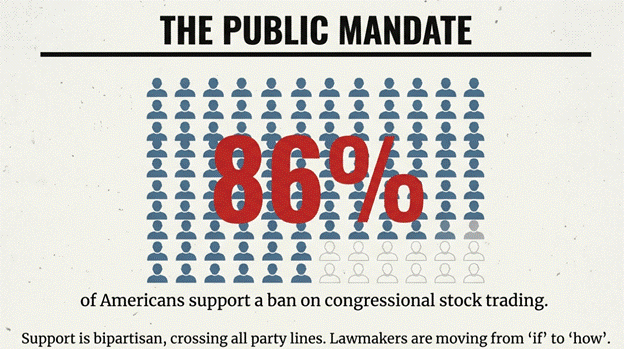
With a staggering 86% of Americans across party lines supporting a ban on congressional stock trading, lawmakers are finally feeling the pressure to act. Several bipartisan bills have recently been introduced to overhaul the current system.
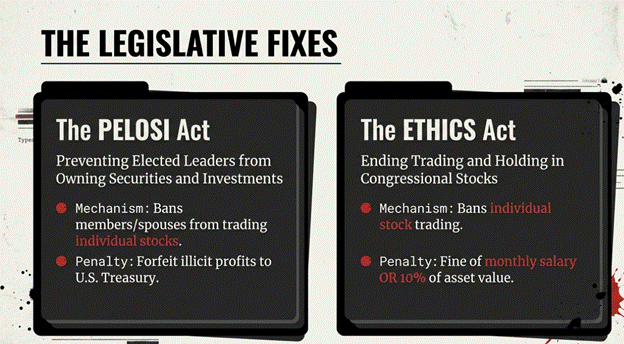
One prominent proposal is the Preventing Elected Leaders from Owning Securities and Investments (PELOSI) Act, which would ban members of Congress and their spouses from holding or trading individual stocks while in office, requiring them to forfeit any illicit profits to the U.S. Treasury. Another piece of legislation, the Ending Trading and Holding in Congressional Stocks (ETHICS) Act, would ban individual stock trading and impose significant fines—either a lawmaker’s monthly salary or 10% of the value of the assets—for failing to divest.
Many of these proposals suggest that lawmakers should be restricted to widely held investment funds (like mutual funds or ETFs) or be required to place their assets into a qualified blind trust.
A qualified blind trust transfers total control of assets to an independent trustee, theoretically shielding the lawmaker from knowing exactly what they own and eliminating conflicts of interest. However, critics argue that blind trusts are expensive to set up and don’t solve the problem entirely, as the lawmaker still knows which original assets they placed into the trust initially. Other proposed solutions include pre-approval requirements for all trades or mandating immediate, 24-hour disclosure of transactions.
The Bottom Line
While the financial success of our elected officials might make for eye-catching headlines, it raises profound ethical questions about information asymmetry and the true purpose of public service. Banning individual stock trades for lawmakers could be a crucial step in rebuilding public confidence. Until meaningful reform passes, everyday investors and financial startups are increasingly turning to apps designed to simply copy the trades of Capitol Hill’s biggest players, adopting an “if you can’t beat them, join them” approach to the market.

Spencer Wright is the Executive Vice President of Halbert Wealth Management, Inc. and the author of Forecasts & Trends. He has been with HWM for over 25 years.