
This week’s highlights…
- We explore the “diversification illusion” inside passive index funds,
- Examine the mechanical feedback loop driving extreme market concentration, and
- Discuss how incorporating non-correlated alternative strategies can help you manage risk and smooth out volatility.
Passive investing is widely considered the ultimate low-cost way to diversify. By placing capital into index funds or ETFs like the Vanguard S&P 500 ETF (VOO), SPDR S&P 500 ETF Trust (SPY), or Invesco QQQ Trust (QQQ), you might assume your money is spread safely across hundreds of companies.
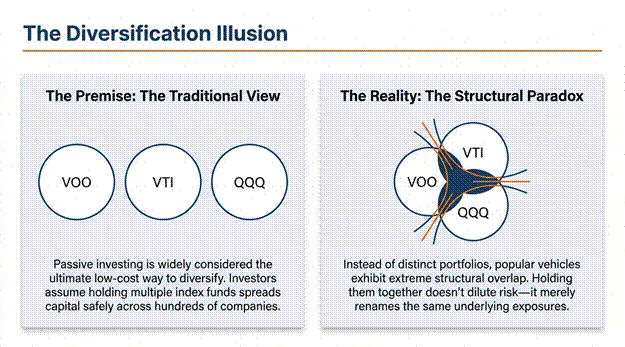
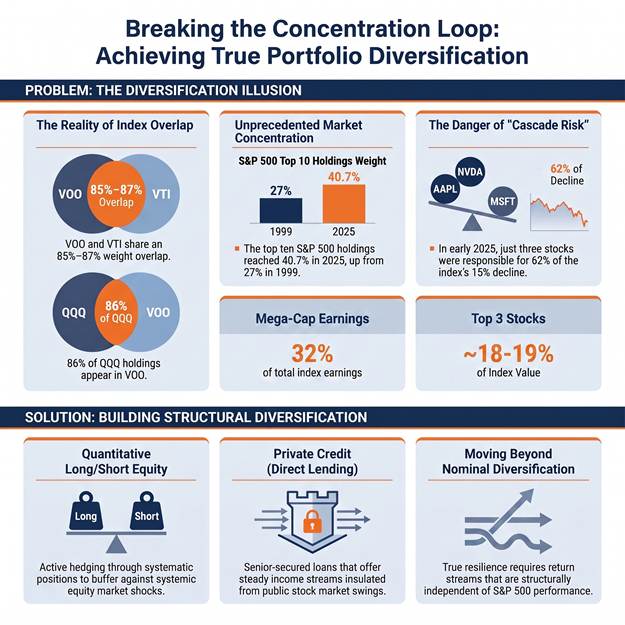
But look under the hood, and a surprising paradox emerges. Instead of holding distinct portfolios, these popular vehicles exhibit extreme structural overlap. VOO and VTI (Total Stock Market) share a massive 85% to 87% overlap by weight. Furthermore, approximately 86% of QQQ’s total holdings also appear in VOO.
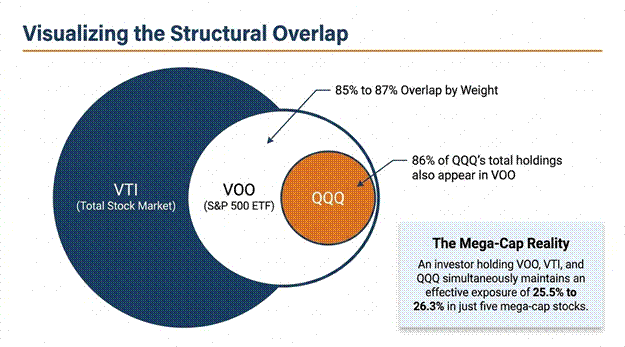
Across typical allocations, an investor holding VOO, VTI, and QQQ simultaneously maintains an effective exposure of 25.5% to 26.3% in just five mega-cap stocks. Holding them together doesn’t dilute your risk, it merely renames the same underlying exposures.
Inside the Passive Feedback Loop
This concentration is driven by a mechanical feedback loop inherent to market-capitalization weighting. When massive waves of capital flow into passive funds, index managers are mechanically forced to purchase more shares of the largest underlying companies.
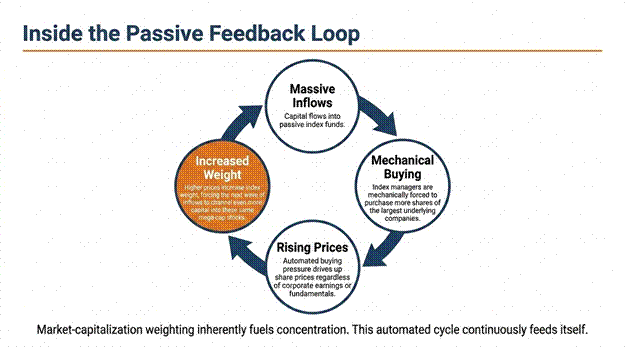
This automated buying pressure drives up share prices for the largest companies, regardless of corporate earnings or fundamentals. As their prices rise, their weights in the index increase, forcing the next wave of inflows to channel an even larger percentage of capital into these same mega-cap stocks.
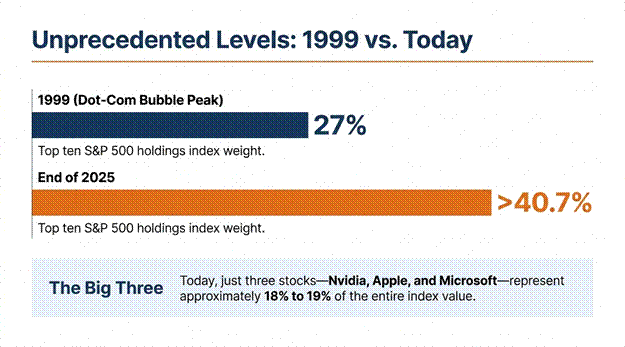
While market concentration moves in waves, Current market concentration is significantly higher than historical averages. During the peak of the dot-com bubble in 1999, the S&P 500’s top ten holdings accounted for about 27% of the index’s weight. By the end of 2025, that skyrocketed to over 40.7%.
Today, just three stocks, Nvidia, Apple, and Microsoft, represent approximately 18% to 19% of the entire index value. Strikingly, while the top ten stocks held nearly 41% of the index weight at the end of 2025, they were expected to generate only about 32% of its total earnings.
The Danger of a “Cascade Risk”
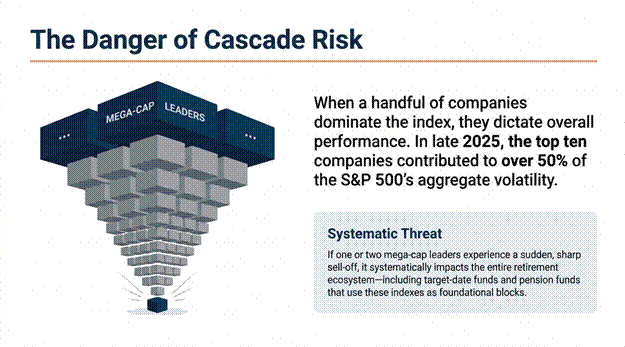
Why does this top-heavy concentration matter? Because it introduces a serious systematic threat called “cascade risk”.
When a handful of companies dominate the index, they dictate overall performance. In late 2025, the top ten companies contributed to over 50% of the S&P 500’s aggregate volatility. If one or two mega-cap leaders experience a sudden, sharp sell-off, it systematically impacts the entire retirement ecosystem—including target-date funds and pension funds that use these indexes as foundational building blocks.
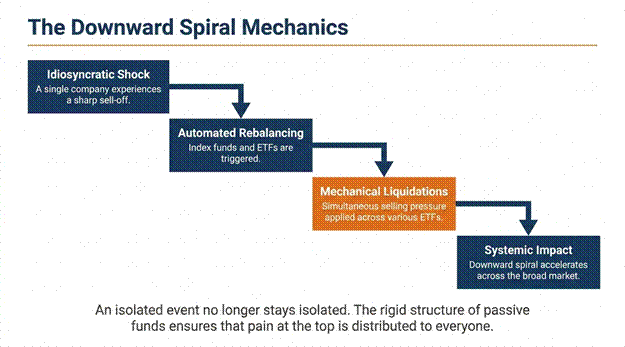
We saw this in action in early 2025, when the S&P 500 corrected by nearly 15%. Just three companies, Apple, Nvidia, and Tesla, were responsible for 62% of that total decline. An idiosyncratic shock to a single company can trigger mechanical liquidations and automated rebalancings across various ETFs simultaneously, potentially accelerating a downward spiral.
True Diversification: Looking Beyond the Index
At Halbert Wealth Management, we believe that achieving genuine peace of mind and long-term portfolio resilience requires moving from nominal diversification to structural diversification. True diversification cannot be achieved simply by holding multiple funds that contain the same underlying mega-cap stocks.
Instead, a robust investment strategy should include return streams that are structurally independent of S&P 500 performance. By incorporating non-traditional, non-correlated assets, we seek to help clients manage risk, smooth out volatility, and build portfolios designed to perform across all macroeconomic environments, reflecting our absolute-return, risk-aware philosophy.
What You’re Missing: Spotlight on Alternative Equity & Credit
While passive index funds leave you heavily exposed to market-wide sell-offs, sophisticated alternative strategies can help cushion your equity portfolio and provide uncorrelated income.
Quantitative Long/Short Equity Strategies
Instead of buying and holding a market index, quantitative long/short strategies aim to isolate active relative outperformance (alpha) from broad market-direction beta. They do this by utilizing systematic long and short positions across broad market indexes rather than picking individual companies.
In a traditional portfolio, investors must accept the full ups and downs of the stock market. Quantitative long/short equity broadens this playing field. By taking defensive, market-neutral, or inverse positions on indices, these managers seek to limit the impact of broad market swings while potentially turning volatility into uncorrelated performance. However, losses are still possible.
Private Credit
Private credit involves non-syndicated, senior-secured loans directly originated by institutional lenders to corporate borrowers.
Because these credit structures are negotiated directly in the private market rather than being traded on public exchanges, they offer a highly reliable, steady income stream that is physically insulated from the day-to-day emotional swings of the stock market. Since these loans are typically secured by the borrower’s actual corporate assets and structured as senior debt, they represent a resilient way to capture yields without depending on equity valuations or broad public credit market sentiments.
Note: All investments involve risk, and past performance is no guarantee of future results. Quantitative long/short equity strategies are subject to manager risk, and can experience drawdowns during sudden sector-wide deleveraging. Private credit carries unique risks, including illiquidity and default risks, particularly during severe credit crises.
| Ready to learn more? We have put together a detailed, client-centric: “Alternative Assets Explainer” This guide breaks down the alternative asset landscape and explains these institutional style strategies. Request your complimentary copy today. You can also schedule a brief, no-obligation consultation to review your current portfolio diversification strategy. |
Infographic Summary

Spencer Wright is the Executive Vice President of Halbert Wealth Management, Inc. and the author of Forecasts & Trends. He has been with HWM for over 25 years.