This week’s highlights…
- Manage risk: Strategies are designed to mitigate downside risk, especially during severe market corrections or “tail events,” which is crucial for investors facing “sequence of returns risk.”
- Generate alternative income: Options-based tools can create systemic income, for instance, by harvesting the Volatility Risk Premium (VRP) through strategies like covered calls.
- Smooth out the investment journey: By mitigating downside and providing systemic income, these tools are intended to provide a smoother ride over the full market cycle.
Rethinking Risk in a Volatile World
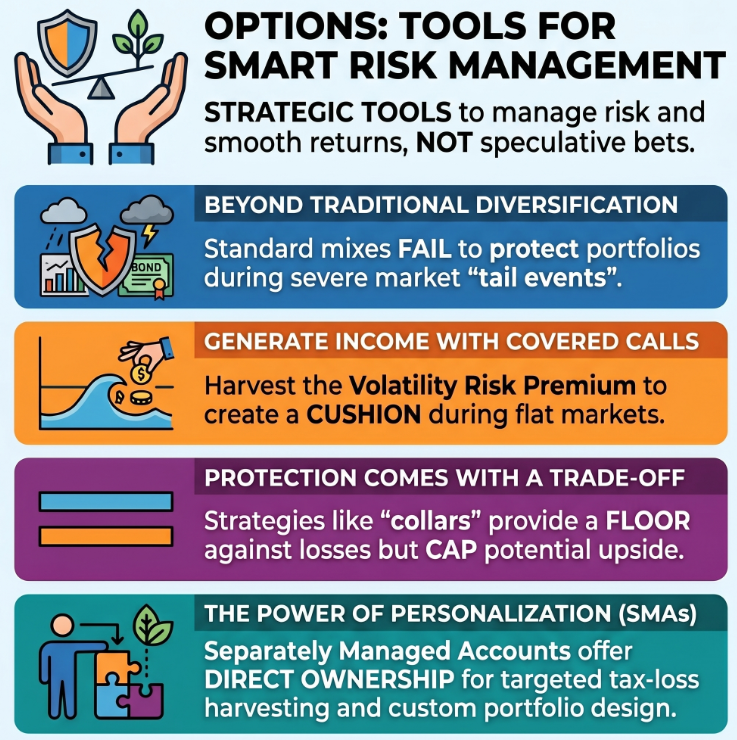
Standard diversification across stocks and bonds is a great starting point, but it may not always protect your portfolio during severe market corrections. Market crashes, often referred to as tail events, can lead to significant wealth destruction and disrupt long-term financial plans.
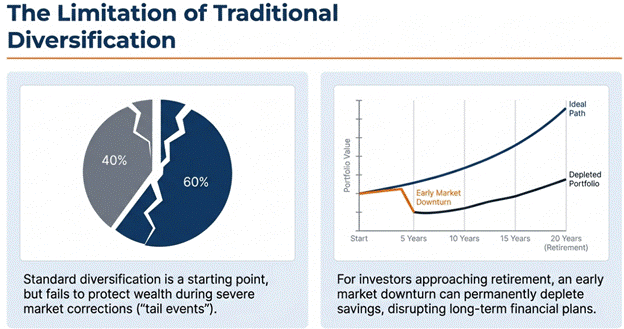
This is especially true for investors approaching retirement, who face “sequence of returns risk”, the danger that a market downturn early in retirement could prematurely deplete their savings.
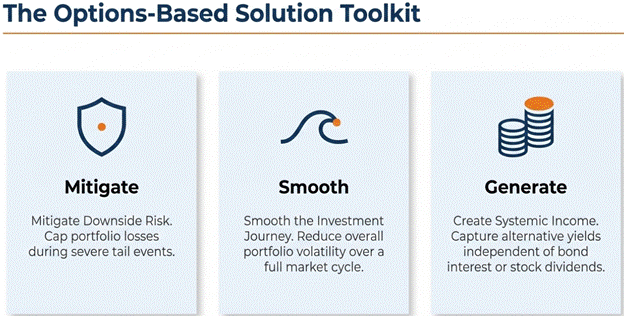
To manage these complex challenges, many institutional investors turn to options-based alternative strategies. These tools are designed to mitigate downside risk, create systemic income, and provide a smoother ride over the full market cycle.
The Give and Take of Options Strategies
One common approach to navigating choppy markets is the use of covered calls, also known as “buy-write” strategies. This involves holding a basket of underlying stocks and selling call options against them, allowing the investor to capture the option premium as a form of income. The core economic driver here is the Volatility Risk Premium (VRP), the historical anomaly where the implied volatility priced into options is often higher than the actual volatility realized by the market.
By harvesting this premium, investors can build a cushion that helps offset losses during flat or moderately declining markets. However, options strategies always involve a trade-off: in exchange for the premium received today, you give up a portion of your potential upside if the market experiences a massive rally.
Collars and Buffered Protection
For those seeking to strictly limit their downside risk, “collar” strategies are frequently utilized. A collar involves purchasing a put option (which acts as a floor against losses) and financing that purchase by selling a call option (which caps the upside). While these are sometimes marketed as “zero-cost” hedges because the initial cash outlay might be minimal, they are not truly free.
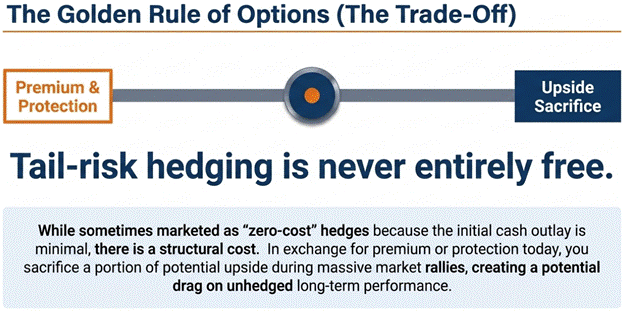
The cost comes in the form of capped growth and a potential drag on long-term performance, making it essential to understand the strategy’s true impact on your portfolio.
Similarly, “buffer” ETFs have grown in popularity. These funds use a combination of options to shield investors from a predetermined level of market losses, such as the first 15% of a decline, over a specific period. To pay for this cushion, the fund caps your maximum gains. Buffer strategies can be an excellent behavioral tool to help skittish investors stay invested during turbulent times. Yet, investors must remember that tail-risk hedging is never entirely free; protecting your downside almost always requires sacrificing some upside potential.
The Right Wrapper Matters
How you hold your investments can be just as important as the strategies themselves. While mutual funds and ETFs are highly popular, Separately Managed Accounts (SMAs) are increasingly becoming the vehicle of choice for affluent investors. Unlike a mutual fund where assets are pooled, an SMA gives you direct ownership of the underlying individual securities. This direct ownership unlocks highly personalized tax management capabilities.
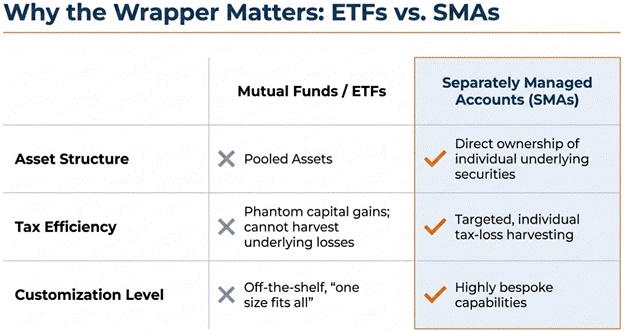
For instance, SMAs allow for targeted tax-loss harvesting, which involves selling specific underperforming stocks to offset capital gains realized elsewhere in your portfolio. Furthermore, SMAs offer the flexibility to customize your holdings, allowing you to exclude specific companies or sectors that conflict with your personal values or to avoid adding to an already concentrated stock position.
What You’re Missing
While off-the-shelf ETFs and mutual funds offer basic access to options strategies, they often lack the precise personalization that high-net-worth investors require. At Halbert Wealth Management, we specialize in non-traditional strategies and bespoke solutions designed specifically for your unique financial landscape.
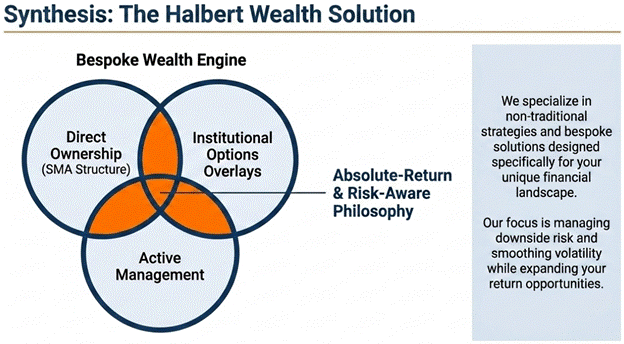
Through customized Separately Managed Accounts (SMAs) and institutional-style options overlays, we can design tailored portfolios that actively address your specific tax situations and risk tolerances. Our focus is always on your individual needs. Our absolute-return, risk-aware philosophy emphasizes managing downside risk and smoothing volatility while expanding your return opportunities. Please keep in mind that all investments involve risk, and returns are never guaranteed.
| At Halbert Wealth Management, we specialize in non-traditional strategies designed specifically for your unique financial landscape. Explore our options strategies. |
Infographic Summary

Spencer Wright is the Executive Vice President of Halbert Wealth Management, Inc. and the author of Forecasts & Trends. He has been with HWM for over 25 years.