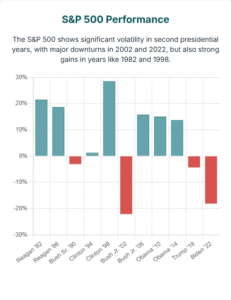
This week’s highlights…
- Explore the hidden mathematics of market volatility.
- How our own minds can work against us when the waters get choppy.
- Practical strategies to keep your long-term financial goals on course.
- At Halbert Wealth Management, our absolute-return, risk-aware philosophy is built on the understanding that simply riding out the market’s wild swings isn’t always the best approach.
The Hidden Cost of the Roller Coaster
We often hear that investors should just hang in there during market downturns because stocks eventually recover. But the mathematical reality of compounding tells a very different story.
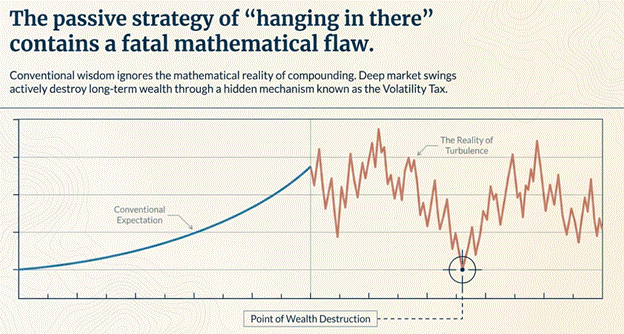
There is a phenomenon known as “variance drag” or the “volatility tax”. Simply put, steep portfolio losses crush your long-term compound growth. When your portfolio drops, it takes a significantly larger percentage gain just to get back to where you started. For example, if a $1,000 investment falls by 50%, it requires a 100% rebound to break even. However, if that same investment only falls by 30%, it just needs a 43% climb to reach its original value.
Because of this math, two portfolios with the exact same average annual returns can have vastly different ending balances if one is more volatile than the other. Limiting large losses isn’t just about sleeping better at night; it’s a mathematical necessity for building long-term wealth and maximizing the power of compounding.
Don’t Let Your Brain Hijack Your Portfolio
Turbulent markets don’t just test our portfolios; they test our psychology. Behavioral biases often prompt us to make irrational decisions exactly when we need to stay disciplined.
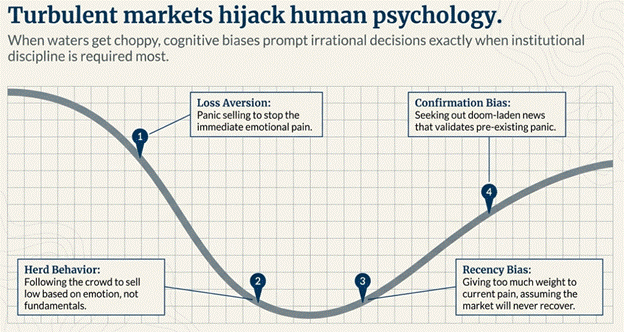
One of the most powerful biases is loss aversion—the psychological reality that we feel the pain of a financial loss about twice as intensely as we feel the pleasure of a comparable gain. This can cause investors to panic-sell at the worst possible time to stop the pain, or stubbornly hold onto a losing investment to avoid admitting a mistake.
Combine this with herd behavior—following the crowd during periods of uncertainty—and you have a recipe for buying high and selling low based on emotion rather than fundamentals. Investors must also guard against recency bias, where we give too much weight to recent events, and confirmation bias, where we only seek out information that validates our pre-existing views.
Smart Moves for Choppy Waters
So, how can you effectively navigate volatility without relying on sheer willpower?
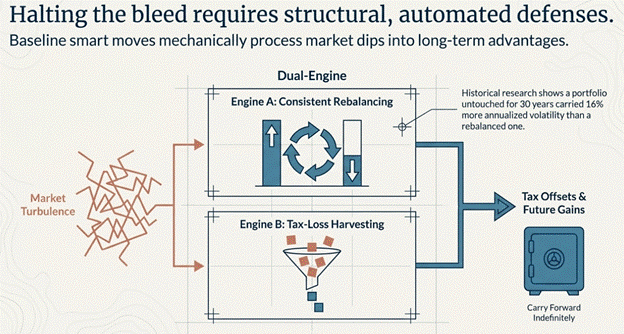
- Consistent Rebalancing: Rebalancing involves periodically shifting your investments back to their target mix. By systematically selling what has gone up and buying what has gone down, a consistently rebalanced portfolio keeps risk in check. In fact, historical research shows that a portfolio left untouched over 30 years carried 16% more annualized volatility than one that was systematically rebalanced.
- Tax-Loss Harvesting: Volatility isn’t all bad. Market dips create opportunities to sell positions at a loss, which can then be used to offset taxable gains elsewhere in your portfolio. This strategy can transform unwelcome market turbulence into welcome tax benefits, and remaining losses can even be carried forward indefinitely to offset future gains.
What You’re Missing (A Contrasting Color) (Will be a recurring feature going forward.)
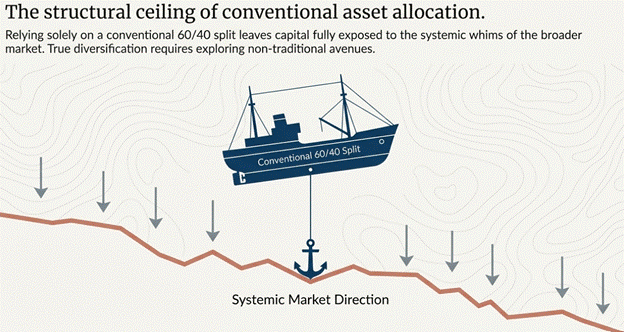
While traditional stock and bond portfolios have their place, relying solely on a conventional 60/40 split can leave you fully exposed to the whims of the broader market. At Halbert Wealth Management, we believe that true diversification requires exploring non-traditional avenues.
This week, we are spotlighting Quantitative-Driven Leveraged Long/Short Strategies.
Traditional investment strategies generally only generate returns when markets go up. A quantitative long/short approach, however, relies on advanced algorithmic models and rigorous data analysis to identify both overvalued and undervalued assets. By taking “long” positions in markets expected to rise and “short” positions in those expected to fall, these strategies aim to generate absolute returns regardless of the overall market direction.
In these institutional-style strategies, leverage is often deployed to amplify potential returns or to balance out risk exposures across different asset classes. When incorporated into a diversified portfolio, these non-correlated investments are designed to smooth out overall volatility and actively manage risk during severe market drawdowns. While complex, these tools reflect our philosophy of utilizing sophisticated, bespoke solutions to seek out opportunity and preserve capital.
Until next time, stay informed.

Spencer Wright is the Executive Vice President of Halbert Wealth Management, Inc. and the author of Forecasts & Trends. He has been with HWM for over 25 years.