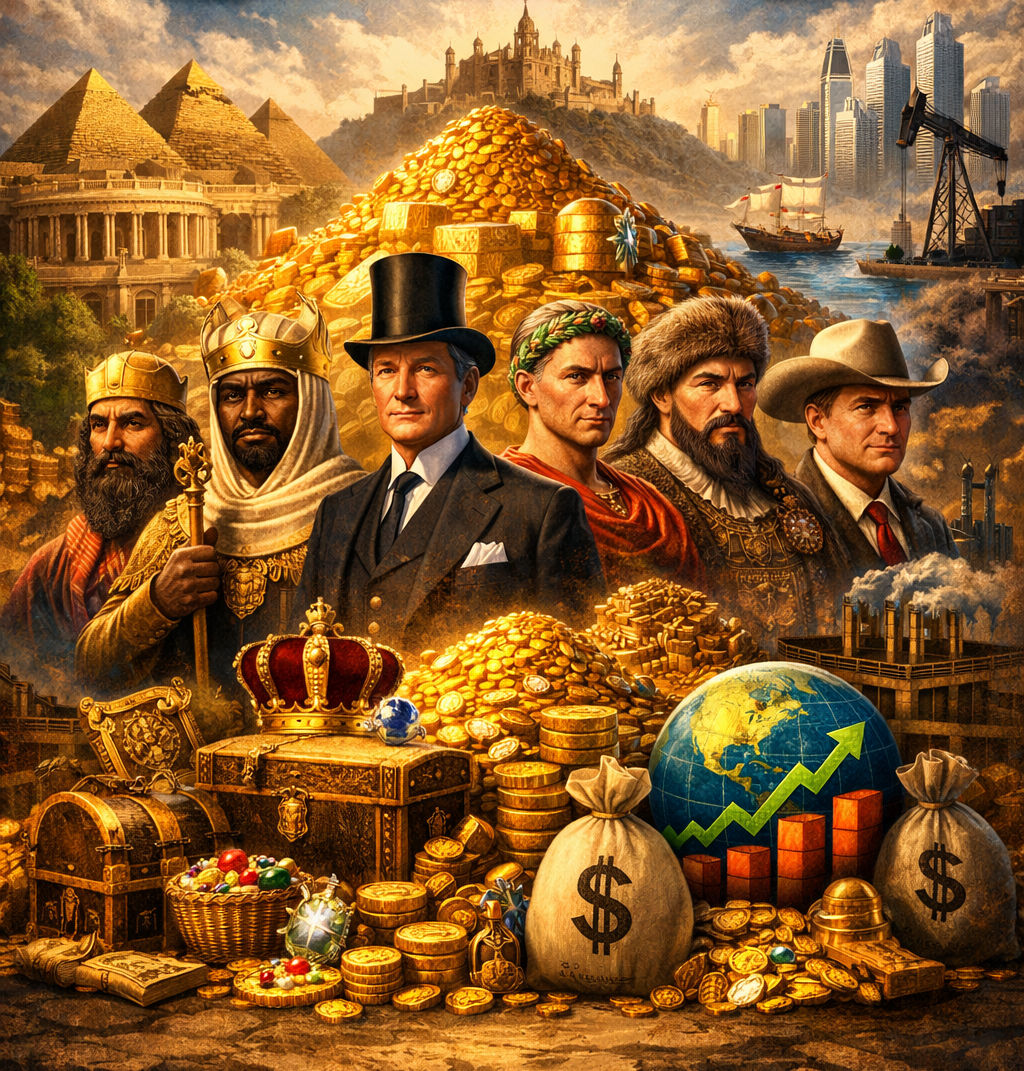
This ranking of history’s ten wealthiest figures uses “Economic Power”— peak fortune as a percentage of contemporary global or regional GDP—for comparison, avoiding simple inflation adjustments. This method compares historical rulers and modern magnates, showing that the unparalleled economic dominance of past monarchs, whose wealth often equated to state treasuries, remains unmatched today.
While contemporary billionaires possess staggering nominal wealth, their share of the total economy pales in comparison to their historical counterparts.
The Proprietor of the Western World
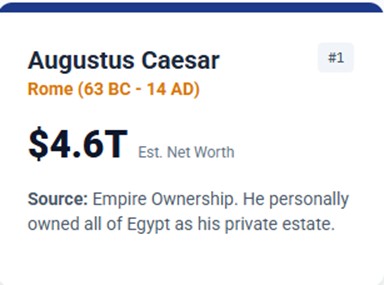
Augustus Caesar’s wealth was a fusion of political and economic power, derived from his position as the first Roman Emperor. He blurred the lines between the state treasury and his personal funds, making him the effective proprietor of the Western world’s economy. The cornerstone of his fortune was the personal acquisition of Egypt, the “breadbasket of the Mediterranean,” which he treated as a private estate rather than a standard province. Its vast grain and tax revenues flowed directly into his personal treasury.
The Master of the Song Bureaucracy
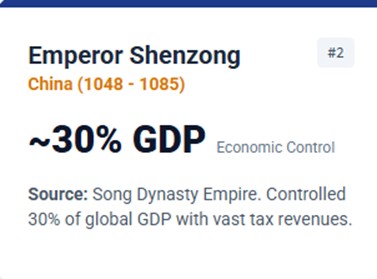
Emperor Shenzong of China’s Song Dynasty commanded an immense wealth derived not from personal resource ownership but from a sophisticated system of state capitalism and bureaucratic control. Historically, the economy he oversaw is considered the most advanced of the pre-industrial era. His chancellor, Wang Anshi, implemented the “New Policies” (Xinfa), which were the mechanism through which this economic power was realized. This system included highly lucrative state monopolies on essential commodities such as salt, tea, and wine. Furthermore, the state acted as a massive national creditor; for example, the “Green Sprouts Program” extended loans to farmers at interest, directly funneling the resulting profits into the imperial treasury.
The Mughal Industrialist
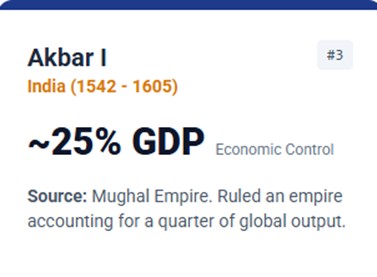
Akbar the Great established the Mughal Empire as a dominant global economic force. The foundation of his wealth was the effective collection of revenue from a vast populace and a powerful manufacturing sector. This wealth was amassed through the highly efficient Mansabdari system, an unparalleled structure for extracting surplus value. Under this system, appointed officials were responsible for collecting revenue from designated lands, with any surplus channeled to the central treasury. Remarkably, the Mughal state’s net revenue during Akbar’s reign surpassed the entire treasury of Great Britain two hundred years later.
The Conqueror of Horizons
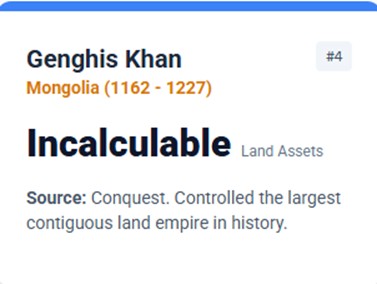
Genghis Khan’s immense economic power stemmed from absolute control over resources, rather than personal net worth, as he lived an austere life. While he did not hoard wealth or construct palaces—reflecting the Mongol philosophy of redistribution over accumulation—he technically “owned” all resources within the largest contiguous land empire in history. His genuine economic influence lay in his command over trade. By establishing the Pax Mongolica, he unified the Silk Road and thereby controlled the tribute and tariffs generated by the largest volume of pre-modern global commerce. Loot was shared among his troops, a key strategy for maintaining their loyalty.
The Apex of Absolute Value
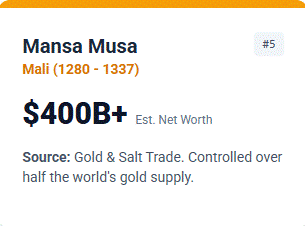
Mansa Musa I, ruler of the Mali Empire, is historically recognized as one of the wealthiest individuals. His immense economic power stemmed from a sovereign monopoly over West Africa’s vast gold and salt production, which was crucial when gold was the global standard of value. By controlling all gold production, he governed the supply of bullion to the Islamic and Mediterranean worlds. His wealth was demonstrated during his 1324 Hajj to Mecca, an unprecedented display involving a 60,000-person entourage and 80 camels, each carrying up to 300 pounds of gold dust.
The Architect of Monopoly
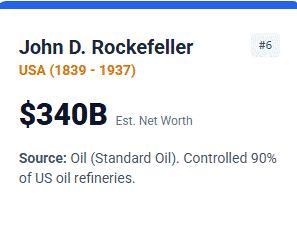
John D. Rockefeller, arguably the richest American in history, dominated the 1880s energy sector. His company, Standard Oil, achieved a near-total monopoly, controlling 90% of U.S. oil refining and providing the world’s primary light source (kerosene). He pioneered vertical integration, securing a cost advantage through control of all production phases and secret railroad rebates. His immense power spurred the Sherman Antitrust Act. Ironically, the 1911 dissolution of Standard Oil into 34 “Baby Standards” ultimately boosted his wealth as the new entities surged with the automobile industry’s rise. Beyond business, Rockefeller is credited with inventing modern institutional philanthropy, significantly impacting medicine, education, and public health.
The Man of Steel
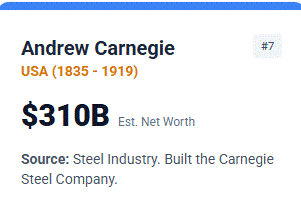
Andrew Carnegie, an immigrant who emerged from poverty, came to dominate the steel industry. His success was fueled by adopting cutting-edge technology and seizing the opportunity presented by America’s post-Civil War infrastructure boom. By implementing the Bessemer process, he enabled the mass production of cheap, high-quality steel—the essential material for modern industry, used to build skyscrapers, bridges, and railroads. The scale of his fortune is best illustrated by a single event: the 1901 sale of Carnegie Steel to J.P. Morgan. The sale price was $480 million, with Carnegie receiving $225 million in liquid 5% gold bonds—a sum equivalent to half of the entire U.S. federal budget at the time.
The Last Grand Mogul
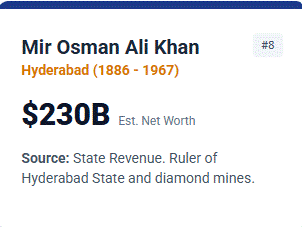
Osman Ali Khan, the Nizam of Hyderabad, was the last major figure whose vast wealth stemmed from a feudal hoard of metals and gems, not modern capital. As ruler of British India’s largest princely state, he controlled its economy and the famed Golconda diamond mines. In 1937, Time named him the world’s richest man, with an estimated $2 billion fortune—2% of U.S. GDP. This semi-feudal wealth included an alleged £100 million in gold and £400 million in jewels. Extravagantly, he once used the 185-carat Jacob Diamond as a paperweight.
The Banker of Kings
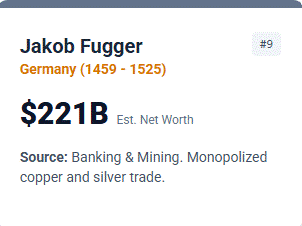
Jakob Fugger expanded his single family bank into a massive trans-European banking and mining conglomerate, essentially inventing modern capitalist strategies that linked financial resources to political control. Fugger’s model involved loaning vast sums to monarchs, securing vital copper mining rights as collateral. This allowed him to corner the European copper trade, essential for currency and military production. His most significant political act was financing the 1519 election of Holy Roman Emperor Charles V, personally supplying 543,000 of the 850,000 florins required for bribes to consolidate the Habsburg Empire.
The Feudal Landlord
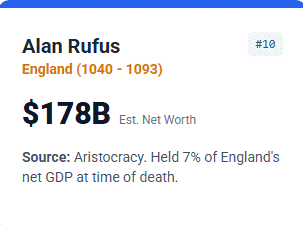
Alan Rufus, a companion of William the Conqueror, acquired immense wealth—7% of England’s total national income—through the violent seizure of land following the 1066 Norman Conquest. Rewarded with 250,000 acres, the 1086 Domesday Book confirmed him as the most significant landholder after the King. In that agrarian era, land was the principal capital asset, giving him economic power impossible to replicate today.
The Bottom Line
For a contemporary figure to match the 2% of US GDP controlled by Rockefeller, they would require a net worth of 500−600 billion. To equal the 20-30% of total economic output controlled by figures like Augustus Caesar or Emperor Shenzong, an individual would need a fortune measured in the tens of trillions of dollars, an inconceivable concentration of power in the modern global economy.
AI Wealth!


Spencer Wright is the Executive Vice President of Halbert Wealth Management, Inc. and the author of Forecasts & Trends. He has been with HWM for over 25 years.