
After a year defined by historic policy shifts, the economy achieved a “soft landing,” albeit a turbulent one.
The Hard Soft Landing Explained
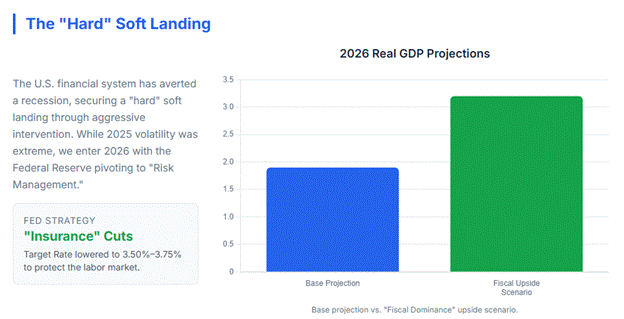
The U.S. financial system ends 2025 at a major inflection point, having successfully navigated extreme volatility to secure a “hard” soft landing. A full-scale recession was averted, but this stability was reached through aggressive government intervention rather than organic market self-correction.
While Real Gross Domestic Product (GDP) is projected to settle near 1.9% growth for the year, this figure masks significant underlying drama. Key events included the “Liberation Day” tariffs in April, the comprehensive “One Big Beautiful Bill” (OBBB) fiscal overhaul, and even a historic government shutdown. For investors, 2025 saw the “Magnificent Seven” tech giants pivot toward heavy industrial execution, and a sharp polarization in the commodity markets.
The Federal Reserve’s Pivot to Insurance
The Federal Reserve has made a major shift from its previous focus on inflation-fighting toward a new goal of “Risk Management,” primarily centered on protecting the labor market and preventing unemployment from rising.
On December 10, the FOMC enacted an “insurance” rate cut, lowering the target range by 25 basis points to 3.50%–3.75%. The 9-3 vote—with some members favoring a deeper cut due to cracks in the job market—indicates the Fed is proactively cutting rates to guard against future downturns, rather than merely reacting to an existing crisis. This move is contributing to the normalization of the yield curve, though persistent government deficits continue to anchor long-term rates.
The Era of Fiscal Dominance: The OBBB Act
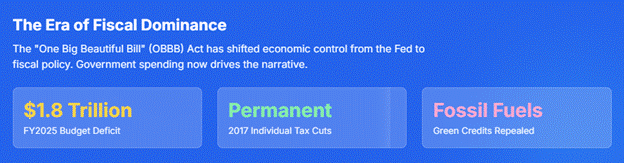
The landmark “One Big Beautiful Bill” (OBBB) Act, signed into law on July 4, 2025, has ushered in an era of “Fiscal Dominance.” In this environment, government spending and tax policy exert a greater influence on the economy than the Federal Reserve’s interest rate adjustments.
The OBBB Act significantly impacted the fiscal landscape by making the 2017 individual tax cuts permanent and providing new relief by eliminating federal taxes on tips and overtime. While these measures supported consumer spending, they also ensured the budget deficit remained high, confirmed at a significant $1.8 trillion for the 2025 fiscal year. Furthermore, the Act repealed green energy credits in favor of fossil fuel leasing, effectively building a moat around traditional energy companies. Due to the high level of government borrowing required to fund these deficits, sustained upward pressure on long-term interest rates is anticipated.
The impact of sweeping deregulation is starting to be felt. Some economists and Secretary Bessent are calling for growth in excess of 3%. Some Wall Street strategists and bank economists (for example, in upside scenarios at Morgan Stanley and others) describe conditions under which real US GDP could exceed 3% in 2026, generally hinging on stronger‑than‑expected demand, rapid AI‑driven productivity gains, and supportive fiscal and monetary policy.
The Shift from AI Hype to Power
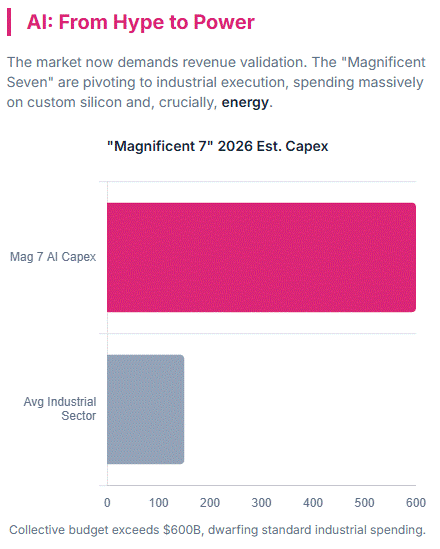
Following the initial AI hype of 2024, 2025 marked the Validation Phase. The market is no longer swayed by mere mention of “AI” in corporate presentations; instead, investors are actively penalizing companies that fail to demonstrate tangible revenue generated by these technologies.
This critical shift is evident in the investment strategies of the “Magnificent Seven” tech giants. With a staggering collective budget for 2026 exceeding $600 billion, their spending priorities have changed. The focus has moved beyond simple chip acquisition to encompass the development of custom silicon and, more significantly, the securing of reliable power generation.
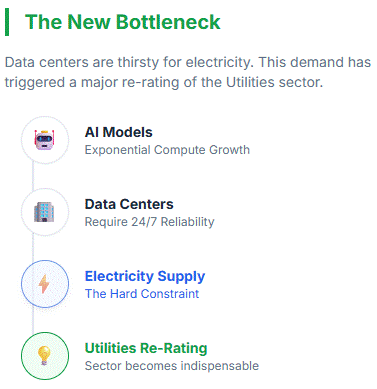
The immense energy demands of AI data centers have created a new bottleneck: electricity. Consequently, this has driven a major re-rating of the Utilities sector, which is now considered an indispensable partner in the ongoing AI revolution.
The Great Commodity Split: Winners and Losers
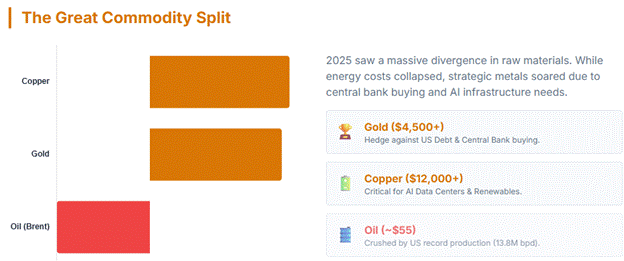
The commodity market is currently undergoing a significant “bifurcation”—or a split into two distinct trends.
The Winners: Gold and Copper
- Gold has seen prices soar past $4,500 per ounce. This surge is notable given the high interest rate environment. Central banks, particularly in China and India, are driving this demand as they purchase gold to diversify away from U.S. Treasuries, using it as a hedge against government debt risks.
- Copper has broken the $12,000 per ton mark. This rise is fueled by massive physical demand stemming from the construction of AI data centers and renewable energy projects.
The Loser: Oil
- Brent crude oil has experienced a collapse, with average prices projected to be around $55 per barrel in early 2026. This is primarily due to U.S. oil production hitting a record 13.8 million barrels per day, which has saturated global demand. While this is detrimental to oil companies, it provides a beneficial deflationary impulse by lowering energy costs for consumers.
Housing, Tariffs, and Digital Assets
The housing market presents a sharply contrasting picture. Although a slight drop in mortgage rates, to approximately 6.18%, has helped facilitate some inventory movement, a significant divide persists. On one side are equity-rich older buyers, who were involved in roughly 33% of all-cash transactions. On the other are younger buyers, who continue to face substantial affordability challenges.
Meanwhile, the “Liberation Day” tariffs, enacted on April 2, have introduced distortions into corporate inventory management, despite the initial stock market selloff they triggered. Many businesses preemptively increased their stockpiles of goods toward the end of 2025 to mitigate the impact of future tariff costs. This pull-forward of demand is likely to create an air pocket, a period of slowed industrial activity, in early 2026 as companies work through their excess inventory.
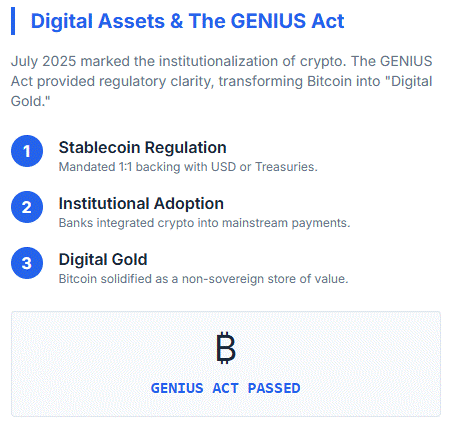
2025 marked a significant turning point for digital assets, solidifying their institutional acceptance. A major catalyst was the passage of the GENIUS Act in July, which established a clear federal structure for stablecoins. By mandating a 1:1 backing with actual dollars or US Treasuries, the government effectively integrated these assets into the mainstream payment system. This newfound regulatory certainty fueled massive institutional uptake, transforming Bitcoin’s perception from a speculative tech asset to “digital gold.”
The Bottom Line
In 2026, investors face a complex, high-pressure market defined by three key shifts:
- Correlation Breakdown: Traditional stock/bond diversification is challenged by $1.8 trillion fiscal deficits, making both vulnerable to inflation.
- Intense Capital Competition: A $600 billion AI capex cycle and massive federal borrowing are “crowding out” capital. This favors cash-rich mega-caps and punishes smaller, debt-reliant companies.
- Strategic Positioning: The “Soft Landing” is secured, but cheap money is over.
AI Peering into 2026


Spencer Wright is the Executive Vice President of Halbert Wealth Management, Inc. and the author of Forecasts & Trends. He has been with HWM for over 25 years.