

AI is revolutionizing upstream oil and gas by overcoming traditional hurdles like high capital expenditure, geological uncertainty, and long project timelines. Through machine learning, deep learning, and generative AI, operators are moving from probabilistic assessments to data-driven optimization.
Subsurface Intelligence and Automated Discovery
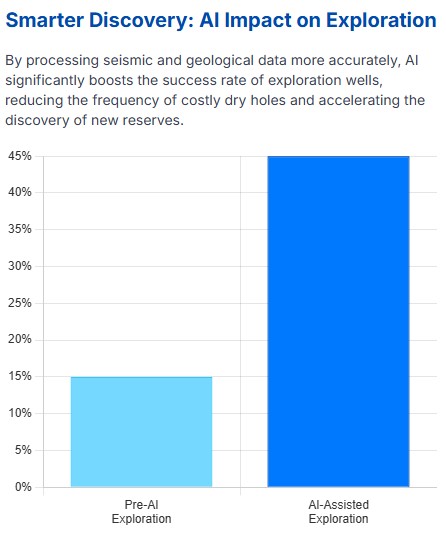
AI is transforming the costly and time-consuming process of interpreting subsurface geology, which is crucial for exploration success.
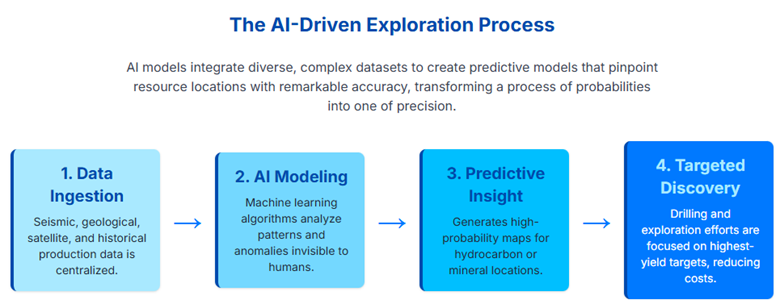
- De-risking Exploration: Machine learning and deep learning analyze vast amounts of seismic, geological, and geospatial data to identify subtle subsurface structures and hydrocarbon probabilities that human analysts might miss, thereby reducing exploration risks.
- Accelerating Analysis: Major operators are seeing significant efficiency gains. Shell, for example, has improved drilling success rates by 30% and processes geological data 50% faster. ADNOC’s ENERGY AI agents have cut the time needed to build geological models by 75%, and ExxonMobil has saved 40% on data preparation costs alone.
- Generative AI in Frontier Basins: Generative AI is a major breakthrough, capable of creating synthetic seismic surveys and high-resolution subsurface models even from limited data. This is a game-changer for de-risking investments in frontier basins where data acquisition is prohibitively expensive, effectively turning AI into a strategic enabler for new exploration territories, not just an optimization tool.
Advanced Reservoir Applications
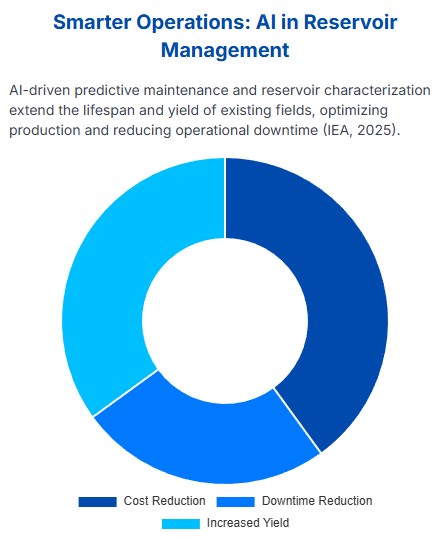
Once a discovery is made, AI significantly enhances reservoir management through advanced characterization and dynamic “digital twins”—real-time virtual replicas of fields.
- Simulation and Optimization: Engineers leverage digital twins to conduct numerous “what-if” scenarios. This allows them to optimize drainage plans, test enhanced oil recovery (EOR) methods, and refine production strategies without incurring physical costs or operational disruptions.
- High-Fidelity Modeling: Sophisticated AI models, such as Self-Attention Convolutional Neural Networks (SACNN) and Spatiotemporal Networks (STNet), analyze well-logging data to achieve new levels of precision.
AI is revolutionizing drilling by transforming it from a manual craft into a data-driven science, enabling both real-time optimization and proactive hazard mitigation.
- Real-Time Optimization: AI algorithms analyze live sensor data from the drill bit to make immediate adjustments to parameters such as the rate of penetration (ROP) and directional steering. This ensures the drill remains in the most productive geological zones, “sweet spots”, for longer improving recovery rates.
- Predictive Hazard Mitigation: By analyzing historical data from thousands of wells, AI models can identify patterns that precede costly issues like stuck pipes or equipment failures. This capability allows operators to implement preventative measures, reducing non-productive time (NPT) and enhancing safety.
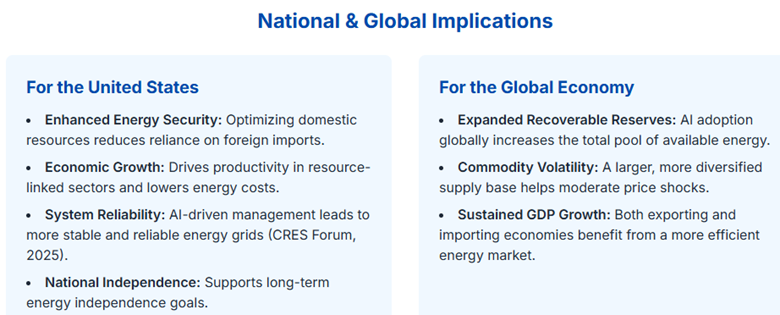
AI’s impact on the energy sector is evident in quantifiable gains, particularly in reserve growth and asset productivity, which are significantly altering corporate balance sheets and the global energy supply.
Expanding Hydrocarbon Reserves
AI is poised to dramatically increase the world’s accessible hydrocarbon reserves. A Wood Mackenzie analysis suggests that AI-powered tools could unlock an additional one trillion barrels of oil from existing fields. This isn’t through new discoveries, but by boosting the average recovery factor by an additional 6-12% from the current 29%. This substantial increase could nearly double the remaining recovery potential from existing assets, potentially bridging a projected 300-billion-barrel supply gap by 2050.
Enhancing Asset Productivity and Lifespan
AI is also maximizing output and extending the productive life of individual energy assets:
- Unconventional Plays: In U.S. shale, AI-guided optimization of hydraulic fracturing is estimated to increase recovery factors by 15-20%.
- Predictive Maintenance: AI-driven monitoring predicts equipment failures, drastically reducing unplanned downtime. Devon Energy reports a 25% increase in well lifespan due to AI, while Shell has seen a 20% reduction in unscheduled rig downtime and a 15% cut in maintenance costs.
A Surge in Profitability
Operational improvements, fueled by AI, are leading to significant financial gains for energy companies.
- Increased Profitability: The Boston Consulting Group predicts that energy companies fully integrating AI could see their incremental profits rise by 30% to 70% within the next five years.
- Enhanced Capital Discipline: AI plays a crucial role in the U.S. shale sector’s strategic shift from prioritizing production volume to focusing on margin resilience. By optimizing drilling and completion processes, operators can boost output with reduced capital expenditure. For instance, Permian Resources decreased its cycle time by 16%, and Chevron expanded its activity in the Permian by over 20% while keeping its rig count flat.
AI’s Impact on the Energy Sector: A Multi-Billion Dollar Market and Economic Catalyst
The integration of artificial intelligence into the energy sector is not only transforming the industry but also serving as a significant economic catalyst. This transformation contributes to market expansion, boosts national economic output, and strengthens geopolitical standing.
Investment in specialized AI solutions for the energy sector is experiencing rapid, double-digit growth, creating a dynamic new market.
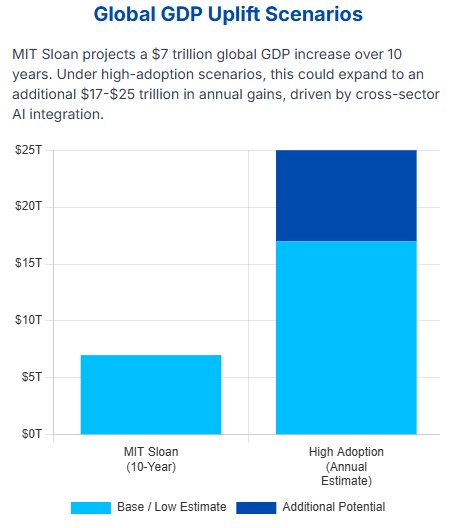
- Explosive Growth Projections: Precedence Research predicts that the global market for AI in oil and gas will surge from $7.64 billion in 2025 to an impressive $25.24 billion by 2034, demonstrating a robust 14.2% Compound Annual Growth Rate (CAGR).
- U.S. Market Dominance: North America leads this expanding market, accounting for over 39% of global revenue. The U.S. market alone is projected to grow substantially from $2.12 billion in 2025 to $7.34 billion by 2034. American energy companies are expected to significantly increase their AI-related capital expenditures within the next five years.
The Bottom Line
AI Oil Boom

Spencer Wright is the Executive Vice President of Halbert Wealth Management, Inc. and the author of Forecasts & Trends. He has been with HWM for over 25 years.