

The Looming Social Security Fiscal Crisis
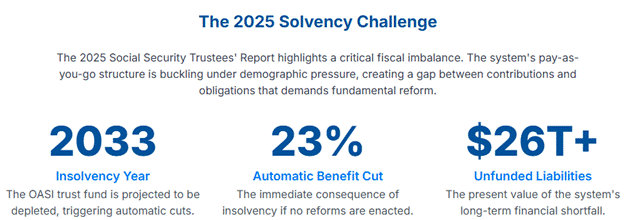
The U.S. Social Security system faces an urgent and worsening fiscal crisis, demanding immediate reform. Its current structure is incompatible with 21st-century demographics, leading to a fundamental imbalance that jeopardizes its long-term viability.
The 2025 Annual Report of the Board of Trustees underscores the program’s unsustainable path, indicating an accelerated timeline for insolvency and a deepening structural deficit. Key findings include:
- Trust Fund Depletion: The Old-Age and Survivors Insurance (OASI) trust fund, responsible for retirement benefits, is projected to become insolvent by 2033. If combined with the Disability Insurance (DI) fund, the depletion date shifts to 2034.
- Automatic Benefit Cuts: Upon depletion, federal law mandates an immediate, across-the-board reduction in benefits. OASI benefits would decrease by 23% (paying only 79% of scheduled amounts), while combined benefits would fall by 19% (paying 81% of scheduled amounts).
- Structural Deficit: The 75-year actuarial deficit has expanded to 3.82% of taxable payroll, marking the largest deficit in nearly five decades. This represents a present-value unfunded obligation exceeding $26 trillion.
- Persistent Negative Cash Flow: The program is already experiencing a permanent cash-flow deficit, with expenditures surpassing non-interest income. The projected net cash outflow for 2025 alone is over $181 billion.
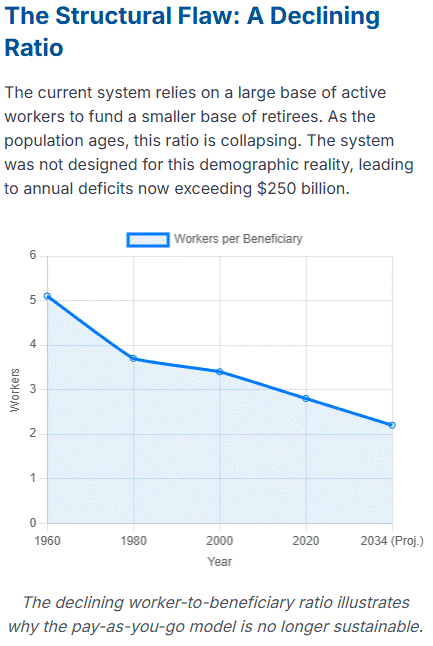
The solvency crisis in our current system is not due to mismanagement, but rather an inherent flaw in its pay-as-you-go (PAYG) structure. This model, which relies on current workers’ contributions to fund current retirees’ benefits, is highly susceptible to demographic shifts.
Key demographic challenges include:
- Declining Worker-to-Beneficiary Ratio: The ratio of workers to beneficiaries has significantly decreased, falling from over five-to-one in 1960 to 2.7-to-1 in 2024. Projections indicate a further decline to below 2.5-to-1 by mid-century.
- Increasing Longevity and Low Fertility: Americans are living longer and, consequently, collecting benefits for extended periods. Concurrently, birth rates are expected to remain below replacement levels. The 2025 Trustees’ Report further worsened long-term projections based on updated assumptions regarding sustained low fertility.
- “Peak 65” Retirements: The system faces additional strain from 2024 to 2027, as over 4.1 million Americans will turn 65 each year. This represents the largest surge of retirements in U.S. history.
Ignoring the issue of solvency for Social Security is not a viable option, as it would lead to an automatic 23% cut in benefits by 2033. To address this, policymakers face difficult decisions within the existing framework:
- Increase payroll tax: An immediate and permanent 29% increase would be required.
- Reduce benefits: An immediate and permanent 22% reduction for all current and future beneficiaries would be necessary.
Political inaction over several decades has exacerbated the problem.
Models for Privatizing Social Security
Privatization proposals offer a structural alternative to the PAYG model by shifting toward a pre-funded system based on individual accounts and market-based returns. Three primary models exist:
- Partial Privatization (“Carve-Out”): This two-tiered model would divert 2 to 5 percentage points of the existing 12.4% payroll tax into privately managed individual accounts. The remaining tax would fund a scaled-back, government-administered safety net benefit. This approach aims to balance market returns with a foundational public benefit.
- Full Privatization (Defined Contribution Replacement): This model would phase out the PAYG system for younger workers and replace it with a mandatory defined contribution (DC) system. Workers would contribute a fixed percentage of earnings to personal accounts managed by regulated private firms. The goal is to create a true savings and investment vehicle, giving workers ownership and boosting national savings.
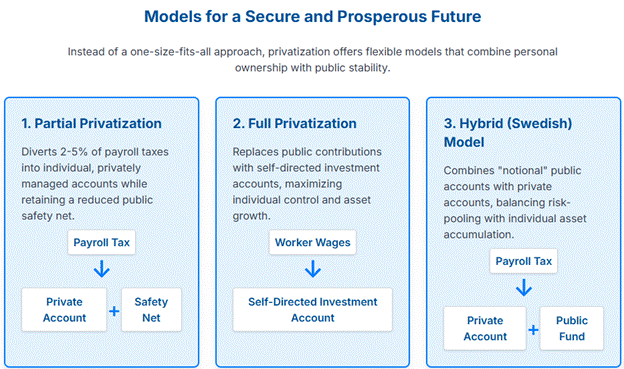
- Hybrid Model (Swedish “Third Way”): This model blends public and private elements. The Swedish system is funded by an 18.5% contribution split into two parts:
- Notional Defined Contribution (NDC) Account (16%): A PAYG system that mimics a DC plan. Each worker has a “notional” account balance that grows based on national wage growth, linking benefits to economic performance.
- Premium Pension Account (2.5%): A fully funded, privately managed individual account where workers choose their investments.
The central argument for privatization is its potential to generate superior returns for individuals and foster macroeconomic growth.
Comparative Rate of Return Analysis
There is a stark differential between the returns offered by the current Social Security system and those historically available in private capital markets.
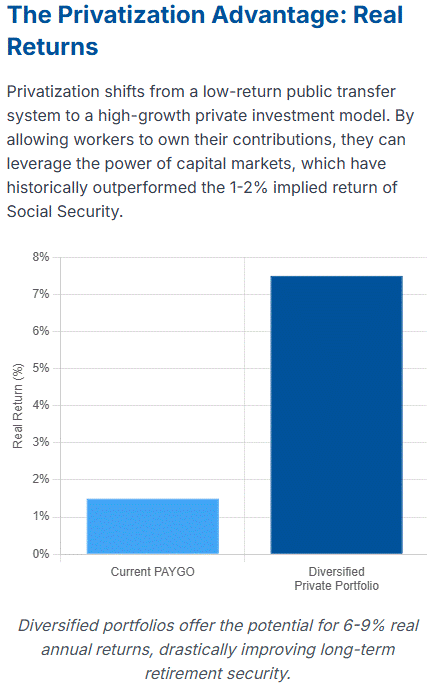
- Social Security’s Return: For future retirees, the maximum sustainable real rate of return from Social Security is projected to be only 1% to 2%. For certain demographic groups, the effective return can even be negative.
- Market Returns: In contrast, the S&P 500 has delivered a long-term real annual return of approximately 6.8%. Even conservative portfolios offer returns significantly higher than Social Security.
This return gap means workers could accumulate substantially larger nest eggs through private investment for the same level of contribution.
Transitioning to a pre-funded system is expected to have substantial positive impacts on the broader economy, primarily through:
- Increased National Savings: Unlike the largely transfer-based PAYG system, a pre-funded system generates a new and expanding pool of national savings.
- Enhanced Capital Investment & Productivity: This new capital will be invested in technology, infrastructure, and equipment, leading to increased worker productivity and economic expansion.
- Economic Growth: The Committee for a Responsible Federal Budget (CRFB) estimates that a comprehensive reform package restoring solvency could boost the economy’s projected size by 3.5% to 13% by 2050.
The Bottom Line
To strengthen Social Security and ensure retirement security:
- Introduce Universal Retirement Savings Accounts: Congress should establish a new system of pre-funded, supplementary retirement savings accounts. These accounts would complement the existing Social Security program, boosting national savings and individual wealth by leveraging higher market returns without the complexities of a full system transition.
- Empower Individual Investment Choices: Giving workers more control and ownership over their retirement funds is crucial. Allowing individuals to invest a portion of their contributions in personal accounts would provide them a direct stake in their financial future and enable them to benefit from long-term market growth.
By combining the current system with these new, pre-funded structures, we can harness the power of capital markets to resolve the solvency crisis and enhance the retirement security of all Americans.
AI Retirement Solutions


Spencer Wright is the Executive Vice President of Halbert Wealth Management, Inc. and the author of Forecasts & Trends. He has been with HWM for over 25 years.