
The Presidential Cycle Theory holds that there is a four-year rhythm in U.S. stock market performance, coinciding with presidential terms. Notably, the second year of a presidency frequently presents the greatest market difficulties. This trend is often linked to the implementation of more stringent policy decisions, typically occurring after the initial “honeymoon” phase and prior to re-election campaigns.
This is an examination of asset class performance during the second calendar year of 11 U.S. presidential terms between 1982 and 2022. The analysis focuses on the S&P 500, Dow Jones Industrial Average (DJIA), S&P GSCI commodity index, and S&P/Case-Shiller U.S. National Home Price Index.
Deconstructing the “Midterm Slump”
Data provides limited, yet specific, support for the hypothesis of a market slump coinciding with midterm congressional elections. The average total return for the S&P 500 across 11 second-year terms was +7.24%, which is notably below the long-term historical average of over 10%.
However, this “slump” is not a reliable predictor of a bear market. Seven of the 11 years analyzed still showed positive returns for the S&P 500. Outcomes varied widely, ranging from a +28.58% gain in 1998 to a -22.10% loss in 2002.
The Importance of Macroeconomic Conditions
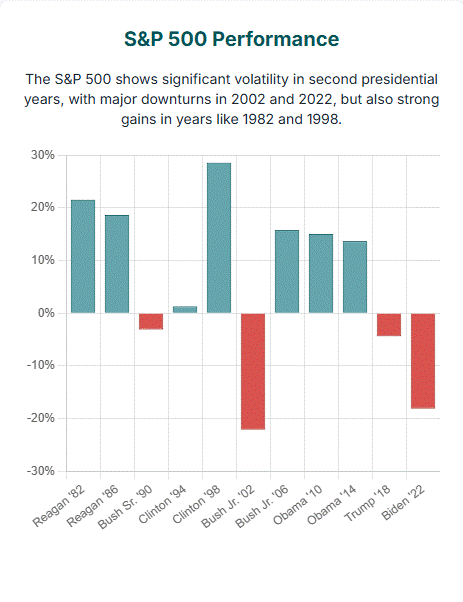
Market performance is primarily driven by economic and monetary policy, not the political calendar. This offers a more robust explanation for returns.
Key Regimes and Market Performance:
- Post-Recession Recovery (1982, 2010): Characterized by strong equity market rebounds, fueled by the Federal Reserve’s accommodative monetary policy to support economic recovery.
- Recession/Pre-Recession (1990, 2002): Experienced weak or negative equity performance. Other assets varied; real estate declined in 1990, while aggressive rate cuts in 2002 spurred housing and commodity booms despite stock declines.
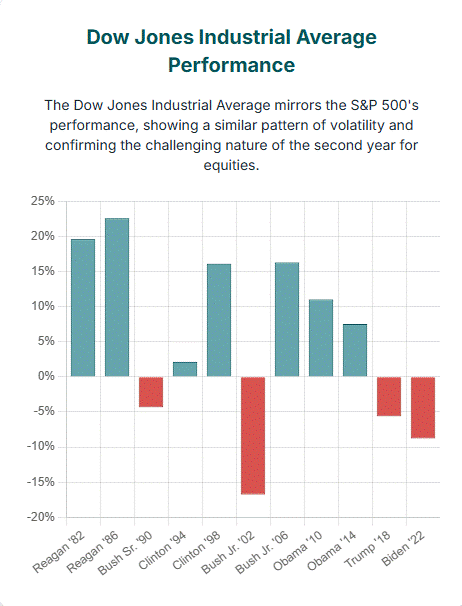
- Mid-Cycle Expansion (1986, 1994, 1998, 2006, 2014, 2018): This category shows the most variability. Performance was strongest during periods of stable growth and low inflation (1986, 1998). Conversely, performance was flat or negative when the Federal Reserve was actively tightening monetary policy to preempt inflation or normalize rates (1994, 2018).
- Inflationary Tightening Cycle (2022): A uniquely challenging environment where the Federal Reserve’s aggressive actions to combat historic inflation directly and powerfully impacted both equities and interest-rate-sensitive assets like real estate.
Independence of Non-Equity Asset Classes
Unlike equities, the performance of commodities and real estate largely operates independently of the U.S. presidential cycle, instead being driven by distinct fundamental factors.
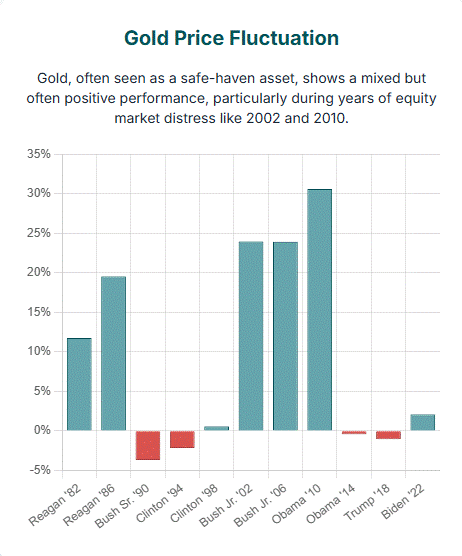
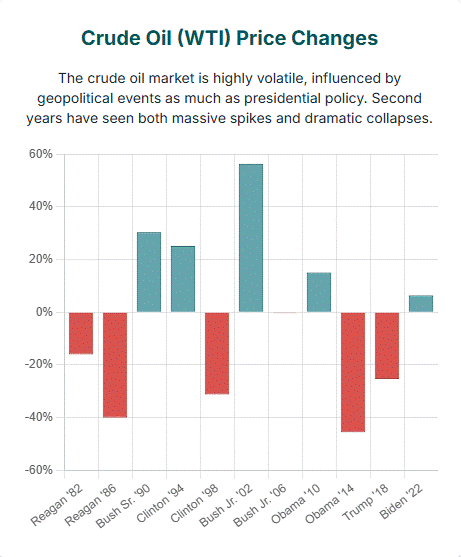
- Commodities: The S&P GSCI’s performance is highly responsive to global supply-and-demand shocks and geopolitical events. Historical examples include the oil price surges in 1990 due to Iraq’s invasion of Kuwait and in 2022 following Russia’s invasion of Ukraine, as well as the demand collapse during the 1998 Asian Financial Crisis.
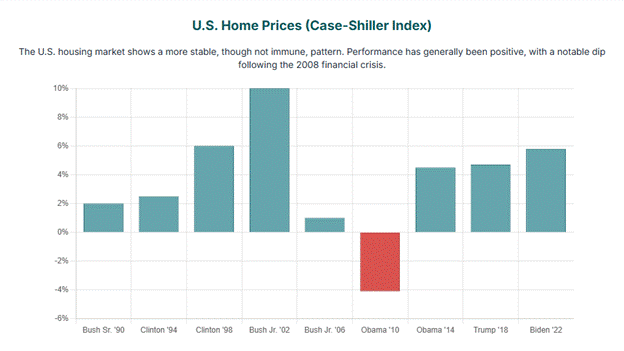
- Real Estate: The U.S. housing market is characterized by long, multi-year cycles. Its trajectory is significantly influenced by demographics, credit availability, and long-term interest rates. Consequently, performance in any given second year of a presidential term is merely a continuation of these broader, established trends.
Identifying Market Regimes by Asset Correlation
Market performance during presidential second years (1982-2022) can be categorized into distinct regimes based on asset correlation:
- Years of Broad Strength (1998): This period saw widespread domestic strength, with the S&P 500 surging by 28.58% and the DJIA by 16.10%. Real estate also appreciated significantly (+6.44%), effectively counteracting a severe commodities bear market (-35.83%).
- Years of Sharp Divergence (2002, 2022): These years highlight the benefits and challenges of diversification.
- 2002 exemplified diversification, as a significant equities downturn (S&P 500: -22.10%) coincided with a robust housing market (+9.56%) and the start of a commodity supercycle (+31.82%).
- 2022 presented a more complex scenario. Equities experienced a major decline (S&P 500: -18.11%), the housing market cooled considerably, and geopolitical factors drove a surge in commodities (+24.08%). This environment proved particularly difficult for traditionally diversified portfolios.
- Years of Correlated Weakness (1990, 2018): These periods were characterized by synchronized declines across major asset classes. In 1990, a recession led to negative returns for both equities and real estate. In 2018, escalating trade disputes and Federal Reserve tightening resulted in negative performance for both equities and commodities.
Performance Ranking of Presidential Second Years
| Final Rank | Year | President | S&P 500 TR | DJIA PR | S&P GSCI | Case-Shiller | Key Macro Economic Context |
| 1 | 1998 | Clinton | +28.58% | +16.10% | -35.83% | +6.44% | Peak of tech boom; robust domestic economy. |
| 2 | 1986 | Reagan | +18.67% | +22.58% | +2.04% | N/A | Mid-cycle boom; collapsing oil prices. |
| 3 | 1982 | Reagan | +21.55% | +19.60% | +11.56% | N/A | Post-recession recovery; beginning of secular bull market. |
| 4 | 2006 | G. W. Bush | +15.79% | +16.29% | -16.12% | +1.73% | Peak of housing/credit bubble before GFC. |
| 5 | 2002 | G. W. Bush | -22.10% | -16.76% | +31.82% | +9.56% | Trough of dot-com bust; housing/commodity boom. |
| 6 | 2010 | Obama | +15.06% | +11.02% | +7.17% | -4.12% | GFC recovery aided by monetary stimulus (QE2). |
| 7 | 1994 | Clinton | +1.32% | +2.14% | +1.70% | +2.51% | Fed tightening cycle under Greenspan. |
| 8 | 2014 | Obama | +13.69% | +7.52% | -32.96% | +4.50% | Steady expansion; conclusion of quantitative easing. |
| 9 | 1990 | G. H. W. Bush | -3.10% | -4.34% | +28.54% | -0.69% | Onset of recession; oil shock from Kuwait invasion. |
| 10 | 2018 | Trump | -4.38% | -5.63% | -13.88% | +4.52% | Fed tightening; escalating global trade disputes. |
| 11 | 2022 | Biden | -18.11% | -8.78% | +24.08% | +5.64% | Historic inflation and aggressive Fed tightening cycle. |
Market Performance in Presidential Second Years (1982-2022)
Top Performers (1998, 1986, 1982): These years saw exceptional U.S. equity performance, fueled by robust economic expansion or post-recession recovery. In 1998, strong domestic growth outweighed poor commodity performance. The Reagan era similarly benefited from top-tier equity returns, marking the start of new bull markets.
Bottom Performers (2022, 2018, 1990): These years were characterized by synchronized downturns across major financial asset classes. Key drivers included Federal Reserve tightening, recessionary pressures, or geopolitical uncertainty. 2022 stands out as the worst due to a damaging combination of a severe equity market decline and a rapidly cooling housing market, both direct results of efforts to combat inflation.
The Bottom Line
Market performance is predominantly driven by the macroeconomic environment and the Federal Reserve’s monetary policy, consistently overshadowing any influence from the domestic political calendar. While the “midterm slump” is an observable phenomenon, it is not the driving force behind market activity in the second year of a presidency.
The AI Presidential Brokerage Firm

Spencer Wright is the Executive Vice President of Halbert Wealth Management, Inc. and the author of Forecasts & Trends. He has been with HWM for over 25 years.