
This Week’s Highlights:
- Diving deep into the fascinating world of headline risk.
- News, factual, exaggerated, or false, has historically and currently drives financial markets and rapid trading.
- Looking at how legendary brands navigated corporate crises.
- Examining the psychological forces behind market panics.
- The best strategies to protect your portfolio from the noise.
What Exactly is Headline Risk?
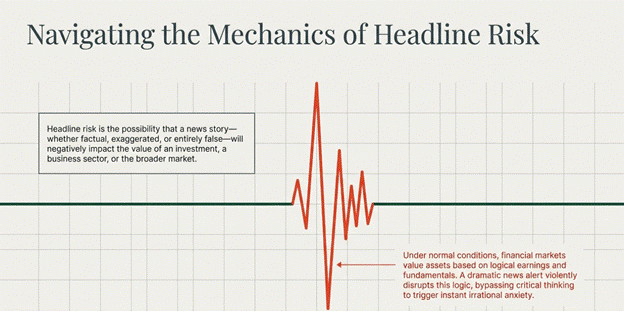
At its core, headline risk is the possibility that a news story will negatively impact the value of an investment, a specific business sector, or the broader market. Under normal conditions, financial markets act as logical mechanisms that value assets based on projected earnings and fundamentals.
However, headline risk disrupts this logic. A dramatic news alert can bypass our critical thinking and trigger irrational anxiety.
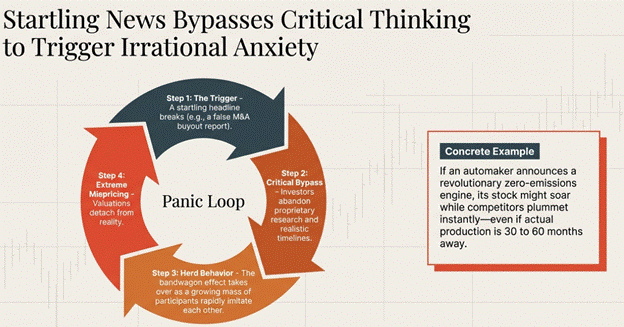
When a startling headline breaks, market participants often panic, guessing extreme outcomes without evaluating realistic timelines. This reaction is fueled by herd behavior, where investors ignore their own research to follow the crowd, and the bandwagon effect, where a growing mass of people rapidly imitate each other.
For example, if an automaker merely announces the future development of a revolutionary zero-emissions engine, its stock might soar while competitors’ plummet instantly—even if actual production is 30 to 60 months away. In the world of mergers and acquisitions, even a false report of a buyout can temporarily inflate the target company’s stock and depress the acquirer’s stock.
The Speed of Modern Markets
In the internet age, the velocity of information has completely transformed headline risk. With the rise of electronic and high-frequency trading, market reactions to news are now almost instantaneous. Modern markets rely heavily on algorithmic trading (or algo trading), which uses computer programs to process vast amounts of real-time news feeds and execute trades in milliseconds.
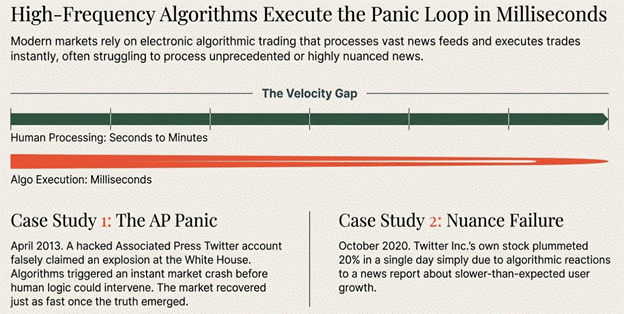
While algorithms can sometimes reduce market volatility by executing trades based purely on logic rather than human emotion, they can also struggle with unprecedented or highly nuanced news. A famous example of modern headline risk is the “Associated Press Panic” of April 2013.
A false news report posted via a hacked AP Twitter account claimed an explosion at the White House had injured the President. The market crashed sharply but recovered just as fast as the truth emerged. This proves how vulnerable automated systems and event-driven hedge funds are to rapid mispricing caused purely by headlines. Similarly, in October 2020, Twitter Inc.’s own stock plummeted by 20% in a single day simply due to a news report about slower-than-expected user growth.
Historical Precedents: Macro Shocks vs. Fundamental Flaws
Looking back over the past 150 years, headline-driven market crashes generally fall into two distinct categories: exogenous noneconomic shocks and fundamental economic bubbles.
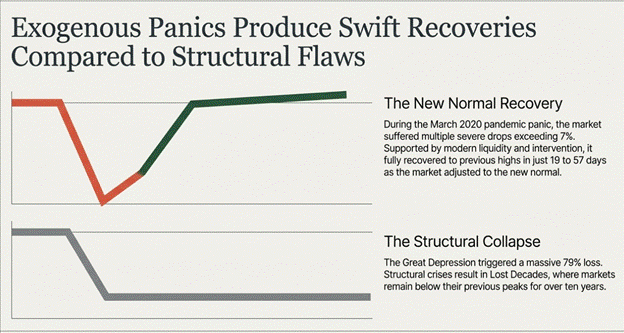
Noneconomic events, such as the 9/11 attacks or the onset of the COVID-19 pandemic, often lead to rapid, acute losses followed by surprisingly swift recoveries as the market adjusts to the new normal. During the pandemic panic of March 2020, the market suffered multiple severe drops exceeding 7%, yet it recovered to its previous highs in just 57 days.
Compare this to crises rooted in fundamental imbalances, like the Great Depression (a 79% loss) or the 2008 Global Financial Crisis. These events often result in “Lost Decades,” where markets remain below their previous peaks for over ten years due to deep structural issues. The good news for today’s investors is that modern market liquidity and intervention mechanisms have made recoveries from pure headline panics faster than ever.
Corporate Crises: Reputation and Remediation
When headline risk targets a specific corporation, the fallout can be existential. However, historical case studies demonstrate that leadership’s response is often more important than the news itself.
The absolute gold standard remains Johnson & Johnson’s handling of the 1982 Tylenol crisis. After tragically poisoned capsules killed seven people in the Chicago area, Tylenol’s market share plummeted from 35% to less than 8% within weeks. By prioritizing public safety, recalling 31 million bottles at a cost of $100 million, and practicing radical transparency, the company rebounded to a 30% market share within a year.
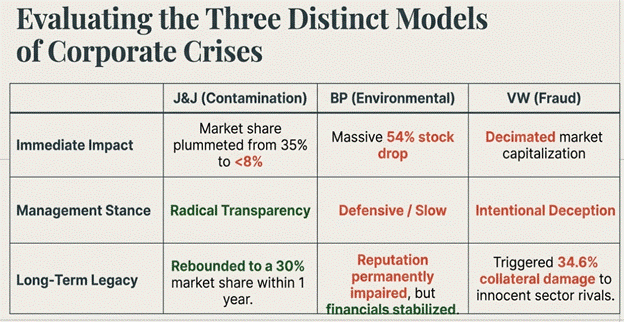
Contrast this with BP’s 2010 Deepwater Horizon spill. The initial explosion and environmental disaster caused a 54% drop in BP’s stock price. While BP’s reputation declined by roughly 50% and remained impaired for years, financial data shows that its long-term stock market returns eventually stabilized. This indicates that massive corporations can endure severe reputational scarring if they maintain strong underlying cash flows.
Sometimes, headline risk creates a collective reputation spillover, harming innocent bystanders. During the 2015 Volkswagen “Dieselgate” scandal, VW intentionally used software to cheat emissions tests. The headlines decimated VW’s market cap, but consumers also associated the fraud with the broader identity of German Engineering. This collective mistrust caused an astonishing 34.6% reduction in annual U.S. sales for other non-VW German automakers like BMW and Mercedes-Benz.
The Bottom Line
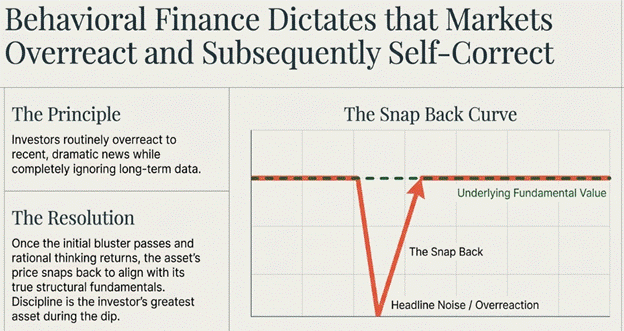
How can investors protect themselves against these unpredictable swings? Behavioral finance teaches us that investors often overreact to recent dramatic news while ignoring long-term data, leading to a snap back once rational thinking returns. Knowing this, discipline is your greatest asset.
Employing alternative assets can help mitigate market turmoil and you will be well-equipped in today’s high-speed economy.
Until next time, stay informed.

Spencer Wright is the Executive Vice President of Halbert Wealth Management, Inc. and the author of Forecasts & Trends. He has been with HWM for over 25 years.