This week’s highlights…
- We explore the contrarian idea that locking up capital can be the key to maintaining long-term focus.
- This letter examines why many market experts now view illiquidity as a feature rather than a bug.
- We will discuss the behavioral and structural advantages of patient capital and how non-traditional strategies can help manage market volatility while supporting long-term financial goals.
Flipping Conventional Wisdom on Its Head
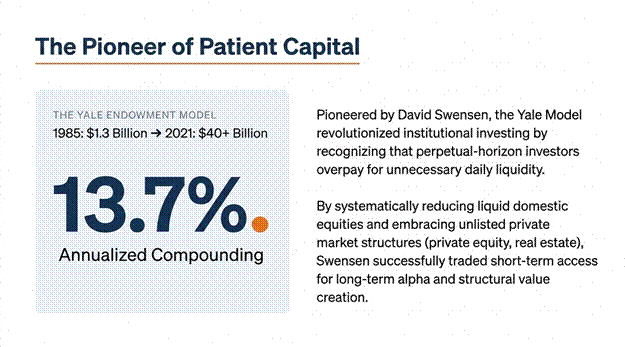
For decades, the “illiquidity premium” was treated as a simple economic transaction: investors demanded higher expected returns to compensate for the inconvenience of locking up their cash. This was a cornerstone of the legendary Yale Model pioneered by David Swensen, who famously recognized that long-term endowments overpay for unnecessary daily liquidity.
Past performance of institutional investors such as Yale is not indicative of future results and does not guarantee similar outcomes for other investors.
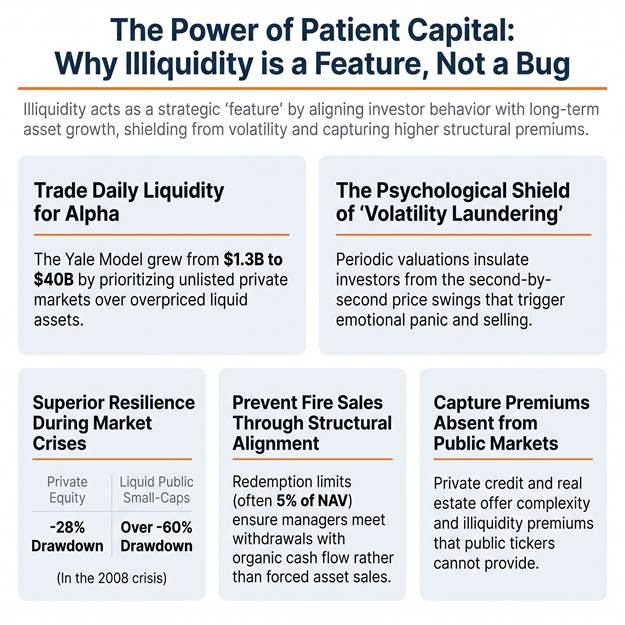
By avoiding overpriced liquid assets and embracing unlisted private market structures, Swensen grew Yale’s endowment from $1.3 billion in 1985 to over $40 billion by 2021, compounding at an astounding 13.7% annually.
Under Swensen’s guidance, Yale systematically reduced its holdings of highly liquid domestic equities, redirecting capital into private equity, real estate, and other unlisted alternatives.
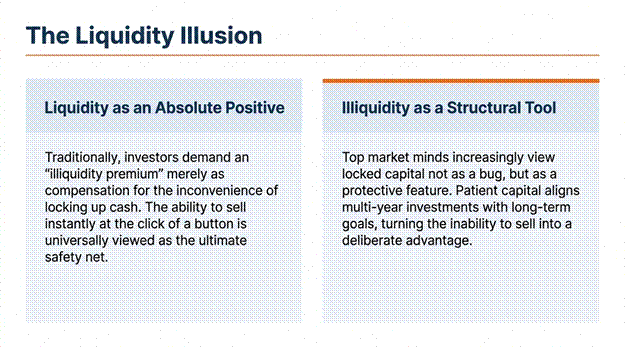
His core insight was simple but revolutionary: university endowments operate with a perpetual investment horizon, meaning they are uniquely positioned to trade short-term liquidity for long-term alpha and structural value creation. Today, a growing cohort of sophisticated allocators are realizing that illiquidity isn’t just a cost to be compensated; it is a deliberate structural tool.
The Psychological Shield of “Volatility Laundering”
One of the most fascinating perspectives on this comes from Cliff Asness, the co-founder of quant giant AQR Capital Management. Asness has pointed out that public, liquid markets “smack you in the face” with second-by-second volatility, which frequently triggers cognitive biases and emotional panic.
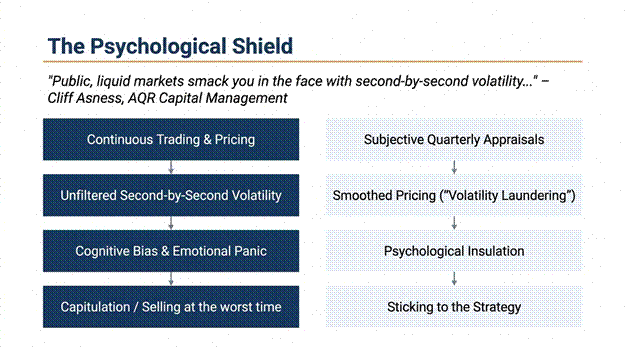
When public stock prices slide, human nature tempts us to sell at the worst possible times. Private assets, however, are valued quarterly via subjective, appraisal-based models rather than trading continuously. This creates what Asness calls, with a bit of friendly academic sarcasm, “volatility laundering”.
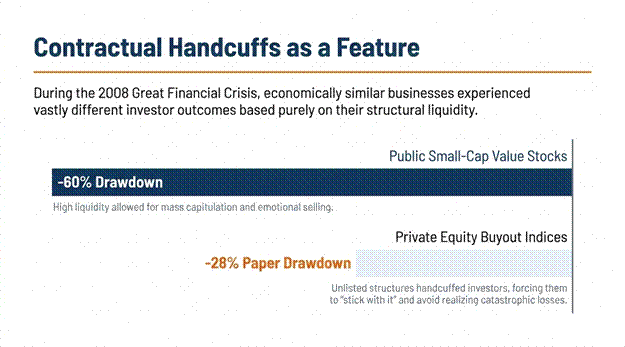
Because you don’t see the daily price swings, you are psychologically insulated from the urge to capitulate. During the Great Financial Crisis, for example, private equity buyout indices reported a paper drawdown of just -28%, while economically similar (but highly liquid) public small-cap value stocks plummeted over -60%.
Economically, the underlying businesses were exposed to similar systematic forces, but the unlisted structure contractually handcuffed investors to “sticking with it,” protecting them from their own worst emotional impulses.
Why Structure Matters in Private Credit
This behavioral insulation is doubly important in specialized lending spaces like private credit. Matthew Bass, Head of Private Alternatives at AllianceBernstein, notes that in direct corporate lending, illiquidity is absolutely a feature, not a flaw.
In private credit, funds often utilize semi-liquid structures that limit quarterly redemptions to 5% of Net Asset Value (NAV).
While a 5% limit might look like an administrative restriction, it is actually a vital safety mechanism. It aligns the duration of the investor’s capital with the multi-year nature of the underlying mid-market corporate loans.
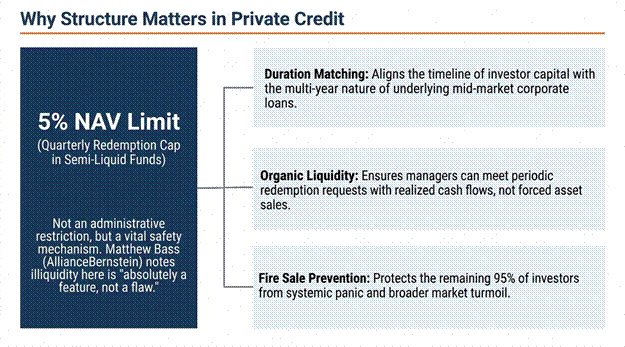
This ensures that the asset manager can meet periodic redemption requests with organic, realized cash flows instead of being forced into fire sales of existing loans during broader market turmoil. Ultimately, you cannot capture a true illiquidity premium if you provide liquidity on demand. By respecting this structure, direct lenders can comfortably focus on underwriting bespoke legal protections and harvesting persistent yield premiums.
What You’re Missing
At Halbert Wealth Management, we believe that a truly robust portfolio should look beyond the daily price ticker of public stock exchanges. While other assets serve as core liquid allocations, incorporating alternative assets, such as private credit, private equity, and private Real Estate Investment Trusts (REITs), can provide access to structural premiums that are entirely absent from public markets.
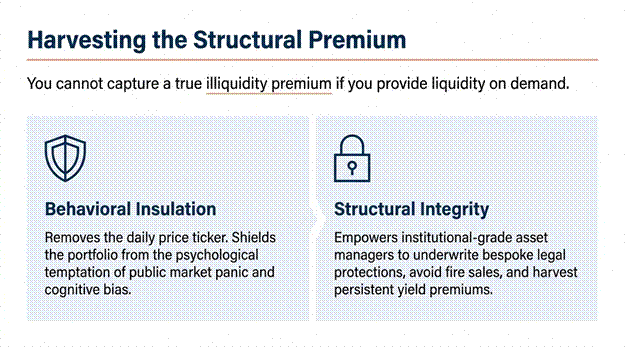
By matching a portion of your wealth with long-horizon alternative structures, you can capture both the complexity and illiquidity premiums engineered by institutional-grade managers. These strategies leverage patient capital to build long-term value, shielding your portfolio from the psychological temptation of public market panic.
While alternative assets are inherently illiquid, carry unique risks, and offer no guaranteed returns, they can serve as a vital behavioral cushion for qualified investors whose personal investment horizons align with long-term, absolute-return structures.
Ready to learn more?
Infographic Summary

Spencer Wright is the Executive Vice President of Halbert Wealth Management, Inc. and the author of Forecasts & Trends. He has been with HWM for over 25 years.