This week’s highlights…
- Understand “Narrative Economics,” the viral spread of stories that increasingly define the financial landscape, often overriding raw data.
- Examine the psychological reasons (“negativity bias” and “loss aversion”) why pessimistic, bearish narratives are more influential in investment decisions.
- Analyze the risk created when stories detach market prices from underlying fundamentals, leading to a “narrative risk premium,” volatility, and potential market corrections.
- Explore bespoke, non-correlated, and alternative investment strategies designed to insulate portfolios from viral market sentiment and media-driven panic.
The Power of a Good Story
As humans, we naturally seek order in a chaotic world, and in the stock market, we do this by latching onto stories. Today’s financial landscape is increasingly defined not just by raw data, but by the viral transmission of economic stories that shape how we perceive that data.
Nobel laureate Robert J. Shiller calls this phenomenon “narrative economics”.
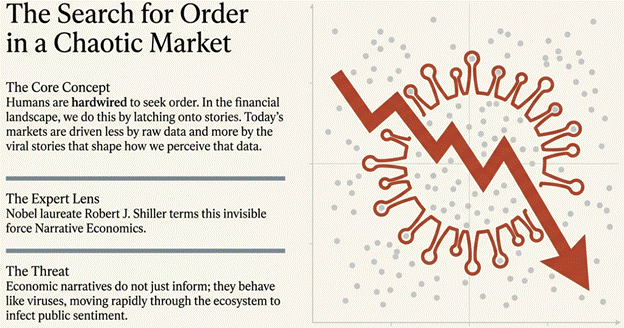
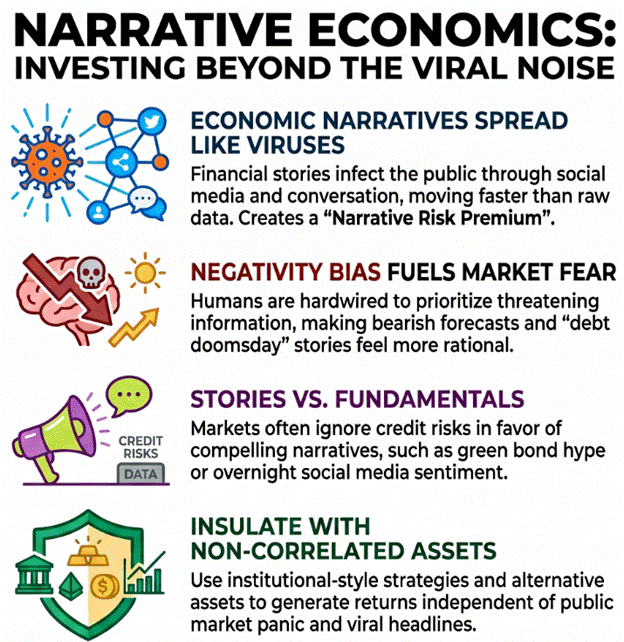
He explains that economic narratives spread much like a virus, moving from person to person through conversations and media until they “infect” the broader public. These stories often rely on psychological shortcuts, known as heuristics, connecting complex financial events to deeply felt human emotions like fear, security, or the fear of missing out.
Why Bad News Travels Faster
Have you ever noticed that pessimistic market forecasts always sound a bit more rational? There is a psychological reason for this. Humans are hardwired with a “negativity bias,” meaning we prioritize threatening information in order to survive.
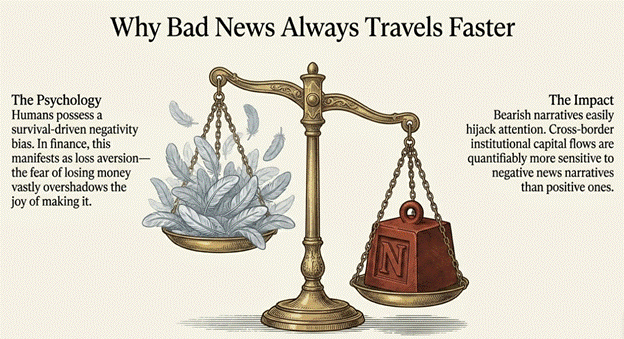
In finance, this translates to “loss aversion,” where the fear of losing money completely overshadows the joy of making it. Consequently, bearish narratives, like warnings of an impending debt crisis or a sudden market crash, grab our attention and heavily influence our investment decisions.
In fact, research shows that cross-border institutional capital flows are significantly more sensitive to negative news narratives than positive ones. Public equities are so sensitive to this daily chatter that researchers have even found that overnight financial sentiment on social media platforms like Twitter can accurately predict the next day’s stock market returns.
The Gap Between Stories and Fundamentals
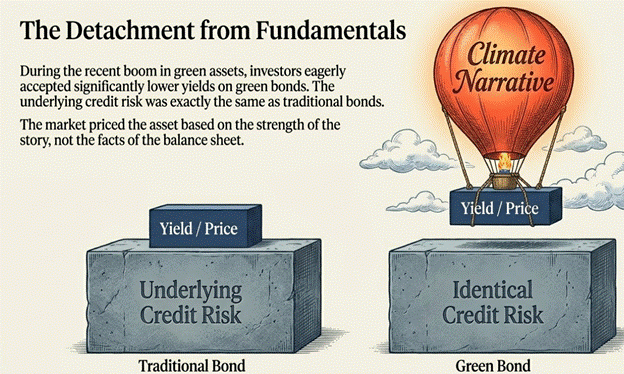
When a compelling story takes hold, it can cause the market to completely detach from underlying fundamentals. For example, during a recent boom in “green” assets, investors eagerly accepted lower yields on green bonds simply because of the strengthening climate narrative, even though the underlying credit risk was exactly the same as traditional, non-green bonds.
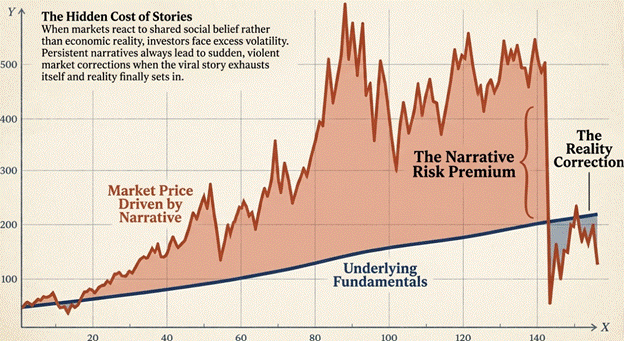
When stories drive prices instead of facts, it creates what researchers call a “narrative risk premium”.
This means investors end up facing excess volatility and mispricing simply because the market is reacting to a shared social belief rather than a fundamental economic reality. Over time, these persistent narratives can lead to sudden shifts or market corrections when the viral story finally exhausts itself and reality sets in.
As successful market observers point out, the key to navigating this landscape is separating the actual signal from the narrative noise. While stories change rapidly, one day predicting a hard recession, the next a soft landing, the underlying market mechanics often remain far more stable.
What You’re Missing
In a world where public markets are constantly pushed and pulled by viral narratives, fleeting sentiment, and media-driven panic, traditional portfolios can feel like a rollercoaster. But what if you could step away from the noise entirely?
At Halbert Wealth Management, we believe in the value of bespoke solutions and alternative assets that are designed to operate independently of the latest market headlines. By focusing on non-correlated investments and institutional-style, absolute-return strategies, we seek to generate performance based on distinct, underlying mechanisms rather than public market sentiment.
Whether we are looking at interval funds, private offerings, or managed accounts, these specialized opportunities aim to smooth out volatility and actively manage risk. Because their performance is detached from the daily tug-of-war of the stock market, they render the panic of viral market narratives largely meaningless for your core wealth-building goals.
Want to learn how to insulate your portfolio from the rumor mill?
Contact us to discuss the non-correlated public and private strategies offered by HWM.
Infographic Summary

Spencer Wright is the Executive Vice President of Halbert Wealth Management, Inc. and the author of Forecasts & Trends. He has been with HWM for over 25 years.