This week’s highlights…
- Unpacking the massive shift bringing Wall Street’s most exclusive investments to Main Street.
- Exploring the democratization of alternative assets.
- Examining the regulatory changes paving the way.
- Analyzing the undeniable power of social media trading communities.
- Highlighting the critical risks you need to watch out for.
The Democratization of Alternative Assets
For decades, the standard “60/40” portfolio, holding 60% equities and 40% fixed income, was the unquestioned bedrock of retail wealth management. However, a recent era of persistent inflation, fluctuating interest rates, and geopolitical uncertainty has exposed the limitations of this traditional model. As a result, everyday investors are eagerly searching for new avenues to diversify their portfolios and capture higher yields.
Enter alternative investments, also known as “alts.” Historically, lucrative asset classes like private equity, private credit, venture capital, and commercial real estate were strictly reserved for ultra-wealthy individuals and massive institutional funds. Today, a wave of digital platforms is completely changing the landscape. Companies like Fundrise, Yieldstreet, and Moonfare are breaking down these barriers, allowing retail investors to access fractional shares of private assets with minimums sometimes as low as $10.
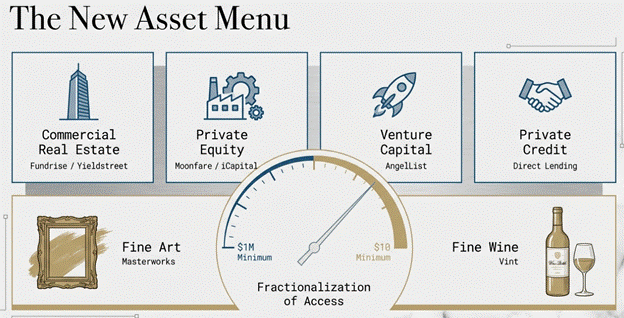
Even passion assets are getting the fractional treatment. Platforms like Masterworks and Vint allow users to buy shares in a blue-chip painting or a rare vintage of Bordeaux wine. This unprecedented access allows regular investors to tap into the “illiquidity premium”, a financial concept where investors are rewarded with potentially higher returns in exchange for locking up their capital for longer periods of time.
Regulatory Tailwinds
This democratization isn’t solely driven by clever technology; global regulators are actively rewriting the rulebook to facilitate broader market participation. In the United States, the Securities and Exchange Commission (SEC) has shown a strategic shift toward exploring ways to safely expand individual access to private markets. For instance, the SEC recently simplified the verification process for “accredited investors” under Rule 506(c), making it much easier for private funds to publicly advertise their offerings through webinars, websites, and social media.
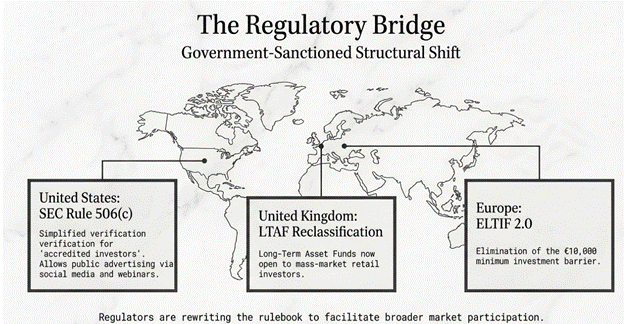
This trend is equally powerful across the Atlantic. In Europe, the newly updated European Long-Term Investment Fund (ELTIF 2.0) framework has eliminated the previous €10,000 minimum investment barrier, opening the doors wide for retail capital. Similarly, the UK’s Long-Term Asset Fund (LTAF) has been reclassified to allow mass-market retail investors to participate in private markets. These innovative fund structures are explicitly designed to lower barriers to entry while providing a regulatory safety net, making alts highly appealing to everyday savers.
The Social Media Trading Floor
While tech platforms and regulators build the infrastructure, social media is heavily fueling the retail demand. Platforms like Reddit (specifically the r/WallStreetBets forum), TikTok, and Discord have essentially become decentralized, digital trading floors. The infamous GameStop short squeeze of 2021 proved that retail investors, when coordinating their actions online, possess enough collective power to move markets and inflict billions in losses on massive institutional hedge funds.
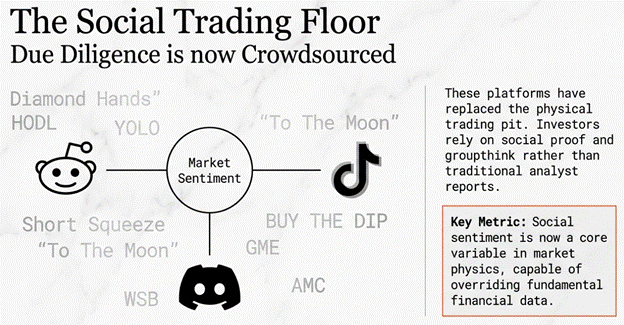
This phenomenon created the era of “meme stocks,” where viral trends, rumors, and sheer internet hype can drive asset prices to dizzying heights, entirely disconnected from a company’s underlying financial fundamentals. Retail traders pool their research and “due diligence” on message boards, creating a hive-mind approach to investing that relies heavily on social proof and groupthink.
While some traditional analysts quickly labeled these retail flows as dumb money driven by the fear of missing out (FOMO) and attention bias, recent data paints a more nuanced picture. When coordinated, retail order flow can actually provide indirect liquidity to institutional investors through high-frequency market makers, acting as a surprising stabilizing force in the market. Regardless of the label, it is undeniable that social sentiment is now a core variable that moves modern financial markets.
Navigating the Hidden Risks
Of course, with great access comes great responsibility. Before we declare a total victory for the democratization of finance, we must acknowledge the structural risks involved in this new era. Private markets are fundamentally different from public stock exchanges.
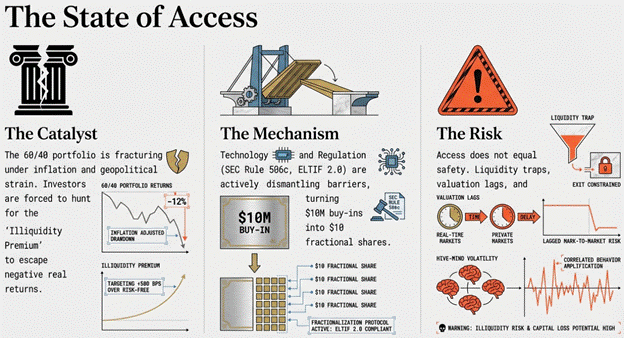
The most glaring difference is illiquidity. Unlike trading a public stock where you can cash out in seconds, you cannot instantly liquidate your stake in a private equity fund or a commercial property; your money may be tied up for months or even years. There is also the issue of valuation opacity. While public stocks have real-time market prices, private assets are valued periodically through appraisals. This means the stated Net Asset Value (NAV) of a retail private fund might lag behind true market conditions, giving a false sense of stability and masking underlying volatility. Furthermore, these retail-oriented alternative funds often come with complex, layered fee structures.
Interestingly, traditional institutional investors are becoming somewhat wary of this retail influx. They worry that mixing retail money into institutional funds could create misaligned incentives, different redemption expectations, and operational headaches. Institutions are now actively seeking legal protections, such as Most Favored Nation clauses, to ensure their rights aren’t diluted by the integration of retail capital.
The Bottom Line
The financial landscape is evolving at a breakneck pace. The gates to the private markets are opening wider than ever, offering exciting new avenues for wealth creation and portfolio diversification. However, adding complex, illiquid assets requires an informed approach. Remember to always understand the fees and lock-up periods before diving in.
AI Alternative Assets


Spencer Wright is the Executive Vice President of Halbert Wealth Management, Inc. and the author of Forecasts & Trends. He has been with HWM for over 25 years.