This week includes a deep dive into the “strong but cooling” U.S. economy, the surprising role of Artificial Intelligence in our recent GDP growth, and a look at the new tools—from Large Language Models to the “E-Rule”—that professionals are using to predict what comes next. While the topline numbers look resilient, there is a lot of movement under the hood.
The Big Picture: Strong, Steady, and Slightly Restricted
On the surface, the American economy is holding its own with several key indicators signaling health. Real Gross Domestic Product (GDP)—which represents the total market value of all final goods and services produced in the U.S.—has shown resilience over the past two years. In the first half of 2025, real GDP grew at an annual rate of 1.4%, and many experts expected it to maintain a similar pace through the rest of the year. However, this growth had a bit of a cool down from the higher rates we saw previously.
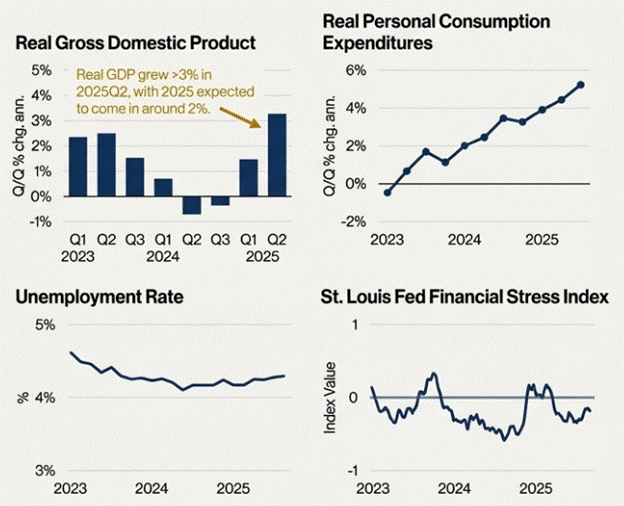
Inflation remains a central character in our economic story. The Federal Reserve’s preferred measure, the Personal Consumption Expenditures (PCE) price index, is still running above the 2% target, currently sitting closer to 3%. Because of this, the Fed is keeping monetary policy in a modestly restrictive setting, which is essentially their way of keeping a gentle foot on the brake to ensure prices don’t spiral higher. They are aiming for a balanced approach, trying to bring inflation down without causing the labor market to freeze up.
The “K-Shaped” Reality
While the broad numbers look okay, many analysts are pointing out that we are living in a “K-shaped” recovery. This means that while some sectors and households are thriving, others are treading water or even struggling. For instance, recent GDP growth has been heavily supported by consumer spending from the top 10% of households. This group also drives nearly half of all consumer spending in the U.S.
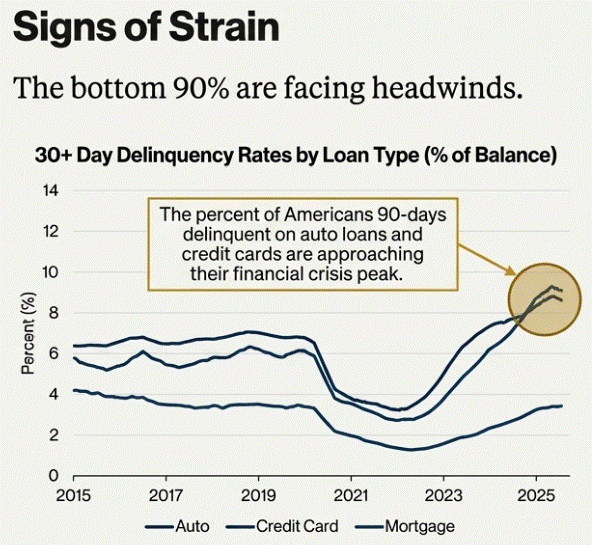
In contrast, the bottom 90% of households are facing significant financial headwinds. We are seeing the percentage of Americans who are 90 days delinquent on auto loans, credit cards, and student loans approaching peaks not seen since the financial crisis of 2008-2009. This divergence is why you might hear one colleague talk about a booming market while another expresses concern about their monthly bills.
Labor Markets: Cooling, Not Freezing
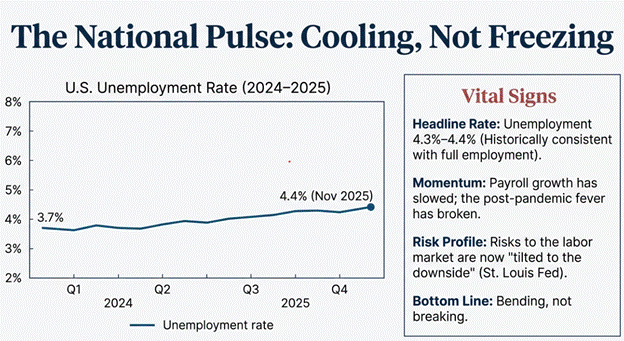
The labor market remains a pillar of strength, but the “Help Wanted” signs are starting to dim. Unemployment is still relatively low, hovering around 4.3% to 4.5%. However, we are seeing signs of a gradual cooling. Payroll growth has slowed in 2025, partly because there are fewer new people entering the workforce and partly because businesses are more hesitant to hire due to fiscal policy uncertainty.
The AI Factor: Engine of Growth or Asset Bubble?
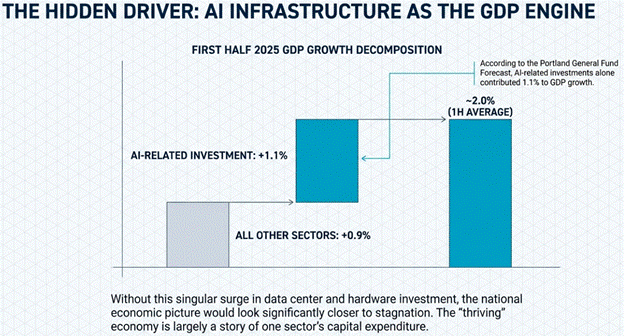
One of the most fascinating drivers of our current economy is the rapid investment in Artificial Intelligence (AI) infrastructure. In the first half of 2025 alone, AI-related investments contributed a whopping 1.1% to our GDP growth. Funding for generative AI has soared, and major tech firms are making aggressive investments in data centers and specialized equipment to meet growing demand.
However, some economists are raising a red flag, worrying that the AI boom might be an asset bubble. They point to the “Cyclically Adjusted Price to Earnings ratio,” which is currently at levels seen just before major market crashes in 1929 and the 2001 dot-com era. If these massive investments don’t eventually lead to the profits that investors are betting on, it could cause a “wealth effect” where people feel less wealthy and suddenly cut back on their spending, potentially triggering a wider slowdown.
Understanding “Meta-Policy” Uncertainty
If you feel like the rules of the game are changing every few weeks, you aren’t alone. We are in a time of significant “Policy and Meta-Policy” change. While policy refers to specific rules like tariffs or immigration laws, meta-policy is the higher-level logic of how those decisions are made.
For example, we’ve seen major upheavals in trade policy, with effective tariff rates hitting their highest levels in nearly a century. Businesses have tried to protect consumers from these price increases, but as inventories run low and profit margins get pinched, those costs are starting to leak into the prices we see at the store.
Similarly, large changes in immigration policy have slowed the growth of the labor force, making it harder for some businesses to find the workers they need. This level of uncertainty makes it very difficult for companies to plan for the long term, often causing them to focus on short-term flexibility instead.
New Tools for the Modern Forecaster
To make sense of this complexity, researchers are turning to high-tech tools. A recent study evaluated “Time Series Language Models” (TSLMs)—which are essentially AI models trained specifically to forecast economic data rather than just text. Models like Google’s TimesFM and Salesforce’s Moirai have shown they can capture complex patterns that traditional models might miss, especially during structural breaks like the post-Covid era.
However, these AI forecasters aren’t perfect; they are still prone to hallucinations where they generate unreasonable predictions. The most promising approach seems to be a hybrid model that combines the structural rigor of traditional econometrics with the flexibility of AI.
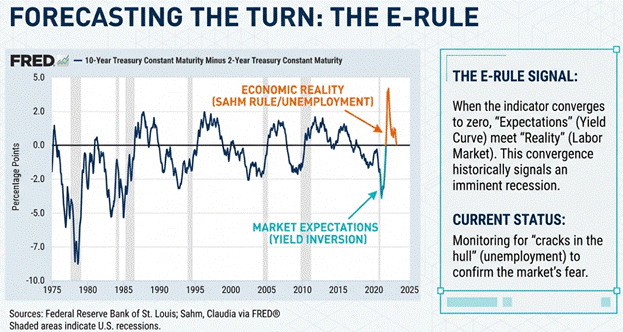
Another exciting development is the “E-Rule,” a novel indicator that combines the “Yield Curve” (the difference between long-term and short-term interest rates) with the “Sahm Rule” (which tracks rises in unemployment). The E-Rule aims to align market expectations with economic reality, signaling a recession risk when it approaches zero. Historically, this tool has provided an early warning signal 1 to 6 months before a downturn begins.
What This Means for You
While the macro economy is steady for now, the high levels of micro uncertainty mean that staying informed is more important than ever. Whether it’s watching the M2 money supply—which tracks how much liquid cash is circulating—or keeping an eye on local property values, the details matter.
The U.S. economy has a century-long history of being incredibly resilient, but it is currently being tested by a K-shaped growth pattern and major policy shifts. By understanding the trends under the hood, you can better position yourself for what comes next.
Curious about these national trends? Check out the St. Louis Fed’s Economy at a Glance tool to see real-time charts on GDP, unemployment, and consumer spending.
AI Economic Assessment

Spencer Wright is the Executive Vice President of Halbert Wealth Management, Inc. and the author of Forecasts & Trends. He has been with HWM for over 25 years.