
The Early Days (1600s–1700s)
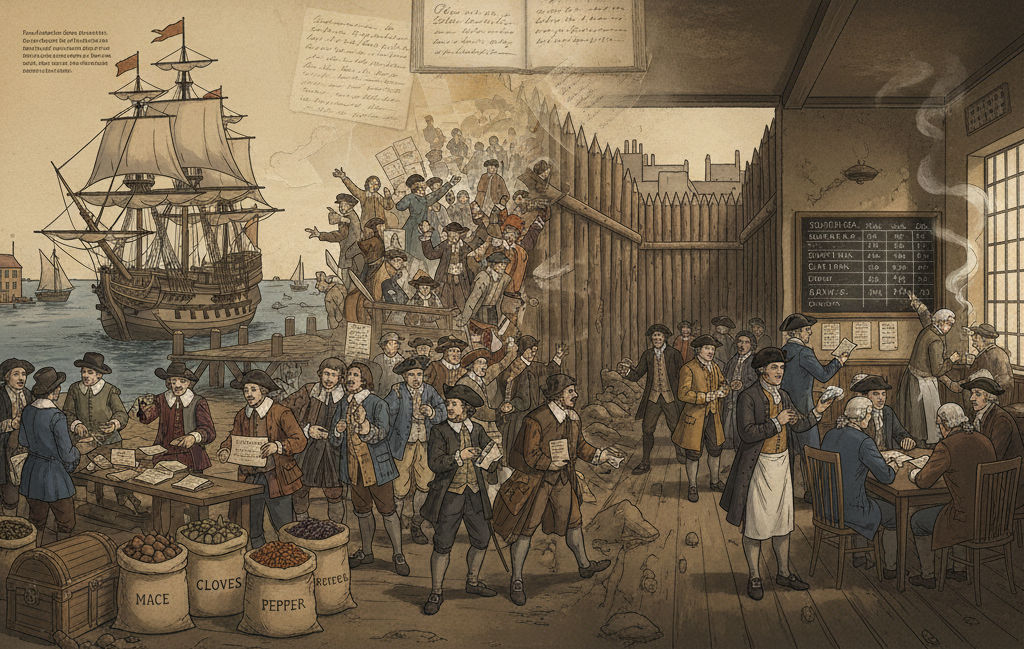
The Birth of the IPO (1602): The Dutch East India Company (VOC) didn’t just invent shares; they invented the “permanent capital” model. Before this, investors funded a single voyage and got their money back when the ship returned. The VOC kept the money to build a massive fleet, giving investors a piece of paper (a share) they could sell to others instead.
Dividends in Spices: In the early 1600s, liquidity was a constant struggle. When the VOC was “asset rich but cash poor,” shareholders were sometimes forced to accept their returns in mace, cloves, or pepper. Imagine a modern investor getting their Apple dividends in the form of iPhone charging cables!
The Original “Wall” Street: The wall was a 12-foot-high barrier of logs and earth. While it was built to keep out invaders, it inadvertently created a “corridor” where merchants and slave traders gathered. By the time the wall was dismantled in 1699, the name was so etched into the local geography that it stuck.
The Original “Confusion”: Joseph de la Vega’s Confusion de Confusiones described the Amsterdam exchange as a “theatre of the world” where “the most clever people are the most cheated.” He outlined the basic rules of trading, the first being: Never give anyone the advice to buy or sell shares, because where insight is fearful, counsel may be misleading.
Coffeehouse Origins: In London, Jonathan’s Coffee House became the hub because “The Royal Exchange” had banned stockjobbers for being too loud and rude. In these shops, the “ticker” was just a man chalking prices onto a blackboard amidst clouds of tobacco smoke and caffeine-fueled shouting.
The Tulip Crash (1637): At the height of the bubble, a single “Semper Augustus” bulb was worth the price of a grand estate in Amsterdam. When the market collapsed, it wasn’t because people ran out of money, but because the “social contagion” broke—people suddenly realized they were trading paper for flowers that would eventually rot.
The South Sea Bubble (1720): This was a classic “pump and dump” on a national scale. The South Sea Company convinced the British government to let them take over the national debt in exchange for a monopoly on trade with South America. The problem? Spain controlled South America, and trade was virtually non-existent.
Building the Giants (1700s–1800s)
The Buttonwood Agreement (1792): Before this, the market was a free-for-all with massive fraud. The 24 brokers who met under that tree agreed to a “fixed commission” and to give each other preference in trades. It was effectively a private club designed to bring “order and trust” to a chaotic New York.
Fractions of Eight: This “Piece of Eight” system stayed in place for an incredibly long time. It wasn’t until 2001 that the NYSE finally switched to decimals (dollars and cents). Before that, if a stock went up a “teenie,” it meant it moved by 1/16th of a dollar.
The First Ticker (1867): Before Edward Calahan’s ticker, “runners” had to sprint from the exchange to brokers’ offices to deliver prices. The ticker changed the speed of information, making it possible for people in different cities to trade in near real-time, sparking the first wave of truly national speculation.
Gongs to Bells: The move from a gong to a bell was purely practical. The NYSE trading floor grew so large and the shouting so deafening that the gong simply couldn’t be heard anymore. The 1903 brass bell was specifically engineered to be “loud enough to pierce through the chaos.”
The 12 Originals: The original Dow list from 1896 is a graveyard of old-world industry. It included companies like U.S. Leather (preferred), Distilling & Cattle Feeding, and American Cotton Oil. General Electric was the longest-lasting original member, finally being removed in 2018.
The Modern Era (1900s–Present)
The Great Depression’s Low: It’s hard to fathom the psychological scarring of 1929. The Dow didn’t just “dip”—it lost nearly 90% of its value from peak to trough. Entire generations of Americans refused to touch the stock market again for the rest of their lives, viewing it as a “rigged casino.”
Computers Take Over (1971): NASDAQ was essentially a giant TV screen in an era of paper. Because it had no physical floor, it became the natural home for “new” technology companies like Apple, Microsoft, and Intel, who didn’t want to be associated with the “stodgy” old-money NYSE.
The 22% Drop (1987): Black Monday was the first “automated” crash. Early computer programs were set to sell if prices fell to a certain level. This created a “death spiral” where selling triggered more selling, happening so fast that human traders couldn’t even pick up their phones to stop it.
The October Jinx: Mark Twain famously joked about this in Pudd’nhead Wilson: “October. This is one of the peculiarly dangerous months to speculate in stocks in. The others are July, January, September, April, November, May, March, June, December, August, and February.”
Flash Boys: In high-frequency trading, companies spend millions to lay straighter fiber-optic cables between Chicago and New York just to save 3 milliseconds. At that speed, the “market” is essentially a conversation between two supercomputers that no human can follow in real-time.
The World’s Largest: The dominance of the U.S. markets is staggering. As of today, the Apple corporation alone is sometimes worth more than the entire stock market of countries like France or the United Kingdom.
AI Lang Syne


Spencer Wright is the Executive Vice President of Halbert Wealth Management, Inc. and the author of Forecasts & Trends. He has been with HWM for over 25 years.
