
A 50-year mortgage, while offering the superficial benefit of a lower monthly payment, creates an illusion of affordability. This product is economically inadvisable as it introduces severe financial risks, fundamentally transforming homeownership from a wealth-building asset into a long-term liability.
The Central Problem: Glacial Equity Accumulation
The primary mechanism for wealth creation for US homeowners is equity accumulation, which is severely undermined by the 50-year term. By stretching the loan over five decades, interest payments are overwhelmingly front-loaded, causing principal reduction to slow to a near crawl.
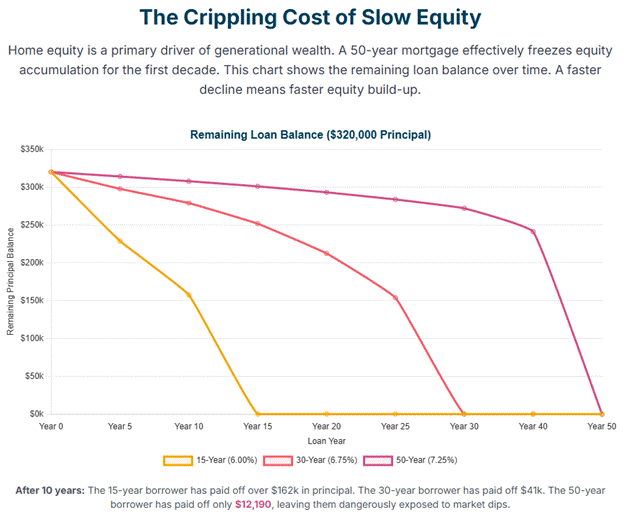
- A Stark Comparison: A borrower on a standard 30-year mortgage accumulates $100,000 in principal equity in about 12 to 13 years. The same borrower with a 50-year mortgage would require 30 years to reach that identical level of equity.
- Misalignment with Tenure: Given that the average US homeownership tenure is approximately 12 years, a typical borrower with a 50-year loan would sell their home having built almost no wealth. This lack of equity traps them, limiting their borrowing power for a subsequent home purchase and potentially making it impossible to refinance into a more favorable loan.
High Default Risk from Stalled Equity Growth
The structure of a 50-year mortgage inherently generates high default risk by dramatically slowing the accumulation of home equity.
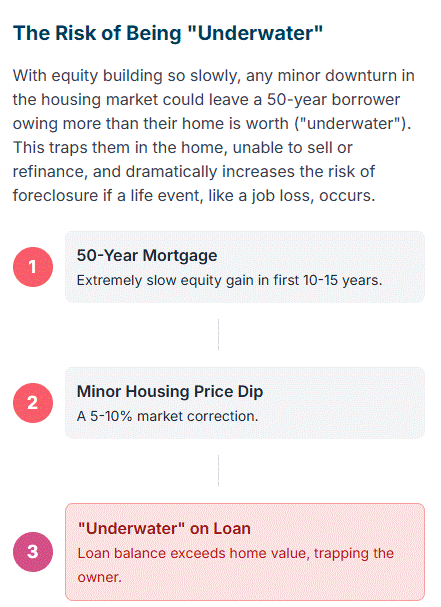
- Vulnerability to Negative Equity: Minimal equity provides no buffer against market downturns. Even a minor dip in home prices can quickly leave the homeowner underwater, where the outstanding loan balance surpasses the home’s market value.
- A Lesson from the 2008 Crisis: Evidence, including research from the FHFA, clearly identifies equity as a key driver of default risk. The 2008 financial crisis highlighted that borrowers with negligible equity are significantly more prone to default. Consequently, a product that structurally minimizes equity is structurally engineered for elevated default rates.
The 50-year mortgage is financially indefensible, offering only a marginal benefit in exchange for a catastrophic increase in the total cost of credit.
The Modest Savings vs. Staggering Debt
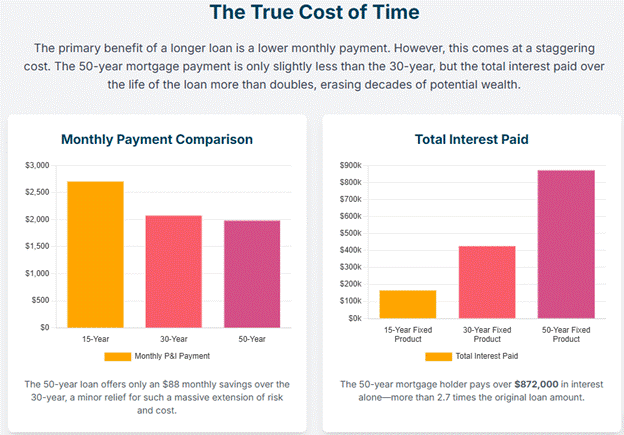
- Minimal Monthly Relief: The primary appeal, a lower monthly payment, is negligible. Based on the average U.S. home price ($415,200), a 50-year term saves borrowers only $250 to $300 per month compared to a standard 30-year loan.
- Exponential Interest Burden: This small monthly saving is offset by an enormous, sometimes double, interest payment over the life of the loan:
- Understated Risk: These staggering cost figures are likely conservative, as they assume the 50-year mortgage would carry the same interest rate as a 30-year one. The extended term represents a higher risk for lenders, who would demand a greater interest rate, making the actual financial trade-off significantly worse.
Comparative Mortgage Costs
This table illustrates the trade-offs using a $373,680 loan amount (average US home price of $415,200 with 10% down) and tiered interest rates reflecting market risk.
| Metric | 15-Year Fixed | 30-Year Fixed | 50-Year Fixed |
| Loan Amount | $373,680 | $373,680 | $373,680 |
| Illustrative Interest Rate | 5.75% | 6.25% | 6.75% |
| Monthly Payment (P&I) | $3,101.40 | $2,301.03 | $2,128.34 |
| Monthly Savings (vs 30-Yr) | +$799.63 | — | $172.69 |
| Total Interest Paid | $184,572 | $454,691 | $903,324 |
| Additional Interest (vs 30-Yr) | -$270,119 | — | +$448,633 |
| Total Lifetime Payments | $558,252 | $828,371 | $1,277,004 |
| Equity after 12 Years (Principal Paid) | ~$201,310 | ~$52,725 | ~$28,405 |
The table shows a borrower paying an additional $448,633 in interest, more than the original loan, to save just $172.69 per month. Furthermore, after the average 12-year tenure, the 50-year borrower will have paid a higher rate while accumulating dramatically less equity.
Regulatory and Legal Obstacles to a 50-Year Mortgage
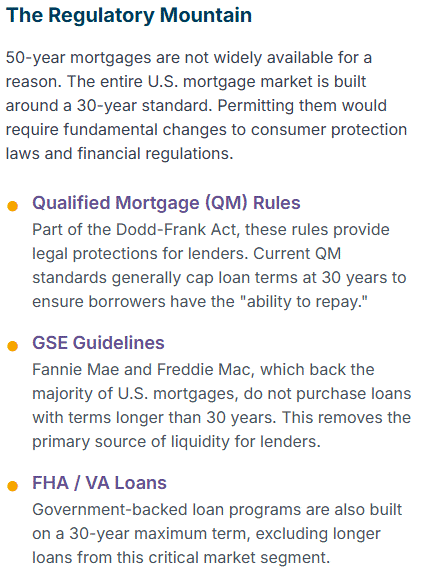
The current financial regulatory structure, established after the 2008 crisis, is fundamentally incompatible with a 50-year mortgage term. The 30-year term is a deliberate, embedded policy choice designed to protect consumers.
The Qualified Mortgage (QM) Standard and the 30-Year Limit
The Dodd-Frank Act introduced the “Ability-to-Repay” (ATR) rule, compelling lenders to verify a borrower’s capacity to afford a loan. To create legal certainty for lenders, the Consumer Financial Protection Bureau (CFPB) created the Qualified Mortgage (QM) standard, which grants lenders a safe harbor from legal liability.
Crucially, a core, legally binding requirement for a loan to qualify as QM is that “the loan term does not exceed 30 years.” This bright line rule was explicitly put in place to prevent the risky, long-amortization products that contributed to the subprime crisis. Therefore, any 50-year mortgage is automatically a non-QM loan.
Exclusion from the Secondary Market
The Federal Housing Finance Agency (FHFA), which regulates Fannie Mae and Freddie Mac (the GSEs), strictly enforces the QM rule. In 2013, the FHFA explicitly directed the GSEs to limit their purchases to QM loans, specifically prohibiting the acquisition of loans even with 40-year terms. A 50-year mortgage would be similarly barred.
This exclusion from the vast secondary market forces lenders to hold 50-year mortgages on their own books as high-risk portfolio loans, inevitably resulting in higher costs for borrowers.
The Misleading 40-Year Modification Precedent
Although regulators permit 40-year terms for certain loan modifications, this is not a precedent for new loan originations. Federal rules state that this tool is only used to help borrowers who are already behind on their payments get back on track and avoid foreclosure. The Department of Housing and Urban Development (HUD) itself acknowledged that this in the longer-term sacrifices equity building in favor of housing retention, highlighting the inherent risk of such a product, rather than endorsing it for general use.
The Bottom Line

Spencer Wright is the Executive Vice President of Halbert Wealth Management, Inc. and the author of Forecasts & Trends. He has been with HWM for over 25 years.