
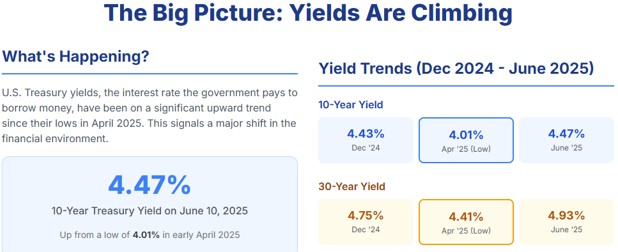
Over recent months, particularly since their Spring 2025 lows, U.S. Treasury yields have been trending upward. This increase, seen across the 5-year, 10-year, and 30-year maturities, mirrors shifting investor views on economic growth, inflation, and monetary policy.
In early December 2024, the 10-year Treasury yield was about 4.43%, decreased to roughly 4.01% by early April 2025, and increased to approximately 4.47% by June 10, 2025. The 30-year Treasury yield moved from about 4.75% to around 4.41% then reached roughly 4.93%. The 5-year Treasury yield started at 4.33%, fell to 3.72%, and recovered to 4.08% by June 10, 2025.
While the 5-year yield experienced a net decrease over the six-month period, all three tenors climbed notably from their mid-April 2025 lows, suggesting a tightening of overall financial conditions.
Two questions are top of mind. Why is this happening? Are rising yields a problem for the economy and the markets? These are straightforward questions with complex answers.
Unpacking the Drivers of Higher Yields
When I said the answers were complicated, I wasn’t kidding. There are six identifiable factors that are driving higher yields. Here is an infographic to start off and cover the basics.
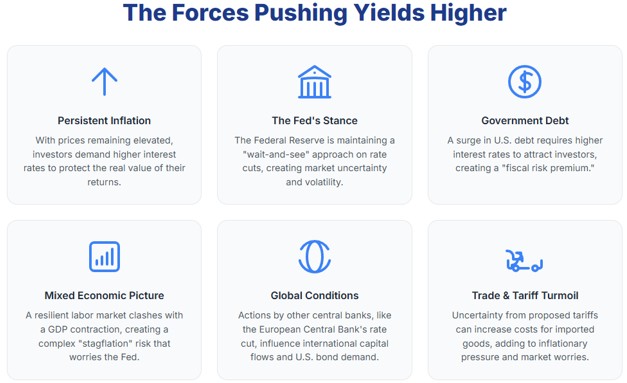
Persistent inflationary pressures remain a primary catalyst. Investors demand higher nominal yields to protect their real returns.
- May's anticipated U.S. Consumer Price Index (CPI) was projected to show headline inflation rising to 2.5% year-over-year and core CPI potentially hitting a three-month high of 2.9%.
- The Federal Reserve's preferred inflation gauge, the Personal Consumption Expenditures (PCE) Price Index, registered a 2.1% year-over-year increase in April, with core PCE at 2.5%.
- Business data suggests companies may pass rising input costs to consumers, signaling “reflation risk.”
- Though long-term recession signals might curb inflation, current and anticipated near-term inflation is driving yields up.
The Fed's policy stance and communication significantly shape Treasury yields.
- In May 2025, the FOMC maintained the federal funds rate target range at 4.25%-4.5%, adopting a “wait-and-see” approach.
- Market forecasts indicate the Federal Reserve will likely implement two 25-basis-point rate cuts in 2025, around September and December.
- Some market strategists predict the Fed will finalize its rate-cutting cycle by June 2026, with the policy rate stabilizing between 3.5-3.75%.
- Due to the Fed's “data-dependent” stance, yield volatility is expected to be elevated around the release of critical economic data.
The health of the U.S. economy plays a significant role.
- A resilient labor market saw nonfarm payrolls increase by 139,000, with the unemployment rate remaining steady at 4.2%.
- Wage pressures persisted as average hourly earnings rose 0.4% for the month and 3.9% annually.
- Contrasting this, the first quarter of 2025 witnessed a 0.2% contraction in real GDP, a stark deceleration from the prior quarter's 2.4% growth.
- Rising yields and persistent inflation risk stagflation, complicating the Federal Reserve's efforts for a soft landing, especially if the labor market weakens.
The U.S. government's fiscal position is an increasingly important factor.
- U.S. debt held by the public surged to $28.9 trillion by the end of 2024, up from $6.4 trillion in 2008.
- Foreign holdings of US federal debt decreased from 35% in December 2020 to 30% in December 2024, increasing reliance on domestic investors.
- A recent U.S. Treasury auction of 20-year bonds resulted in a high yield of 5.047% indicating market sensitivity to borrowing costs and supply dynamics.
- Government debt's net interest payments, now the second-largest expense, are expected to increase by 6.5% yearly from 2025 to 2035.
U.S. Treasury yields are influenced by global factors and other major central banks.
- The European Central Bank (ECB) lowered its key interest rates by 25 basis points in June 2025, setting its deposit facility rate at 2.00%.
- The Bank of Japan (BOJ) is grappling with persistent inflation (core CPI rose 3.5% YoY in April) alongside slowing economic growth.
- The observation that German and Japanese 30-year government bond yields have also risen indicates global factors contributing to upward pressure on yields.
Trade policies and geopolitical developments add complexity.
- Businesses report that uncertainty from tariffs makes forecasting difficult.
- The Federal Reserve has acknowledged that trade policy has “elevated the risks of both higher inflation and increased unemployment.”
- The “tariff turmoil” appears to be creating a unique pressure on yields, where the market is weighing inflation and uncertainty more heavily than the growth-dampening effect, potentially leading to a higher “uncertainty premium.”
The Ripple Effect of Rising Yields
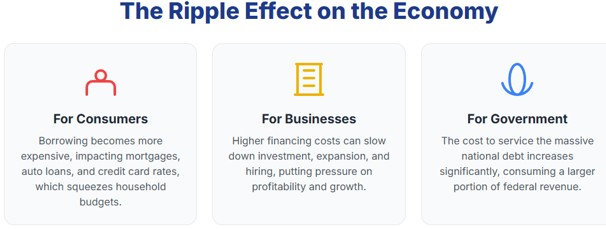
This infographic does a great job of encapsulating the effects rising yields have on the economy.
Rising Treasury yields are increasing borrowing costs for consumers and businesses, impacting mortgages, auto loans, credit cards, and corporate financing. This reduces consumer purchasing power, hinders business investment and growth, and poses risks to smaller companies. Prolonged high borrowing costs can slow economic growth and reduce international competitiveness. Government borrowing could further exacerbate the issue by crowding out private investment. Overall, increased borrowing costs act as a drag on GDP growth and economic stability.
The Bottom Line
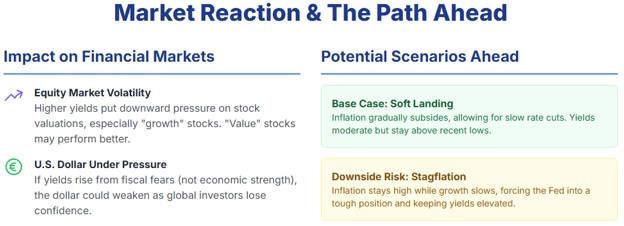
U.S. 10-Year Treasury yield forecasts indicate a gradual decline, from 4.32% in Q2 2025 to 4.15% in Q1 2026. While the Federal Reserve is expected to implement rate cuts through 2026, some analysts foresee yields holding steady in 2025. Concerns persist about a potential “fiscal risk premium” driving yields upwards.
Three distinct scenarios emerge: a “Muddling Through” scenario marked by gradual inflation and rate reductions; a “Stagflation/Fiscal Dominance” scenario characterized by sustained high inflation and fiscal instability; and a “Soft Landing with Productivity Boom” scenario featuring rapid disinflation and aggressive rate cuts. This last scenario is the one I believe to be the most likely and is my ‘base case’.
The interaction between monetary and fiscal policy is paramount. Policymakers face the challenge of balancing inflation control with debt sustainability, with potential risks to the U.S. economy. The situation is complex and no one can say with certainty where it all lands. But I am certain about one thing, the period of exceptionally low interest rates is over.
AI Yields Are Rising!
[Spencer]

Spencer Wright is the Executive Vice President of Halbert Wealth Management, Inc. and the author of Forecasts & Trends. He has been with HWM for over 25 years.